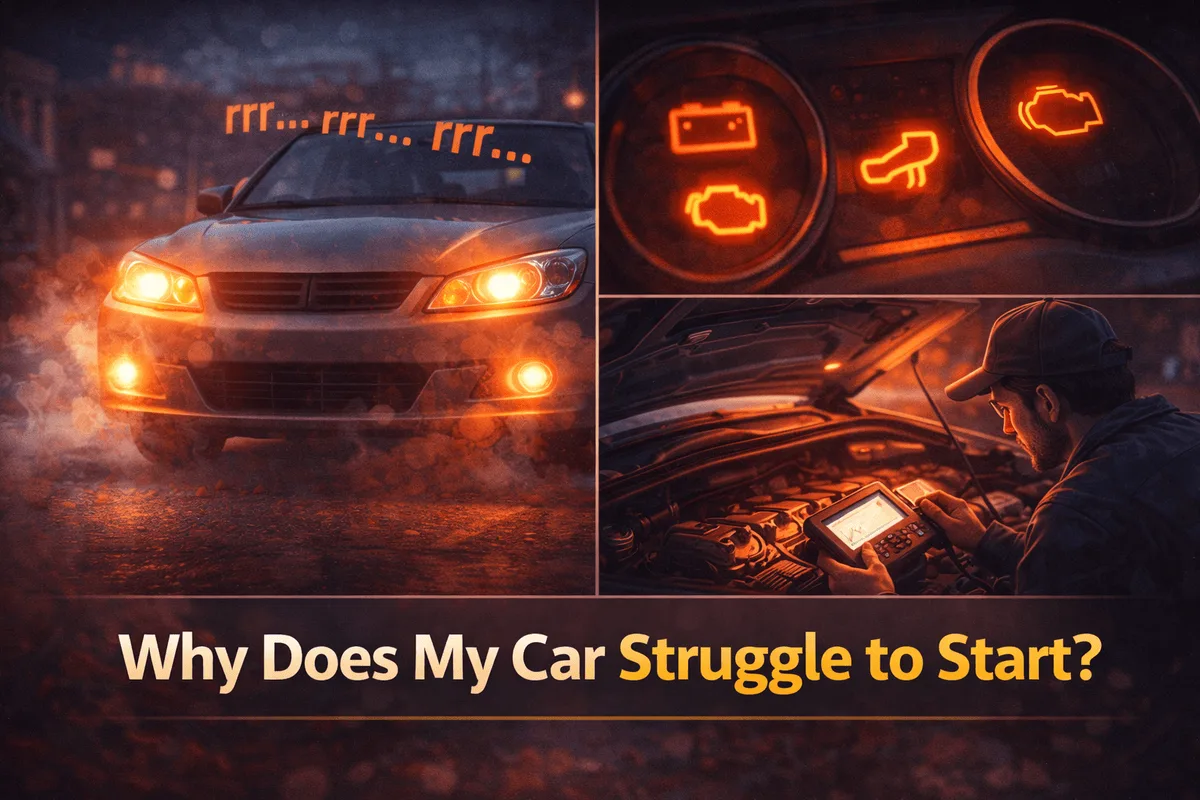
A car that takes longer than normal to start is often signaling an underlying issue rather than a one-time inconvenience. Extended cranking, delayed ignition, or weak starts can occur intermittently at first, which makes the problem easy to dismiss. Over time, however, these symptoms usually become more frequent and harder to ignore.
Starting difficulties can stem from several systems working at the edge of proper operation. Battery condition, starter performance, fuel delivery, ignition components, and engine sensors all play a role in how quickly an engine fires. When one of these begins to fail, the engine may still start—but only after hesitation or repeated attempts.
The explanation ahead outlines the most common reasons cars struggle to start, how those causes differ based on timing and conditions, and which warning signs point to simple fixes versus issues that deserve prompt attention. The emphasis is on recognizing patterns early so the problem can be addressed logically before it leads to a no-start situation or unnecessary repairs.
What “Struggling to Start” Actually Means
When people say their car struggles to start, they usually mean one of these things:
- The engine cranks slowly
- It takes several seconds to fire up
- It starts, then almost stalls
- It needs multiple attempts
- It starts fine sometimes, but not others
These are not random behaviors. Each one points toward a different kind of problem. The trick is learning to notice how it struggles, not just that it does.
Why Starting a Car Is Harder Than It Looks
Starting a car seems simple from the driver’s seat, but behind the scenes, a lot has to go right at the same time.
To start properly, your car needs:
- Enough electrical power
- The right fuel delivery
- Correct air intake
- Accurate timing
- Sensors working together
If even one part of that chain is weak, starting becomes slow or unreliable.
The Most Common Reason: Weak Battery Power
In my experience, battery-related issues are the number one reason cars struggle to start.
A battery doesn’t fail all at once. It slowly loses strength over time.
Early signs include:
- Slower cranking
- Dim lights during startup
- Struggling more in cold weather
What fooled me at first was that everything else still worked. The radio came on. The dashboard lit up. But starting an engine demands far more power than accessories do.
Why Cold Weather Makes Starting Problems Worse
Cold temperatures slow chemical reactions inside the battery. That means:
- The battery delivers less power
- The engine oil becomes thicker
- The starter has to work harder
So if your car struggles more in the morning or during winter, the battery is often involved—even if it’s not completely dead yet.
Starter Motor Issues That Feel Like Battery Problems
Sometimes it’s not the battery at all.
A worn starter motor can:
- Turn the engine slowly
- Struggle intermittently
- Sound weak or uneven
This can feel exactly like a weak battery, which is why these two issues are often confused.
The key difference is consistency. Starter problems often come and go in strange patterns.
When the Engine Cranks but Takes Too Long to Start
If the engine turns over at normal speed but takes a long time to fire, the issue is usually not the battery.
This points more toward:
- Fuel delivery
- Air intake
- Sensor data
The engine is physically turning—it just isn’t getting what it needs to start running.
Fuel Delivery Problems That Affect Starting
Fuel needs to reach the engine quickly and at the right pressure.
If something interferes with that, starting becomes delayed.
Common fuel-related causes include:
- Weak fuel pressure
- Dirty injectors
- Old or contaminated fuel
In these cases, the engine may crank normally but take several seconds to catch.
Why Starting Problems Sometimes Improve After a Few Tries
This detail matters more than people realize.
If the car:
- Struggles on the first attempt
- Starts easier on the second or third
It often means fuel pressure is building slowly or a sensor is warming up enough to send better information.
That’s a clue—not a coincidence.
Air Intake Issues That Make Starting Harder
An engine needs air just as much as fuel.
If airflow is restricted or measured incorrectly:
- The mixture becomes unbalanced
- Combustion weakens
- Starting takes longer
Dirty intake components or small leaks can quietly cause big starting delays.
Why Sensors Matter So Much During Startup
Modern cars rely heavily on sensors to decide how much fuel and air to use.
During startup, the engine depends on:
- Temperature readings
- Position data
- Airflow information
If a sensor gives incorrect data, the engine may struggle to find the right balance to start smoothly.
When the Car Starts, Then Almost Dies
This one always feels alarming.
The engine starts, stumbles, and nearly stalls before recovering—or shuts off entirely.
This often happens when:
- The engine can’t maintain idle speed
- Airflow control is inconsistent
- Fuel delivery is unstable
It’s a sign that the engine can start, but can’t stay running easily.
Why Short Trips Can Make Starting Problems Worse
Top reasons
Short trips:
- Don’t fully recharge the battery
- Don’t let the engine warm completely
- Increase moisture buildup
Over time, this creates the perfect conditions for slow starts and weak performance.
Electrical Connections That Quietly Cause Trouble
Even with a good battery, poor connections can restrict power.
Things like:
- Corroded terminals
- Loose cables
- Aging wiring
…can reduce the amount of power reaching the starter, making the engine struggle even though the battery itself is fine.
Why Starting Problems Can Feel Random
One of the most frustrating parts is inconsistency.
The car may:
- Start perfectly one day
- Struggle badly the next
- Act fine again later
This happens because:
- Temperatures change
- Electrical resistance changes
- Components warm up or cool down
Intermittent issues are often the hardest to diagnose—but they’re still real.
Engine Timing and Starting Difficulty
Timing matters most during startup.
If ignition timing is off, even slightly:
- Combustion becomes inefficient
- The engine hesitates
- Starting takes longer
This doesn’t always cause obvious running problems once the engine is warm, which makes it harder to spot.
Why the Problem Feels Worse After Sitting Overnight
If your car struggles most after sitting for hours, pay attention.
That often points to:
- Battery drain
- Fuel pressure loss
- Temperature-sensitive components
Overnight conditions expose weaknesses that short stops don’t.
Why the Engine May Start Fine When Warm
This is another important clue.
Warm engines:
- Require less fuel enrichment
- Have thinner oil
- Receive stronger sensor signals
So if starting problems disappear once the engine is warm, the issue is usually related to cold-start conditions, not major mechanical failure.
When Warning Lights Don’t Appear
A lot of people assume that if there’s no warning light, nothing is wrong.
That’s not true.
Many starting problems:
- Develop gradually
- Stay within “acceptable” limits
- Don’t trigger alerts right away
By the time a light appears, the problem is often more advanced.
Howto Listen to the Sound
Sound tells you a lot.
Start paying attention to:
- How fast the engine cranks
- Whether the sound is steady
- If it changes between attempts
A slow, labored sound usually points to power delivery. A fast but empty cranking sound points toward fuel or air issues.
Why Replacing Parts Randomly Rarely Works
I’ve seen people replace:
- Batteries
- Starters
- Sensors
…without understanding the cause. Sometimes they get lucky. Often they don’t.
Starting problems are about systems, not single parts.
What I Check First When a Car Struggles to Start
My personal approach now looks like this:
- How fast does it crank?
- Is the problem worse when cold?
- Does it improve after a few tries?
- Does it struggle more after sitting?
Those answers narrow things down quickly.
When It’s Safe to Keep Driving (and When It’s Not)
If the car:
- Always starts eventually
- Drives normally afterward
…it may not be an emergency—but it shouldn’t be ignored.
If starting becomes:
- Significantly slower
- Unpredictable
- Worse over time
…it’s time to act before it becomes a no-start situation.
Why Ignoring Starting Problems Costs More Later
Most starting issues begin small.
Ignoring them can lead to:
- Complete battery failure
- Starter damage
- Being stranded unexpectedly
Early attention almost always costs less than waiting.
What Starting Problems Are Not
This part matters too.
Struggling to start does not automatically mean:
- The engine is failing
- The car is near the end of its life
- Repairs will be extreme
Most causes are manageable when addressed early.
How Long You Can “Get Away With It”
This depends on the cause.
Some issues linger for months. Others worsen quickly. The problem is you never know which one you’re dealing with until it gets worse.
That uncertainty is why I stopped ignoring early signs.
A Simple Way to Think About It
Here’s how I explain it now:
If a car struggles to start, something is either:
- Lacking power
- Lacking fuel
- Lacking accurate information
Finding out which one makes everything clearer.
Final Thoughts
When my car struggled to start, I learned that the engine wasn’t being dramatic—it was asking for attention. Starting problems are one of the clearest ways a car communicates that something is weakening. The key is listening early instead of waiting for complete failure.
Once you understand the patterns, the fear fades. You stop guessing, and you start noticing real clues. That confidence makes all the difference.