
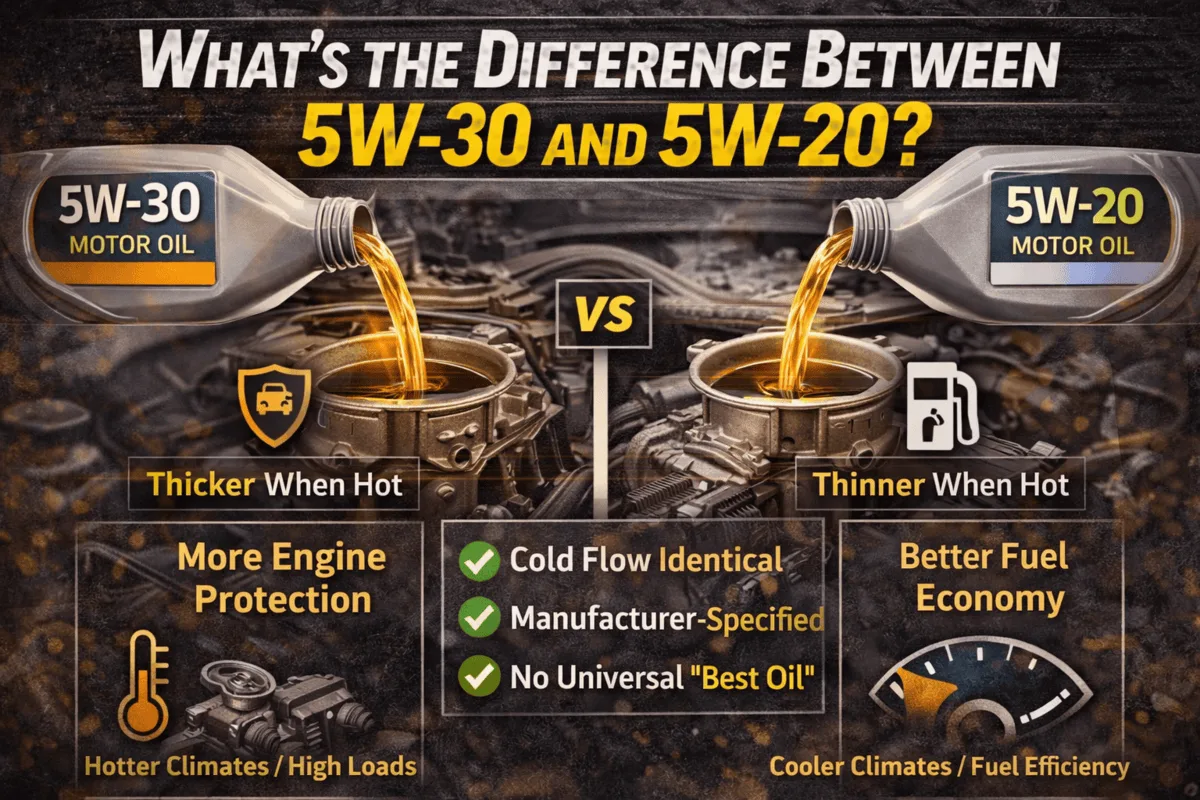
Engine oil labels can look deceptively similar, yet small differences in viscosity ratings can influence how an engine behaves in everyday conditions. Two of the most commonly specified options—5W-20 and 5W-30—often appear interchangeable at a glance, which is why they’re frequently confused or treated as equivalent.
Those numbers, however, reflect how each oil flows at low temperatures and how it protects engine components once fully warmed. The difference affects cold starts, internal friction, fuel efficiency, and long-term wear, especially in engines designed around a specific viscosity range. Choosing the wrong grade doesn’t always cause immediate damage, but it can reduce performance or protection over time.
The explanation that follows breaks down what 5W-20 and 5W-30 actually mean, how each behaves inside an engine, and why manufacturers recommend one over the other. The focus is on real-world operation and practical decision-making, helping drivers choose the correct oil based on engine design, climate, and usage rather than assumptions or conflicting opinions.
Let’s Start With the Basics: What Those Numbers Actually Mean
Before comparing the two, we need to understand the numbers themselves.
When you see 5W-20 or 5W-30, you’re looking at a viscosity rating. Viscosity is simply how thick or thin the oil is.
- The “5W” part describes how the oil flows in cold temperatures
- The “20” or “30” part describes how thick the oil is when the engine is warm
So right away, there’s one big thing to notice:
👉 Both oils behave the same in cold starts
👉 They behave differently once the engine heats up
That difference matters more than you might think.
What the “5W” Part Means (Cold Starts Explained Simply)
The “W” stands for winter.
Both 5W-20 and 5W-30:
- Flow the same when the engine is cold
- Help the engine start easily
- Reach engine parts quickly on startup
This means:
- Cold-weather protection is equal
- Startup lubrication is equal
- Initial wear protection is equal
So if you’re choosing between these two oils, cold weather is not the deciding factor.
Where the Real Difference Is: Operating Temperature
The real difference appears once the engine reaches normal temperature.
- 5W-20 becomes thinner
- 5W-30 stays slightly thicker
That’s the entire debate in one sentence.
Now let’s explain why that thickness matters.
How Oil Thickness Affects the Engine
Once the engine is warm:
- Oil forms a protective film between metal parts
- That film prevents wear
- Thicker oil creates a stronger cushion
- Thinner oil flows more easily
So there’s a trade-off:
- Thicker oil = stronger protection
- Thinner oil = easier movement
Neither is automatically “better.” It depends on how the engine is designed.
What 5W-20 Is Designed to Do
5W-20 is a thinner oil at operating temperature.
Its strengths include:
- Reduced internal resistance
- Slightly better fuel efficiency
- Faster oil circulation
Engines designed for 5W-20:
- Have tighter internal clearances
- Rely on precise oil flow
- Are often built for efficiency
This oil helps the engine move with less effort.
What 5W-30 Is Designed to Do
5W-30 is thicker once warm.
Its strengths include:
- Stronger oil film
- Better protection under stress
- Greater resistance to heat
Engines that prefer 5W-30:
- May experience higher temperatures
- May carry heavier loads
- May operate under more strain
This oil prioritizes durability over minimal resistance.
Why Manufacturers Recommend One Over the Other
This is important.
Car manufacturers don’t guess when they recommend oil. They test engines extensively and choose an oil that matches:
- Bearing clearances
- Oil pump design
- Engine temperature behavior
- Emissions requirements
If your engine is designed for 5W-20, that oil supports how it was engineered to work. The same goes for 5W-30.
Fuel Economy Differences (Yes, There Is One)
Here’s the honest truth.
5W-20:
- Can slightly improve fuel economy
- Reduces drag inside the engine
5W-30:
- Uses slightly more energy to move
- Prioritizes protection over efficiency
The difference is usually small, but it exists. Over time, manufacturers choose thinner oils partly to meet fuel economy standards.
Engine Protection: Which One Protects Better?
This is where opinions get heated, so let’s stay factual.
- 5W-30 provides a thicker protective layer when hot
- 5W-20 still protects well when used as designed
Thicker oil doesn’t automatically mean better protection in every engine. Protection depends on correct oil for the engine, not thickness alone.
How Engine Age Plays a Role
This is something I’ve learned from experience.
As engines age:
- Internal clearances can increase
- Oil consumption may rise
- Heat management changes slightly
In some older engines:
- 5W-30 can help reduce oil burning
- 5W-20 may feel “too thin”
But this only applies if the engine allows it. You should never switch oil grades without confirming compatibility.
What Happens If You Use 5W-30 Instead of 5W-20
This question comes up constantly.
In many engines:
- Short-term use may not cause damage
- Long-term use may affect efficiency
- Oil flow behavior changes
In some engines:
- Oil pressure may rise slightly
- Fuel economy may drop
- Cold flow remains the same
The bigger risk is ignoring what the engine was designed for.
What Happens If You Use 5W-20 Instead of 5W-30
This is usually more concerning.
In engines designed for 5W-30:
- Thinner oil may not maintain adequate film strength
- Protection under load may decrease
- Wear risk can increase
This is especially true in:
- Hot climates
- Heavy-use engines
- High-mileage vehicles
Thinner oil in a heavier-duty engine is not ideal.
Why Some Engines Are Very Specific About Oil Type
Modern engines are precision machines.
They rely on:
- Specific oil pressure ranges
- Exact flow characteristics
- Controlled heat dissipation
Using the wrong oil can:
- Trigger warning lights
- Affect timing systems
- Reduce long-term reliability
That’s why oil caps and manuals matter.
Howto Choose Between 5W-20 and 5W-30
Here’s my real-world approach:
- Check the owner’s manual
- Look at the oil cap
- Consider engine mileage
- Consider climate and usage
Climate Considerations (Hot vs Cold)
Since both are 5W oils:
- Cold behavior is the same
In hotter conditions:
- 5W-30 handles heat slightly better
- 5W-20 still works if specified
Climate only becomes a deciding factor if the manufacturer allows multiple grades.
Why You’ll See Both Oils Listed for Some Engines
Some engines allow flexibility.
That usually means:
- The engine was tested with both
- Operating conditions vary
- Either oil meets minimum requirements
In these cases:
- 5W-20 favors efficiency
- 5W-30 favors protection
You choose based on how you drive and where you live.
Common Myths About 5W-20 vs 5W-30
Let’s clear up some confusion.
- “Thicker oil always protects better” — Not always
- “Thinner oil damages engines” — False when used correctly
- “They’re basically the same” — Not true
- “Switching doesn’t matter” — It can
Oil choice matters more than people think.
Does Oil Quality Matter More Than Viscosity?
Yes—and this is important.
A high-quality oil of the correct grade:
- Protects better
- Lasts longer
- Handles heat and deposits better
Quality and correct viscosity together matter more than just thickness.
How This Affects Engine Longevity
Engines last longest when:
- Oil grade matches design
- Oil changes are done on time
- Oil quality is consistent
Using the right oil reduces wear, heat stress, and internal friction over thousands of miles.
What to Tell People Who Are Still Unsure
If you’re ever unsure, here’s the safest rule follow:
👉 Use exactly what the manufacturer recommends unless a professional advises otherwise.
That one choice removes nearly all risk.
Final Thoughts
The difference between 5W-20 and 5W-30 isn’t about right or wrong—it’s about matching the oil to the engine. Both oils are excellent when used as intended. Problems only start when guesswork replaces guidance.
I’ve learned that oil is not just a fluid—it’s a carefully chosen component of the engine’s design. Once you understand what those numbers mean and why they exist, choosing the right oil stops being confusing and starts feeling logical.
If you take one thing from this guide, let it be this: the best oil is the one your engine was built to use.