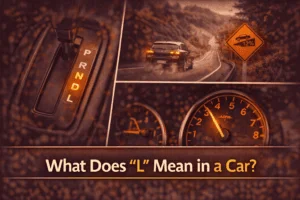
Automatic transmissions include several drive modes that are familiar to most drivers, but the “L” position often raises questions. Unlike Park, Reverse, or Drive, its purpose is rarely explained during everyday driving, even though it serves a specific and useful function. Because it isn’t needed in routine conditions, many drivers notice it without ever being told when—or why—to use it.
The L setting, commonly labeled as Low, changes how the transmission behaves by limiting gear selection and increasing engine braking. It is not an emergency mode, nor is it harmful when used correctly. However, it is also not intended for normal cruising, which is where confusion usually begins.
The explanation ahead clarifies what the L gear means, how it affects transmission behavior, the situations where it provides real benefit, and when it should be avoided. The emphasis is on practical use cases and clear expectations so drivers know exactly what the setting does and when it makes sense to use it.
The Short Answer: What “L” Means
In most automatic cars, “L” means Low gear.
When you shift into L, you’re telling the transmission:
- Stay in a lower gear
- Do not shift up automatically
- Provide more control, not more speed
That’s it at its core. But what that does in real life is where things get interesting.
Why “L” Exists in Automatic Cars
Automatic transmissions are designed to:
- Shift smoothly
- Choose gears for efficiency
- Make driving easier
So why give the driver control with L at all?
Because there are situations where:
- You need extra control
- Automatic shifting isn’t ideal
- Engine power needs to behave differently
L exists for control, not convenience.
What Actually Happens When You Shift Into “L”
When you move the shifter into L, the car:
- Locks itself into a lower gear
- Keeps engine speed higher
- Prevents upshifting
The engine sounds louder, RPM stays elevated, and the car feels more “engaged.”
That’s normal—and intentional.
“L” Is Not for Speed
This is a common misunderstanding.
L does not make the car faster.
In fact:
- Top speed is limited
- Fuel efficiency drops
- Engine noise increases
Low gear is about power and control, not acceleration at high speeds.
Why the Engine Sounds Louder in “L”
The engine noise surprises people.
In L:
- RPM stays high
- The engine resists upshifting
- You hear more engine braking
That noise doesn’t mean strain—it means the engine is actively helping manage speed.
The Most Common Situation to Use “L”: Steep Hills
This is where L really shines.
When going downhill:
- Don’t want to ride the brakes
- Want the engine to help slow the car
- Want steady, controlled descent
Shifting into L lets the engine hold speed without overheating the brakes.
Why Riding the Brakes Is a Bad Idea on Hills
Constant braking:
- Builds heat
- Wears pads quickly
- Can reduce braking effectiveness
Using L spreads the workload between the engine and brakes, which is much safer.
Going Up Hills: Another Good Use for “L”
On steep uphill climbs, L helps by:
- Preventing gear hunting
- Keeping steady power
- Avoiding constant upshifts and downshifts
The car feels more stable and predictable.
Towing and Heavy Loads
When I’m carrying something heavy or towing:
- The car needs more torque
- Automatic shifting can struggle
- Heat builds quickly
L keeps the transmission in a strong, controlled gear and reduces stress.
Snow and Slippery Roads: A Mixed Case
This surprises some people.
In slippery conditions:
- L can reduce wheel spin
- Throttle response becomes smoother
- Power delivery is more controlled
But it must be used gently. Abrupt throttle in L can still cause traction loss.
Why “L” Is Not the Same in Every Car
This is important.
In some cars:
- L means first gear only
In others:
- L allows first and second
- Or behaves differently based on speed
The exact behavior depends on the transmission design.
“L” vs “2” vs “1” on the Gear Selector
Some cars don’t show L at all.
Instead, they show:
- 1
- 2
- Or a range of gears
These work similarly, just with more defined limits.
L is often the simplest version of this system.
Can You Shift Into “L” While Driving?
Yes—but with common sense.
Only shift into L when:
- Driving at lower speeds
- Needing more control
- Conditions call for it
Aoid shifting into L at high speeds because:
- RPM can spike
- The transition can be harsh
What Happens If You Use “L” at Highway Speed?
Most modern cars:
- Will protect themselves
- Won’t allow damaging shifts
But that doesn’t mean it’s smart.
At high speed:
- Engine braking becomes aggressive
- RPM jumps suddenly
- The ride feels rough
Treat L as a low-speed control tool.
Is It Bad for the Engine to Use “L”?
No—when used correctly.
Engines are designed to:
- Handle higher RPM
- Provide engine braking
- Work under load
Using L in appropriate situations does not harm the engine.
Is It Bad for the Transmission?
Again—no, when used properly.
In fact:
- L can reduce transmission strain
- Prevent overheating
- Improve longevity in tough conditions
Problems only happen when it’s used improperly or aggressively.
Why You Don’t Use “L” for Everyday Driving
For normal city or highway driving:
- Drive mode is smoother
- Fuel efficiency is better
- Shifting is optimized
L is a tool, not a default setting.
Fuel Consumption in “L”
Fuel usage increases in L because:
- RPM stays high
- Gears don’t upshift
- The engine works harder
That’s fine short-term, but wasteful long-term.
Engine Braking: The Hidden Benefit of “L”
Engine braking is when:
- The engine resists forward motion
- The car slows without braking
- Control improves
This is one of the biggest advantages of L, especially on descents.
Why New Drivers Often Ignore “L”
Most driving instructors focus on:
- Park
- Reverse
- Drive
L doesn’t get much attention, so many drivers never learn when it’s useful.
When to Avoid Using “L” Completely
Avoid L when:
- Driving at steady highway speed
- In stop-and-go traffic
- When fuel efficiency matters
It’s not meant for comfort—it’s meant for control.
“L” in Modern Cars With Manual Modes
Some newer cars replace L with:
- Manual shifting
- Paddle shifters
- Gear selection modes
These give similar control, just in a more modern way.
Older Cars vs Newer Cars: How “L” Changed
In older automatics:
- L was very basic
- Gear control was limited
In newer cars:
- Computers manage transitions
- Protection systems prevent damage
- Use is more forgiving
But the purpose stayed the same.
Can “L” Help With Brake Wear?
Yes, especially in the hills.
Using L:
- Reduces brake usage
- Keeps brakes cooler
- Extends brake life
It’s a smart habit in mountainous areas.
Why Some Drivers Think “L” Is for Emergencies
Because it’s rarely explained.
But L is not an emergency mode—it’s a situational mode.
What “L” Is NOT
Let’s clear this up.
L is not:
- A racing mode
- A boost button
- A fix for mechanical problems
- A replacement for proper brakes
It’s a control setting—nothing more, nothing less.
Common Myths About “L”
“Using L damages the engine.”
No, not when used properly.
“L is only for old cars.”
Still very relevant today.
“You should never shift while moving.”
You can—just do it wisely.
How to Decide Whether to Use “L”
Ask yourself:
- Are you on a steep hill?
- Are you towing or carrying weight?
- Do you need more control than speed?
If yes, L helps.
If not, Drive is fine.
Why “L” Feels Different Mentally
Driving in L makes me more aware:
- Engine sound is louder
- Car responds more directly
- Speed control feels tighter
That’s not stress—that’s feedback.
Using “L” in City Driving: Rare but Possible
In rare cases:
- Steep city streets
- Heavy loads
- Slow, controlled movement
L can help—but it’s not common.
Why Manuals Don’t Need an “L”
Manual drivers:
- Choose gears directly
- Control engine braking naturally
L is simply the automatic version of that control.
The One Mistake People Make
Using L without knowing why.
They hear noise, feel resistance, and panic—thinking something is wrong.
Nothing is wrong. The car is doing exactly what you asked.
Final Thoughts
So, what does L mean in a car? It means Low gear, and more importantly, control. It’s there for hills, heavy loads, tricky conditions, and moments when automatic shifting isn’t ideal. It’s not something to fear, ignore, or misuse—it’s a tool designed to make driving safer and more predictable when conditions demand it.