Engine size is often described in liters, yet many drivers hear those numbers without ever being told what they actually represent. Specifications like 1.5-liter, 2.0-liter, or 3.0-liter engines are mentioned in reviews, dealership conversations, and brochures as if their meaning is obvious—but for many people, it isn’t.
Engine liters do not measure fuel consumption or power directly. Instead, they describe the total internal volume of the engine’s cylinders, which influences how much air and fuel the engine can process in each cycle. That single measurement plays a role in how an engine delivers power, how it responds to throttle input, and how efficiently it uses fuel—but it does not tell the whole story on its own.
The explanation that follows breaks down what engine liters actually mean, how the number is calculated, and how it connects to real-world driving characteristics. The focus is on clarity and context, helping readers understand engine size as one piece of a larger performance and efficiency picture rather than a standalone measure of how “good” a car is.
What “Engine Liters” Actually Means
Let’s start with the simplest definition.
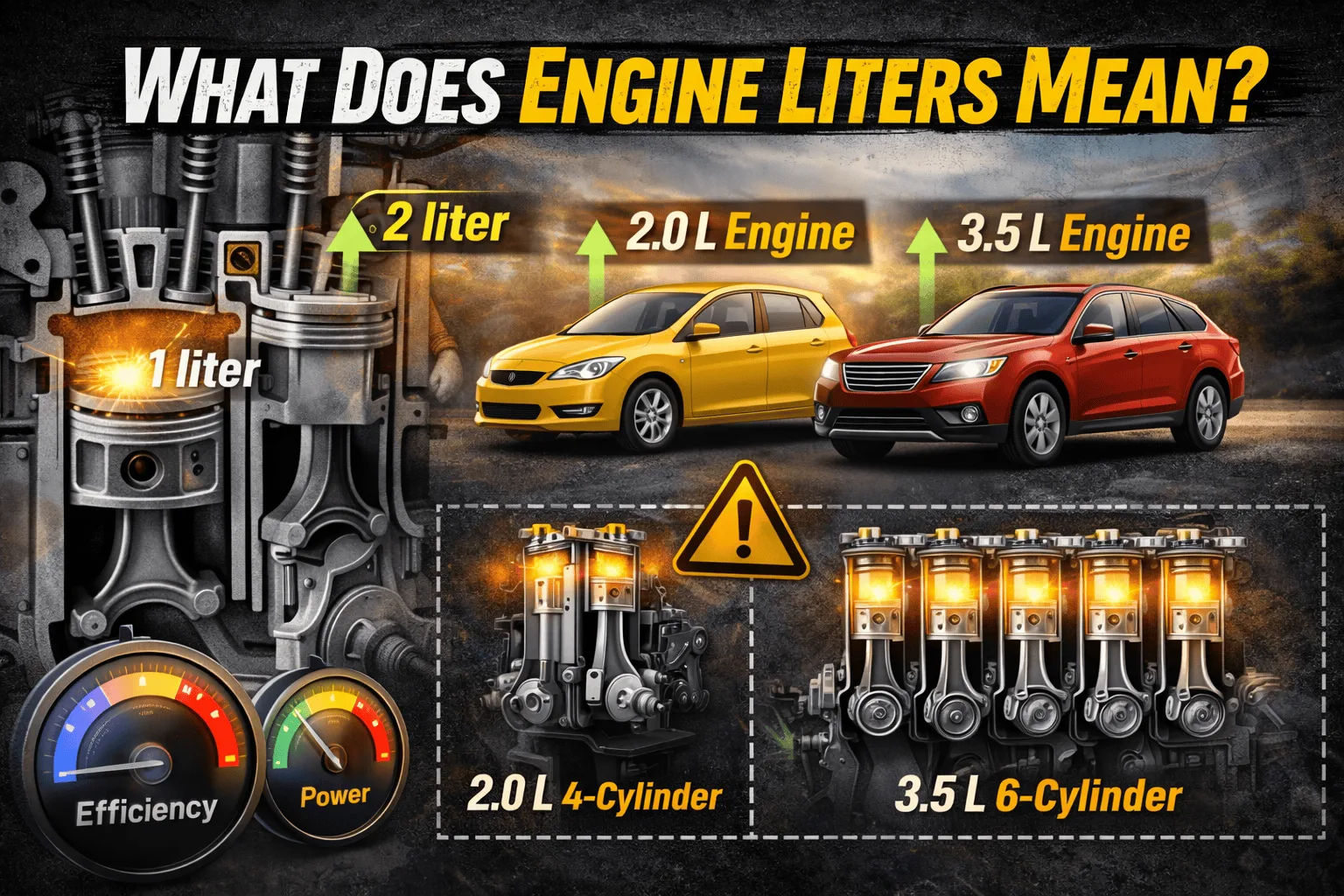
Engine liters describe the total volume of all the engine’s cylinders combined.
That’s it.
It does not refer to:
- Fuel capacity
- Oil capacity
- Engine weight
It refers to space—specifically, how much air and fuel the engine can pull in and compress during one complete cycle.
So when someone says:
- 2.0-liter engine
They’re saying: - The engine’s cylinders together hold 2.0 liters of volume
Why Volume Matters Inside an Engine
To understand why this matters, picture the engine like a set of air pumps.
Each cylinder:
- Pulls in air
- Mixes it with fuel
- Compresses it
- Ignites it to make power
The larger the total space, the more air and fuel the engine can burn at once.
More burned fuel = more potential power.
That’s why engine size has traditionally been linked to strength and performance.
A Simple Meaning
Here’s the easiest analogy I’ve found.
Imagine two syringes:
- One small
- One large
If you push both at the same speed:
- The large one moves more air
- The small one moves less
Engines work the same way.
A larger-liter engine can move more air per cycle, which allows it to produce more force—assuming everything else is equal.
Engine Liters and Cylinder Count — How They Work Together
Engine size and cylinder count are related, but they are not the same thing.
For example:
- A 2.0-liter engine can have 4 cylinders
- A 3.0-liter engine can have 6 cylinders
Each cylinder contributes part of the total volume.
Example:
- 4 cylinders totaling 2.0 liters
- Each cylinder ≈ 0.5 liters
More cylinders don’t automatically mean more liters, and fewer cylinders don’t automatically mean less power.
Why a 2.0-Liter Engine Can Feel Faster Than a 3.0-Liter One
Engine liters show potential, not guaranteed performance.
Other factors matter just as much:
- Turbocharging
- Engine tuning
- Transmission gearing
- Vehicle weight
A modern 2.0-liter turbo engine can easily outperform an older 3.0-liter engine.
So engine size tells part of the story—not the whole one.
Small Engine Liters — What They’re Good At
Smaller engines usually range from:
- 1.0 to 1.6 liters
These engines are designed for:
- Fuel efficiency
- Daily commuting
- Lighter vehicles
What to notice when driving them:
- Less fuel consumption
- Quieter operation
- Adequate power for city use
They’re not meant to feel aggressive. They’re meant to be practical.
Medium Engine Liters — The Balance Zone
Engines around:
- 1.8 to 2.5 liters
This is the sweet spot for many drivers.
Why:
- Good balance of power and efficiency
- Comfortable highway driving
- Enough strength for overtaking
This range suits most sedans, compact SUVs, and family cars.
Large Engine Liters — Where Power Lives
Engines above:
- 3.0 liters
These are typically found in:
- Performance cars
- Trucks
- Larger SUVs
What stands out:
- Strong acceleration
- Better towing ability
- Higher fuel usage
Larger engines don’t need to work as hard to move heavy vehicles.
How Engine Liters Affect Fuel Consumption
This is where many misunderstandings come from.
In general:
- Larger engines consume more fuel
- Smaller engines use less
But it’s not absolute.
A small engine pushed hard all the time can use more fuel than a larger engine cruising calmly.
Driving style matters as much as engine size.
Engine Liters vs Horsepower — Not the Same Thing
This is a common mistake.
- Engine liters = size
- Horsepower = output
You can have:
- A large engine with low horsepower
- A small engine with high horsepower
Modern technology has blurred the old rules.
That’s why never judge a car by engine liters alone anymore.
What Engine Liters Tell Me When Buying a Car
When see engine size listed, we think about:
- How heavy the car is
- How to plan to use it
- Whether it’s turbocharged
- My fuel budget
Engine liters help me predict behavior, not decide quality.
Turbocharged Engines and Engine Liters
Turbochargers changed everything.
A turbo:
- Forces extra air into the engine
- Makes a smaller engine behave like a bigger one
That’s why many manufacturers now use:
- Smaller engines with turbos
They get:
- Better efficiency
- Strong performance
- Lower emissions
This is why engine size alone doesn’t tell the full story anymore.
Why Manufacturers Still List Engine Liters
Even with modern tech, engine liters still matter because they:
- Give a basic idea of engine capacity
- Help compare vehicles
- Affect insurance and regulations in some regions
It’s a starting point, not a verdict.
Common Misunderstandings About Engine Liters
Let me clear up a few things to hear all the time.
- “Bigger liters always mean faster” — Not true
- “Small engines are weak” — Not anymore
- “Liters tell you fuel economy” — Only partially
Understanding this saves disappointment.
Engine Liters and Longevity
This is interesting.
Larger engines often:
- Work under less stress
- Last longer in heavy vehicles
Smaller engines:
- Work harder
- Rely more on tuning and boost
Maintenance matters more than size in the long run.
How Engine Liters Affect Insurance and Taxes
In some countries:
- Larger engines cost more to insure
- Road taxes increase with engine size
This is another reason manufacturers downsize engines.
Choosing the Right Engine Size for You
Here’s how to decide:
- City driving → smaller to mid-size
- Highway and family use → mid-size
- Towing or performance → larger
There’s no “best” size—only the right one for your needs.
Why Engine Liters Still Matter in 2025
Even as electric vehicles grow, engine liters remain important for:
- Understanding traditional cars
- Comparing options
- Making informed choices
It’s a basic building block of automotive knowledge
Final Thoughts
When you finally understood what engine liters mean, car specs stopped feeling confusing. It’s simply a measure of how much space the engine uses to make power—nothing more, nothing less.
Once you combine that knowledge with how the car is built, how heavy it is, and how you plan to use it, engine size becomes a helpful guide instead of a mystery.
If you remember one thing from this guide, let it be this: engine liters describe capacity, not personality. The real character of a car comes from how that engine is designed and used.