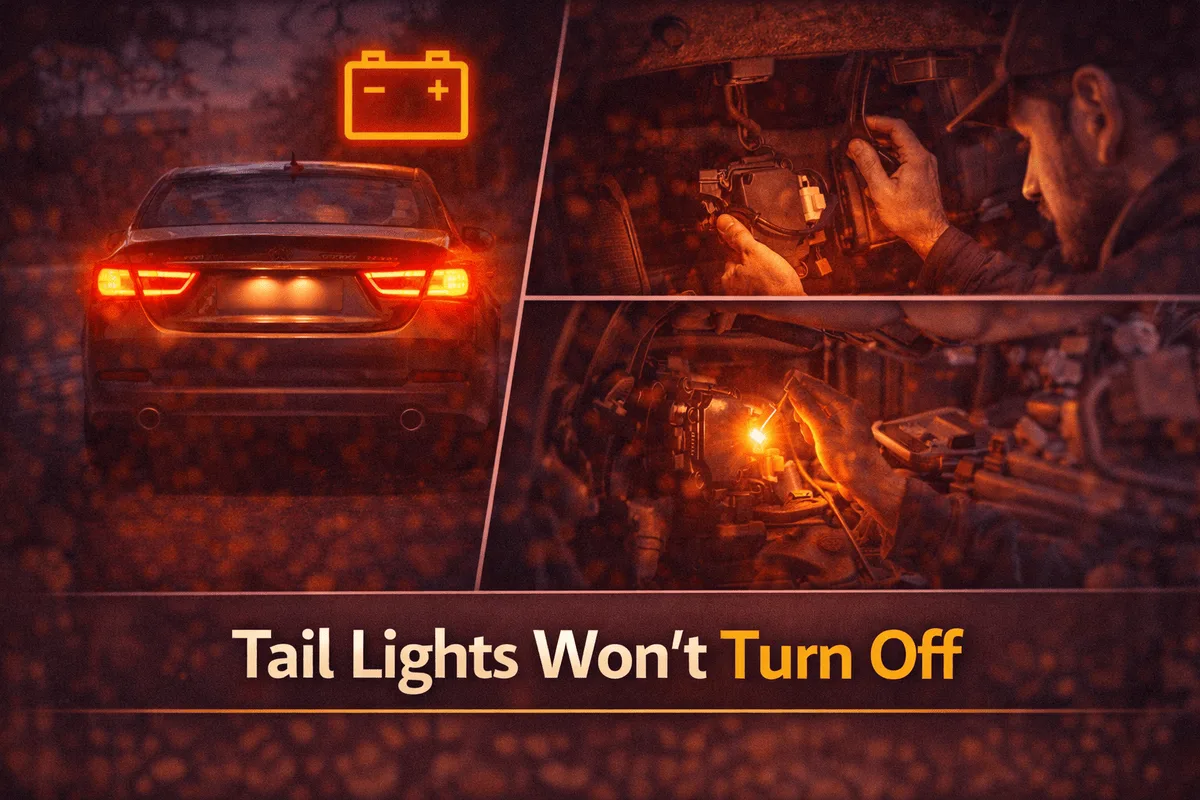
Tail lights that remain on after a vehicle is parked and shut off indicate a fault in the lighting or electrical control system. Because tail lights are designed to turn off automatically when the ignition is off, their continued operation is not normal and should be addressed promptly. Left unresolved, the issue can drain the battery and leave the vehicle unable to start.
This problem is commonly linked to components such as the brake light switch, body control module, headlight switch, wiring faults, or aftermarket accessories that interfere with normal circuits. In some cases, the lights remain on at full brightness; in others, they stay dimly illuminated, which can make the issue harder to notice at first.
The information ahead explains why tail lights can stay on with the car off, which components are most often responsible, what immediate steps prevent battery drain, and how the problem is typically corrected. The emphasis is on identifying the root cause efficiently rather than disconnecting the battery or relying on temporary fixes.
Why Tail Lights Staying On Is Such a Big Deal
At first glance, tail lights staying on might seem like a small electrical glitch. But it matters more than most people realize.
When tail lights won’t turn off:
- The battery drains constantly
- You risk waking up to a dead car
- The issue often points to an underlying electrical fault
Unlike headlights, tail lights are usually controlled automatically. When they stay on, it’s a sign the system thinks the car is still “active” in some way.
What Tail Lights Are Supposed to Do
Under normal conditions, tail lights turn on when:
- The headlights are on
- Parking lights are selected
- Automatic lighting senses darkness
They should turn off when:
- The car is shut down
- Lights are switched off
- The system no longer detects a need for them
If they don’t turn off, something is telling the car to keep them powered.
The First Question I Ask: Are They Really Tail Lights?
This may sound obvious, but it’s important.
Sometimes what looks like tail lights staying on are actually:
- Parking lights
- Running lights
- Brake lights
Each one is controlled differently. Identifying which lights are on helps narrow down the cause quickly.
Brake Lights vs Tail Lights: A Common Mix-Up
Brake lights and tail lights sit close together, but they behave differently.
If:
- Brake lights stay on constantly
- They brighten when you press the pedal
- The center brake light is also on
Then the issue is often related to the brake pedal system, not the lighting switch.
If:
- Only the dim rear lights stay on
- The center brake light is off
Then the problem is usually with lighting control.
One of the Most Common Causes: Brake Light Switch Problems
This is one of the first things I check.
The brake light switch sits near the brake pedal. Its job is to:
- Detect when the pedal is pressed
- Turn brake lights on and off
If this switch:
- Sticks
- Fails internally
- Loses proper alignment
…the car thinks the brake pedal is always pressed, keeping the rear lights on.
Why This Can Happen Suddenly
Brake light switches don’t always fail gradually.
They can:
- Work perfectly one day
- Fail the next without warning
That’s why tail lights staying on often feel like they come out of nowhere.
How I Tell If It’s the Brake Switch
Here’s what I look for:
- Are the brake lights bright instead of dim?
- Does the car think the brake pedal is pressed?
- Do the lights turn off if I lift the pedal by hand?
If yes, the brake switch moves to the top of my suspect list.
Headlight Switch Issues That Keep Lights On
If your car has a manual headlight switch, it can also cause this issue.
Over time:
- Switches wear internally
- Contacts stick
- Signals don’t shut off cleanly
The switch may be telling the car to keep the parking or tail lights on even when it looks “off.”
Automatic Light Systems Can Get Confused
Modern cars often use automatic lighting.
These systems rely on:
- Light sensors
- Control modules
- Software logic
If the system gets confused or receives incorrect input, it may leave the tail lights on indefinitely.
Why the Lights Stay On Even After Locking the Car
This is especially frustrating.
You lock the car, walk away, and:
- The tail lights stay on
- The mirrors fold in
- The car otherwise shuts down
This means the issue isn’t about locking—it’s about power still being sent to the rear lights.
Body Control Module Problems (Behind-the-Scenes Control)
Many cars use a central control unit to manage lights.
This module:
- Decides when lights turn on
- Decides when they turn off
- Communicates with switches and sensors
If it malfunctions, lights can behave unpredictably—including staying on when they shouldn’t.
Wiring Issues That Cause Constant Power
Sometimes the problem isn’t a switch or module—it’s wiring.
Damaged wiring can:
- Send power when it shouldn’t
- Create feedback loops
- Bypass normal shutoff signals
This is more common in older vehicles or cars that have had previous electrical work done.
Why Aftermarket Accessories Can Trigger This
I’ve seen tail lights stay on after:
- Alarm installations
- Remote start installs
- Trailer wiring additions
If wiring wasn’t done cleanly, it can backfeed power into the lighting circuit.
Trailer Wiring: A Sneaky Cause
If your car has a trailer wiring harness, pay attention.
Poorly wired or damaged trailer connections can:
- Send constant power to tail lights
- Cause lights to stay on even when parked
This issue often appears after rain or corrosion buildup.
Door and Sensor Confusion
Some vehicles use door or position sensors to manage lighting.
If the car thinks:
- A door is still open
- The car isn’t fully shut down
…it may keep certain lights on as a safety measure.
Why the Battery Dies Overnight
Tail lights draw less power than headlights—but they still draw power continuously.
Left on for hours:
- The battery slowly drains
- Starting becomes difficult
- The car may not start at all
This is why addressing the issue quickly matters.
What I Do Immediately to Protect the Battery
If I can’t fix it right away, I focus on damage control.
Short-term steps include:
- Disconnecting the battery
- Removing the tail light fuse
- Parking where jump-starting is easy
These steps don’t fix the cause, but they prevent being stranded.
Why Pulling a Fuse Can Be Helpful
Removing the correct fuse:
- Stops power to the lights
- Preserves the battery
- Buys time for diagnosis
I always check the fuse diagram first to avoid disabling critical systems.
Why This Problem Can Come and Go
This inconsistency confuses many people.
The lights may:
- Turn off once
- Stay on the next time
- Behave differently each drive
This usually means:
- A failing switch
- A loose connection
- An intermittent electrical fault
Intermittent problems are still real problems.
Why Temperature and Weather Can Affect It
I’ve noticed this issue sometimes worsens with:
- Cold temperatures
- Rain
- High humidity
Moisture and temperature changes affect electrical contacts and wiring resistance.
Can This Happen Without Any Warning Lights?
Yes, and that’s common.
Tail light issues often:
- Don’t trigger dashboard warnings
- Don’t affect drivability
- Go unnoticed until the battery dies
That’s what makes them so frustrating.
Why Ignoring It Always Makes Things Worse
Ignoring tail lights that won’t turn off almost always leads to:
- Dead batteries
- Repeated jump-starts
- Battery replacement sooner than expected
Fixing the cause early is far cheaper than replacing batteries over and over.
How I Narrow Down the Cause Step by Step
My calm approach looks like this:
- Identify which lights are on
- Check brake lights vs tail lights
- Test the brake pedal behavior
- Inspect recent electrical modifications
- Protect the battery first
This avoids guessing and random part replacement.
When It’s Likely a Simple Fix
In many cases, the cause is:
- A brake light switch
- A worn headlight switch
- A loose connector
These are manageable and relatively inexpensive to address.
When It Gets More Complicated
If:
- Multiple lights behave oddly
- Other electrical issues appear
- The problem is constant and unpredictable
Then deeper electrical diagnosis may be needed.
What I Avoid Doing
When tail lights won’t turn off, I avoid:
- Ignoring it overnight
- Replacing parts blindly
- Assuming it’s “normal”
Cars are very clear when something isn’t right—this is one of those signals.
Why This Issue Feels So Stressful
Lighting problems feel stressful because:
- They happen when the car is “off”
- They threaten the battery
- They make you feel out of control
That stress is understandable—but the issue is usually solvable.
A Simple Way I Think About It
Here’s how I simplify it:
If tail lights won’t turn off, something is:
- Telling the car it’s still active
- Or bypassing the normal shutoff path
Finding what’s doing that solves the problem.
Final Thoughts
When tail lights won’t turn off, it’s easy to feel stuck or frustrated—especially when everything else seems normal. But this issue almost always comes down to a small number of causes, most of which are fixable once you understand what’s happening. The key is acting early, protecting your battery, and narrowing the problem logically instead of guessing.
Your car isn’t haunted—it’s just responding to a signal that doesn’t belong there.