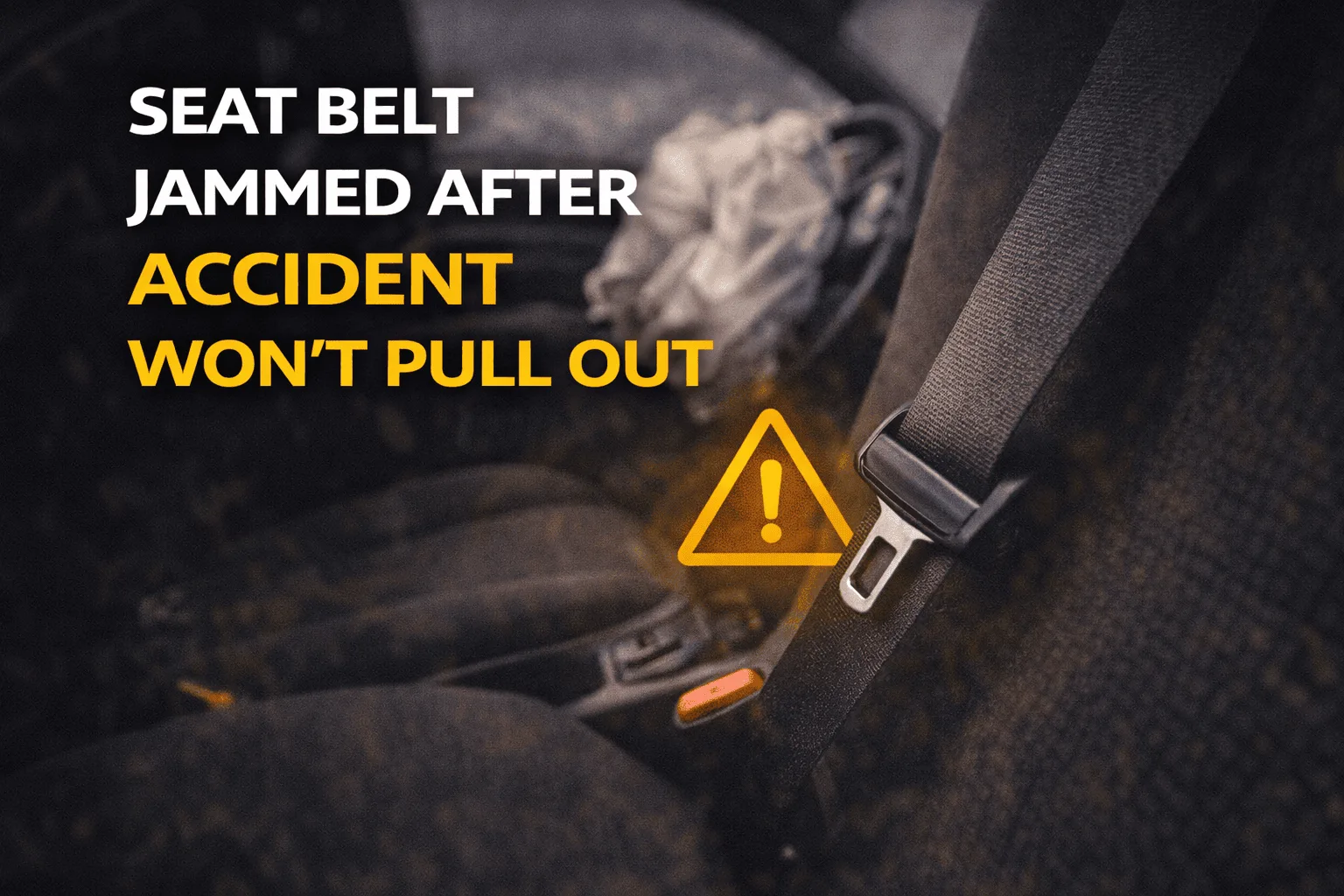
After a car accident, it’s not unusual to discover that a seat belt will no longer pull out. The belt may feel completely locked, refusing to extend no matter how gently it’s tugged or adjusted. This can be alarming, especially because seat belts are designed to be simple, reliable, and always ready to use.
A non-retracting seat belt after a collision often raises immediate concerns about safety and drivability. Many people assume the belt is twisted, jammed, or broken. In reality, this behavior is frequently the result of the restraint system doing exactly what it was designed to do.
Modern seat belts include mechanisms that lock permanently or semi-permanently after an impact, even a minor one. These systems are meant to protect occupants during a crash, but once activated, they can render the belt unusable until it is repaired or replaced.
The sections below explain why a seat belt may stop pulling out after an accident, how the locking mechanism works, what actions should be avoided, and when replacement is the only safe option. The goal is to provide clear, practical information so the situation can be handled correctly and safely.
Why Seat Belts Lock After an Accident
One of the first things you should know is that seat belts are designed to lock during sudden movement. This isn’t a malfunction — it’s a safety feature.
During an accident, the seat belt system detects:
- Sudden deceleration
- Sharp angle changes
- Rapid vehicle movement
When that happens, the system locks the belt to keep occupants firmly in place.
Why the Belt Stays Locked Even After the Crash
What surprised me is that the belt doesn’t always unlock afterward.
In many vehicles, once the system detects a significant event, it:
- Locks permanently
- Engages internal safety mechanisms
- Assumes the belt has done its job
From the car’s perspective, this prevents reuse of a potentially compromised safety component.
Why This Happens Even in Minor Accidents
Not all accidents feel serious, but the car doesn’t measure severity the way humans do.
Even low-speed impacts can:
- Trigger internal sensors
- Activate restraint systems
- Lock the belt mechanism
That’s why a seat belt can jam even after a fender bender.
How the Seat Belt Mechanism Works (Simply Explained)
Inside the seat belt retractor is a locking system that responds to motion.
It reacts to:
- Sudden pulls on the belt
- Changes in vehicle angle
- Rapid deceleration
When conditions return to normal, the belt usually unlocks — unless the system has been triggered beyond its reset threshold.
Why the Belt Feels Completely Stuck
When a seat belt is jammed after an accident, it often feels like:
- It won’t extend at all
- It won’t retract properly
- It’s locked solid in place
That’s because internal components have shifted or locked into a fail-safe position.
Why Gently Pulling Harder Doesn’t Help
Pulling harder feels logical, but it rarely works.
In fact, aggressive pulling can:
- Tighten the lock further
- Damage the belt fabric
- Stress internal components
If the system has fully locked, force won’t undo it.
Why Twisting or Angling the Belt Usually Fails
Some people try:
- Tilting the car seat
- Changing belt angle
- Twisting the strap
These tricks only work when the belt is temporarily locked — not when it’s locked due to a collision event.
Temporary Lock vs Post-Accident Lock
This distinction matters.
A temporary lock:
- Releases when movement stops
- Responds to gentle repositioning
A post-accident lock:
- Stays engaged
- Indicates internal activation
- Often requires replacement
Knowing which one you’re dealing with saves frustration.
Why Seat Belts Are Treated as One-Time Safety Devices
Seat belts are considered critical safety components.
After an accident, manufacturers assume:
- The belt absorbed force
- Internal parts were stressed
- Safety integrity may be compromised
Reusing it could be unsafe.
Why Resetting Isn’t Always Possible
Some people ask if seat belts can be reset.
In many modern vehicles:
- They cannot be reset
- They are designed for replacement
- Internal mechanisms are sealed
This is intentional, not a design flaw.
Why Pretensioners Play a Role
Many modern seat belts use pretensioners.
These devices:
- Tighten the belt instantly during impact
- Remove slack for better restraint
- Activate using mechanical or electrical force
Once activated, pretensioners usually cannot be reused.
Why Pretensioner Activation Isn’t Always Obvious
A pretensioner can activate without:
- Visible damage
- Smoke or noise
- Airbag deployment
That’s why seat belts can jam even when airbags didn’t deploy.
Why the Belt May Retract but Not Extend
In some cases, the belt retracts but won’t pull out.
This happens when:
- Internal locking pawls are engaged
- Retraction spring still functions
- Extension is blocked for safety
It feels confusing but is a known post-accident behavior.
Why Driving Without a Working Seat Belt Is Not Safe
Even if the car drives normally, a jammed belt is a serious issue.
Driving without a functioning seat belt:
- Reduces protection dramatically
- Increases injury risk
- Can be illegal
A working restraint system is non-negotiable.
Why Ignoring the Issue Is Risky
Some people try to live with it, especially if the car “seems fine.”
That’s risky because:
- The next impact could be worse
- Safety systems rely on proper restraint
- Insurance and inspections may flag it
It’s not just inconvenience — it’s safety.
Can a Jammed Seat Belt Ever Be Fixed?
In most post-accident cases, the honest answer is no.
Once the internal safety mechanism has activated:
- Repairs aren’t reliable
- Resetting isn’t approved
- Replacement is recommended
Temporary fixes don’t restore original safety performance.
Why Cutting the Belt Is a Bad Idea
Some people consider cutting the belt out of frustration.
That:
- Eliminates any protection
- Creates inspection failures
- Can complicate insurance claims
Cutting solves nothing long-term.
Why Insurance Often Covers Seat Belt Replacement
This is one of the most reassuring things.
After an accident, insurance often:
- Covers seat belt replacement
- Treats it as safety equipment
- Includes it in repair estimates
It’s worth asking rather than assuming.
Why Seat Belts Are Replaced Along With Airbags
If airbags deploy, seat belts are almost always replaced.
That’s because:
- Systems work together
- Forces are shared
- Integrity must be restored fully
Partial replacement isn’t enough.
Why DIY Repairs Aren’t Recommended
Seat belts are engineered for life-saving performance.
DIY attempts:
- Bypass safety standards
- Risk improper operation
- Create liability issues
This isn’t an area for experimentation.
Why Warning Lights May or May Not Appear
Some cars display restraint warnings. Others don’t.
A jammed belt:
- May not trigger a dashboard light
- May still be unsafe
- Should not be judged by lights alone
Physical function matters more.
Why the Seat Belt Worked When You Needed It
It helps to remember this: the belt did its job.
It locked because:
- It sensed danger
- It restrained movement
- It reduced injury risk
The jam is evidence of protection, not failure.
Why Replacement Is About Future Safety
Replacing the belt isn’t about fixing the past — it’s about protecting the future.
A compromised belt:
- Can’t be trusted again
- May fail when needed
- Removes peace of mind
Safety equipment must be dependable.
How to Approach This Situation Now
If this happens again:
- Don’t force it
- Don’t ignore it
- Don’t improvise
Treat it as a safety issue, not a nuisance.
Why This Knowledge Matters for Any Driver
Most people don’t think about seat belts until something goes wrong.
Understanding how they work:
- Reduces panic
- Prevents unsafe decisions
- Helps you respond correctly
Knowledge replaces fear.
Final Thoughts
If your seat belt won’t pull out after an accident, it’s usually not a coincidence or a simple jam. From my experience and research, it’s often the result of the system doing exactly what it was designed to do — locking permanently to protect occupants after a significant event.
While it’s frustrating, it’s also a sign that safety systems were engaged. The best response isn’t force or shortcuts, but understanding, proper evaluation, and replacement when necessary.
A seat belt is something you trust with your life. Once that trust is compromised, restoring it fully is the only responsible choice.