A seat belt that refuses to extend is more than an inconvenience—it immediately turns a usable vehicle into one that shouldn’t be driven. Because seat belts are designed to lock under specific conditions, a jammed belt often leaves drivers unsure whether they’re dealing with a minor issue or a built-in safety response doing its job.
Modern seat belt systems use inertia-based and tension-sensitive locking mechanisms. These systems are meant to prevent movement during sudden stops or impacts, but they can also activate under everyday conditions such as sharp angles, contamination inside the retractor, or internal wear. That’s why a belt can suddenly feel stuck even when the car hasn’t been in an accident.
The explanation that follows breaks down how seat belt retractors work, the most common reasons a belt won’t pull out, which checks can be done safely, and when replacement is the only responsible option. The focus is on restoring proper function without compromising safety or overlooking a critical restraint component.
First, Let Me Say This Clearly
If your seat belt won’t pull out, don’t force it aggressively.
Seat belts are safety devices. Yanking, twisting, or prying them can:
- Damage internal parts
- Weaken the belt
- Make replacement unavoidable
The goal is understanding first, not brute force.
How a Seat Belt Is Supposed to Work (Simple Explanation)
To understand why it jams, you need to know how it normally works.
Inside the pillar or seat is a retractor. This mechanism:
- Allows smooth extension during normal movement
- Locks instantly during sudden stops or impacts
- Uses gravity and motion sensors
The belt isn’t just on a spring. It’s actively monitoring movement at all times.
So when it won’t pull out, the system thinks something is wrong—or dangerous.
The Most Common Reason a Seat Belt Won’t Pull Out
This surprises a lot of people.
👉 The seat belt is usually locked, not broken.
Seat belts lock when they sense:
- Sudden pulling
- Sharp angles
- Vehicle tilt
- Internal misalignment
The belt is doing its job—just at the wrong time.
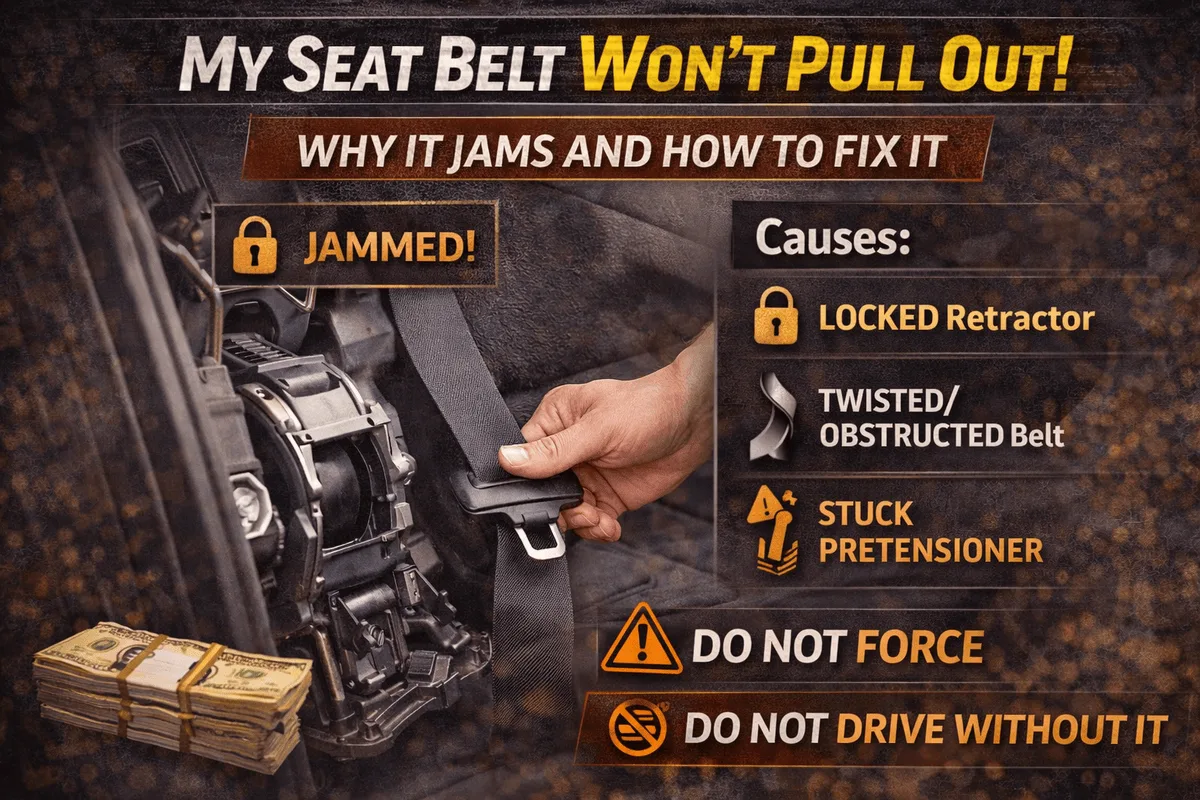
1. The Emergency Lock Is Activated
Seat belts are designed to lock instantly during a crash.
But they can also lock when:
- You pull too fast
- The car is parked on a slope
- The belt twists inside the retractor
When this happens:
- The belt won’t extend
- It feels completely jammed
This is the most common scenario I see.
What Do First
Sit back and:
- Let the belt retract fully
- Keep it straight
- Slowly pull again
In many cases, that alone fixes it.
2. The Car Is Parked on an Angle
This one is easy to overlook.
Many seat belt retractors use a gravity-based sensor. If the car is:
- Parked on a steep incline
- Lifted on one side
- On uneven ground
The retractor may think the car is tipping and lock the belt.
Simple test:
- Try the belt on flat ground
- Roll the car slightly if possible
I’ve “fixed” jammed seat belts just by moving the car a few feet.
3. Twisted or Folded Seat Belt Inside the Retractor
This happens more than people realize.
If the belt:
- Twists near the pillar
- Gets folded repeatedly
- Is pulled sideways often
It can wind incorrectly inside the retractor and lock itself.
What to check:
- Pull the belt out slowly (if possible)
- Straighten the entire length
- Let it retract evenly
A twisted belt almost always causes trouble.
4. Dirt, Dust, or Debris Inside the Mechanism
Seat belts live in dirty places.
Over time:
- Dust enters the retractor
- Small debris builds up
- Internal movement becomes restricted
This is especially common in:
- Older cars
- Vehicles used off-road
- Cars parked outdoors often
Dirt doesn’t break the belt—but it can stop it from moving smoothly.
5. Cold Weather Can Make It Worse
Cold temperatures affect seat belts more than people expect.
In cold weather:
- Internal grease thickens
- Plastic parts stiffen
- Springs respond slower
This can cause:
- Delayed extension
- Temporary jamming
Once the interior warms up, the belt may behave normally again.
6. Seat Belt Pretensioner Activation (Serious Case)
This is important.
If the car has been in:
- An accident
- A sudden hard stop
- Airbag deployment
The pretensioner may have activated.
When that happens:
- The belt locks permanently
- It will not pull out again
- The retractor must be replaced
This is a safety feature, not a malfunction.
7. Worn or Failing Retractor Spring
Seat belts rely on a spring to retract and extend smoothly.
Over time:
- Springs weaken
- Tension becomes uneven
- Movement becomes jerky
Eventually:
- The belt may refuse to extend
- Retraction may feel sluggish
This is more common in older, high-mileage vehicles.
Why Seat Belts Jam Suddenly (Without Warning)
People often tell me:
“It worked perfectly yesterday.”
That’s normal.
Seat belts fail suddenly because:
- Internal parts are hidden
- Wear happens gradually
- Failure only shows at certain angles
There’s rarely a warning light or early symptom.
What to Never Do When a Seat Belt Is Jammed
Avoid:
- Pulling violently
- Using tools to pry
- Lubricating with oil or grease
- Cutting or modifying the belt
Seat belts are engineered systems. Improvising can make them unsafe.
Can You Fix a Jammed Seat Belt at Home?
Sometimes—but only in limited cases.
You can safely try:
- Letting the belt fully retract
- Straightening the belt
- Moving the car to level ground
- Gently pulling slowly
If these don’t work, it’s time to stop.
When a Jammed Seat Belt Is NOT Fixable
The belt should not be “repaired” if:
- The pretensioner has fired
- The belt won’t move at all
- There’s visible damage
- The belt was involved in an accident
In these cases, replacement is the only safe option.
Why Lubricating the Seat Belt Is a Bad Idea
This is a common mistake.
Oils and sprays can:
- Damage the belt fabric
- Attract more dirt
- Interfere with locking mechanisms
Seat belts are designed to work dry.
Is It Safe to Drive Without a Working Seat Belt?
No—and don’t say that lightly.
Driving without a working belt:
- Puts you at serious risk
- Can be illegal
- Can affect insurance claims
Even short trips aren’t worth the risk.
How a Professional Fixes This Problem
When a technician checks a jammed belt, they:
- Inspect the retractor
- Check pretensioner status
- Test locking behavior
- Decide between repair or replacement
Most modern seat belt retractors are not serviceable and are replaced as a unit.
Replacement vs Repair — What Usually Happens
In real life:
- Minor locking issues → reset or reposition
- Mechanical failure → retractor replacement
- Crash-related lock → full assembly replacement
Safety parts are replaced, not rebuilt.
Why Seat Belt Replacement Isn’t Cheap (But Makes Sense)
Seat belts are:
- Tested to strict safety standards
- Designed to save lives
- Integrated with airbags and sensors
The cost reflects the responsibility of the part.
How Long a Seat Belt Should Last
Under normal use:
- Seat belts can last many years
- But not forever
Factors that shorten life:
- Sun exposure
- Dirt
- Repeated twisting
- Accidents
They are durable—but not immortal.
How to Prevent Seat Belt Jamming Now
Here’s what to do consistently:
- Pull the belt smoothly
- Avoid sharp yanks
- Keep it straight
- Clean the belt fabric occasionally
- Don’t let it snap back aggressively
Small habits make a difference.
Common Myths About Jammed Seat Belts
Let’s clear a few up.
- “It just needs oil” — No
- “It’s fine if it locks sometimes” — Not always
- “Can disable the lock” — Dangerous
- “It’s only annoying, not serious” — Wrong
Seat belts are safety equipment first.
My Honest Advice If Your Seat Belt Won’t Pull Out
If your seat belt won’t pull out:
- Stay calm
- Try the simple checks
- Don’t force anything
- Don’t drive without it
If it remains jammed, replacing it is the right move—not an overreaction.
Final Thoughts — Annoying, But Not a Mystery
A seat belt that won’t pull out feels frustrating, but it’s rarely random. Most of the time, it’s responding to movement, angle, or internal wear. Understanding how the system works turns confusion into clarity.
I’ve learned that seat belts are incredibly smart devices—but that intelligence can sometimes work against convenience. When it does, the best response is patience, not force. Your seat belt’s job is to protect you when things go wrong. Treating it with respect ensures it can still do that job when it matters most.