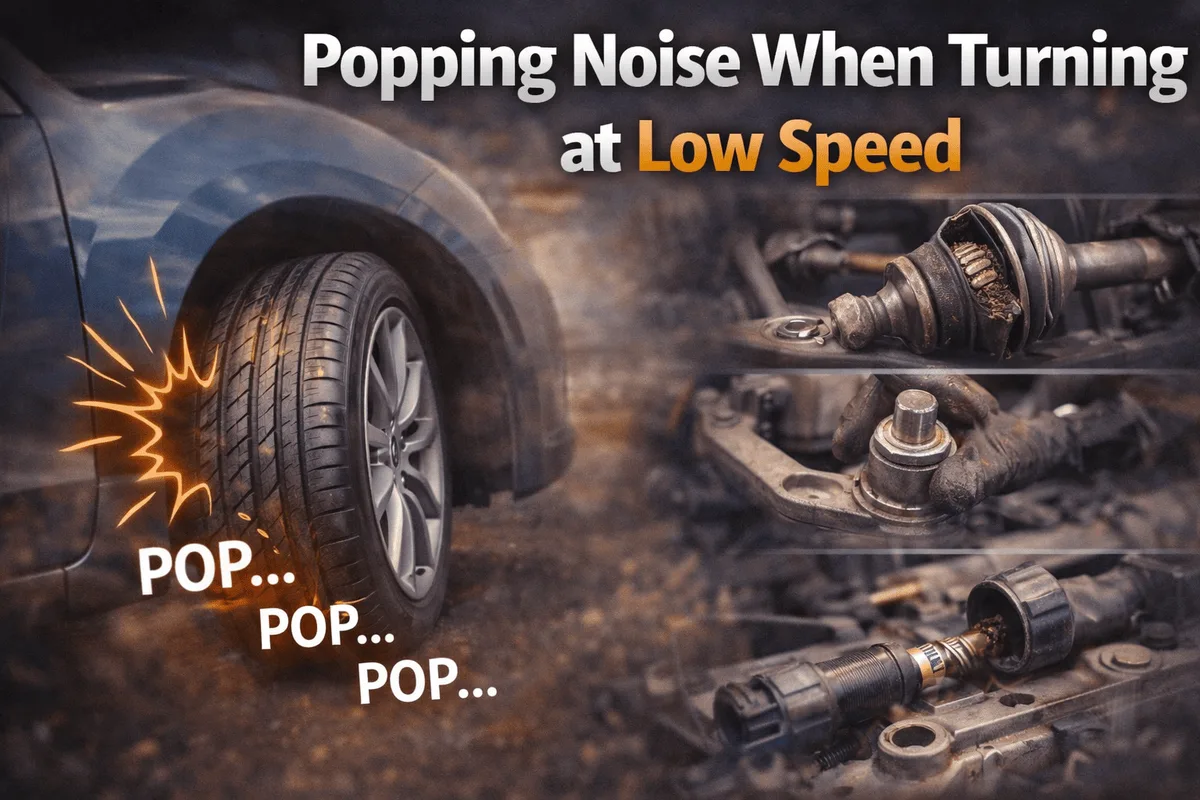
A popping or clicking noise that appears only during low-speed turns is a strong mechanical clue rather than a random sound. These noises are most noticeable while parking, making tight turns, or maneuvering at very low speeds because steering and suspension components are moving through their widest range of motion under load. At higher speeds, the same parts may remain quiet, which often delays diagnosis.
Low-speed turning places stress on joints, bushings, bearings, and drive components in a way straight-line driving does not. When wear, looseness, or binding develops, the sound tends to appear rhythmically as the wheels rotate or the suspension shifts. The specific noise pattern—popping, clicking, or clunking—helps narrow which system is involved.
The explanation ahead outlines why these noises show up primarily at low speed, which components are most commonly responsible, how sound behavior points to the source, and how to determine whether continued driving is acceptable or immediate inspection is necessary. The focus is on using the noise itself as a diagnostic signal rather than ignoring it or replacing parts at random.
Why popping noises show up at low speed
This is the part that may confuse you at first. If something is wrong, why don’t you hear it all the time?
Low-speed turning puts unique stress on certain parts of the car:
- The steering is at a sharper angle
- Suspension components twist more
- Axles and joints operate at extreme angles
- Tires grip instead of sliding
At higher speeds, those same parts don’t move through such extreme ranges. That’s why the noise often disappears once you’re driving straight or faster.
What “popping” usually means in mechanical terms
A popping noise almost always means something is moving when it shouldn’t, or not moving smoothly anymore.
That can happen when:
- A joint is worn
- A bushing is torn
- A component is dry or binding
- A part has developed excess play
The sound is the moment that tension releases.
The most common cause: worn CV joints
If your car is front-wheel drive or all-wheel drive, this is the first place you should look.
What a CV joint does
A CV (constant velocity) joint allows the axle to:
- Transfer power to the wheels
- While turning
- And while the suspension moves
It’s designed to flex smoothly at sharp angles.
What happens when it wears
When a CV joint starts failing:
- The grease inside dries out or leaks
- Internal bearings wear unevenly
- Movement becomes jerky instead of smooth
That’s when you hear clicking or popping during slow, tight turns, especially with the wheel turned all the way.
Clues it’s a CV joint
- Noise is louder when turning one direction
- Sound repeats rhythmically
- Often worse in parking lots
This was the cause in my case.
Ball joints: another common offender
Ball joints connect the suspension to the steering knuckle. They allow the wheel to:
- Move up and down
- Turn left and right
How ball joints create popping sounds
As ball joints wear:
- Internal surfaces lose lubrication
- The joint develops play
- Movement becomes abrupt
At low speeds with steering input, that play shows up as a single pop or dull clunk.
Signs it might be a ball joint
- Noise happens once per turn, not repeatedly
- Steering may feel loose
- Uneven tire wear may appear
Ball joints are serious because failure can affect steering control.
Control arm bushings: quiet parts that get loud when worn
Control arm bushings don’t get much attention, but they work hard.
What bushings do
Bushings:
- Absorb vibration
- Allow controlled movement
- Keep suspension geometry stable
They’re made of rubber, which ages and cracks.
Why they pop at low speed
When bushings tear:
- The control arm shifts suddenly under load
- Steering input exaggerates that movement
- The shift makes a popping or creaking sound
This often happens when turning slowly or going over slight uneven surfaces.
Strut mounts and bearings
What strut mounts do
At the top of the strut is a mount that:
- Allows the strut to rotate when steering
- Supports the vehicle’s weight
Many mounts include a bearing.
How they cause popping noises
When the bearing wears or binds:
- The strut doesn’t rotate smoothly
- Tension builds as you turn
- Then releases suddenly with a pop
You’ll usually hear this near the front, sometimes accompanied by a spring “twang” sound.
Steering components that can pop
Several steering-related parts can create noise at low speed.
Tie rod ends
Tie rods connect the steering rack to the wheels.
Worn tie rods can:
- Shift under steering load
- Create a pop when changing direction
Steering rack issues
Less common, but possible:
- Internal play
- Mounting bushings worn
This often comes with a vague steering feel.
Sway bar links and bushings
Sway bars reduce body roll, but they’re active during turns.
Why they make noise
If sway bar links or bushings wear:
- The bar twists unevenly
- Metal contacts metal
- You hear a pop or knock
This noise can happen even at very low speed, especially on uneven pavement while turning.
Tires and wheels: don’t overlook them
Sometimes the noise isn’t suspension at all.
Tire-related causes
- Tires rubbing inner fender liners
- Aggressive tread patterns catching and releasing
- Low tire pressure causing sidewall flex noises
Wheel issues
- Loose lug nuts (rare but dangerous)
- Bent wheels shifting under load
How to narrow it down step by step
Don’t guess. listen and observe.
Step 1: Notice when it happens
ask yourself:
- Only when turning left or right?
- Only at full steering lock?
- Only when moving slowly?
Patterns matter.
Step 2: Listen from outside
If possible, have someone turn the wheel while you listen from outside the car.
Step 3: Check visually
Look for:
- Torn rubber boots
- Leaking grease
- Cracked bushings
You don’t need special tools to spot obvious damage.
Is it safe to keep driving?
This depends entirely on the cause.
Usually okay short-term
- Mild CV joint noise
- Sway bar bushing noise
- Minor bushing wear
Not okay to ignore
- Ball joint popping
- Steering looseness
- Loud, worsening noises
If steering or suspension integrity is involved, don’t gamble.
Why the noise often gets worse over time
Wear doesn’t stabilize—it progresses.
What starts as:
- Occasional popping
Turns into:
- Constant noise
- Steering issues
- Expensive repairs if ignored
Early attention almost always saves money.
Why temperature affects the noise
You might notice:
- Noise worse in cold mornings
- Quieter after driving a while
Cold stiffens rubber and grease. As things warm up, movement smooths slightly—but the wear is still there.
What a mechanic usually checks first
When I’ve taken cars in, most mechanics:
- Inspect CV boots
- Check ball joints and tie rods
- Look at strut mounts
- Inspect bushings under load
Diagnosis often doesn’t take long once the car is on a lift.
Can alignment cause popping noises?
Alignment itself usually doesn’t cause popping, but:
- Worn parts cause misalignment
- Misalignment stresses worn parts
So alignment issues often show up alongside popping noises.
DIY vs professional repair
Some fixes are beginner-friendly:
- Sway bar links
- Strut mounts (with experience)
Others are best left to professionals:
- Ball joints
- CV axles (depending on car)
Honest with myself about my skill level. That saves frustration.
Common myths about popping noises
“It’s normal for older cars.”
No. Older cars can make noise, but popping means wear.
“If it drives fine, it’s fine.”
Not always. Some failures happen suddenly after long warning periods.
“It’s just the brakes.”
Brake noises are usually different and not tied strictly to turning.
Final thoughts
Cars talk. Not in words, but in sounds, vibrations, and changes in feel. A popping noise when turning slowly is one of those messages that deserves attention. It doesn’t always mean disaster—but it always means something has changed.