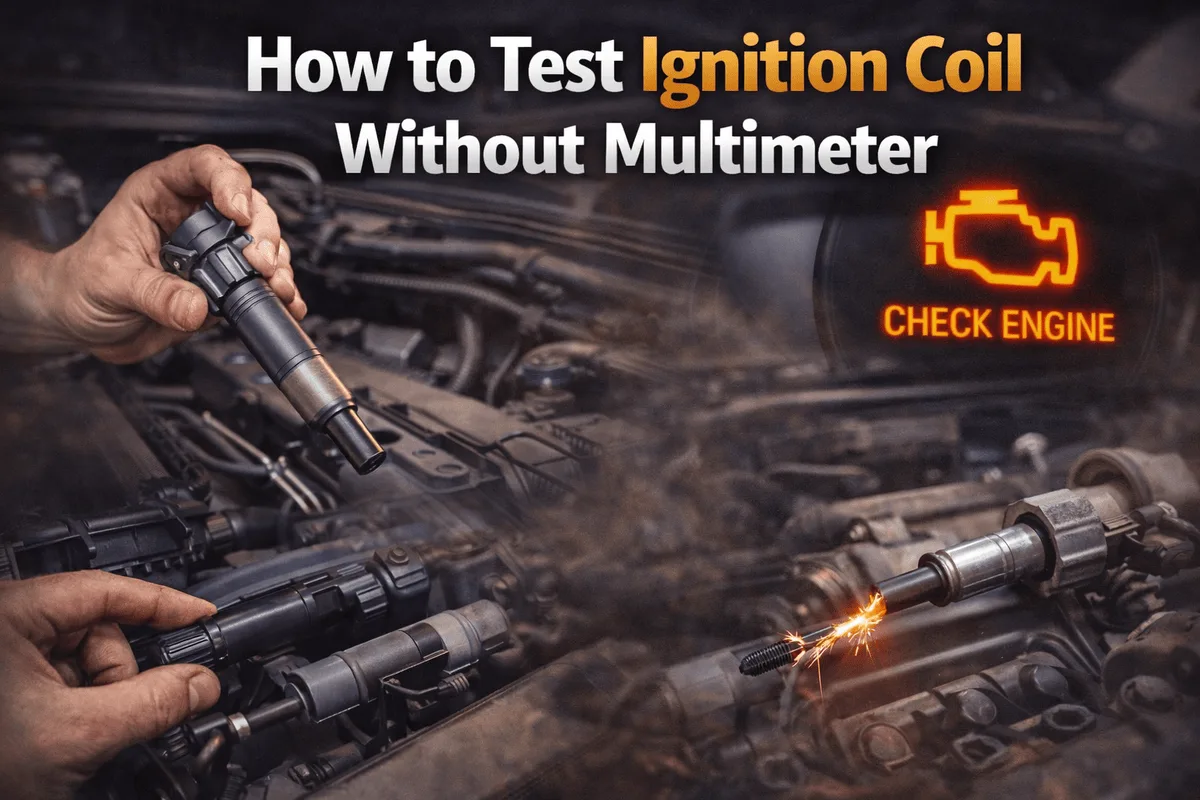
Ignition coil problems often show up as rough idle, hesitation, misfires, or warning lights that appear without much warning. Because these symptoms overlap with several other engine issues, coils are frequently suspected early—sometimes correctly, sometimes not. The challenge is confirming a faulty coil without immediately replacing parts or relying on specialized equipment.
While a multimeter is commonly used for electrical testing, it is not the only way to evaluate ignition coil behavior. Certain failure signs can be identified through engine response, visual inspection, and controlled checks that rely more on observation than measurement. When done carefully, these methods can narrow the problem significantly before any money is spent.
The explanation ahead outlines practical ways to test an ignition coil without a multimeter, explains what symptoms point toward coil failure versus other ignition issues, and highlights safety precautions that matter during the process. The focus is on reliable, real-world checks that help determine the next step with confidence rather than guesswork.
What an ignition coil actually does
Before testing anything, it helps to understand the role the ignition coil plays.
The ignition coil:
- Takes low voltage from the battery
- Boosts it into high voltage
- Sends that power to the spark plug
That spark is what ignites the fuel-air mixture. When a coil fails, combustion becomes weak or inconsistent, and the engine immediately lets you know something’s wrong.
Common signs that point toward a bad ignition coil
Before touching tools, always pay attention to symptoms. A bad ignition coil almost always leaves clues.
Here’s what to notice most often:
- Engine misfiring
- Rough idle
- Hesitation when accelerating
- Reduced power
- Poor fuel usage
- Engine shaking at stops
If one or more of these show up, an ignition coil becomes a prime suspect.
Important safety note before testing
Can’t stress this enough—ignition systems deal with high voltage.
Before doing anything:
- Turn the engine off
- Let it cool down
- Keep hands clear of moving parts
- Never touch exposed connectors while the engine is running
Safety first, always.
Method 1: The cylinder drop test (my go-to method)
This is the simplest and most effective test to use without any tools.
How it works
Each ignition coil fires one cylinder. If you disconnect a coil and the engine behavior doesn’t change, that coil is likely not doing its job.
How to do it
- Start the engine
- Let it idle
- Carefully unplug one ignition coil
- Listen and feel for changes
- Plug it back in
- Move to the next coil
What I’m looking for
- Good coil: Engine stumbles or runs worse
- Bad coil: No noticeable change
If unplugging a coil does nothing, that coil is already failing or dead.
Method 2: Swap the ignition coils
This method has saved me money more than once.
Why it works
Ignition coils are often identical. If the problem moves when you swap coils, you’ve found the culprit.
Step-by-step
- Identify the cylinder that seems to be misfiring
- Remove the ignition coil from that cylinder
- Swap it with a coil from another cylinder
- Start the engine and observe
Results to watch for
- If the misfire moves to the new cylinder, the coil is bad
- If the problem stays put, the issue may be elsewhere
This test is simple, logical, and surprisingly reliable.
Method 3: Visual inspection (don’t skip this)
What look for
- Cracks in the plastic housing
- Burn marks or discoloration
- Oil contamination
- Loose or damaged connectors
Oil-soaked coils are especially common when valve cover gaskets start leaking.
Method 4: Check spark plug condition
Ignition coils and spark plugs work as a team. One can reveal issues with the other.
What remove and inspect
- Pull the spark plug from the suspected cylinder
Warning signs
- Wet fuel smell
- Heavy carbon buildup
- Oil fouling
- Uneven wear compared to others
A dead coil often leaves the spark plug looking very different from the rest.
Method 5: Listen to the engine carefully
This sounds simple, but it’s incredibly helpful.
A healthy engine:
- Sounds steady
- Has a consistent rhythm
A coil issue often causes:
- Random popping
- Uneven exhaust sound
- Rhythmic shaking
I’ve identified bad coils just by listening closely at idle.
Method 6: Smell test (yes, really)
A failing ignition coil can produce unburned fuel.
What notice for:
- Strong fuel smell from the exhaust
- Sharp, raw odor
This happens because fuel enters the cylinder but never ignites properly.
Method 7: Check for heat damage
After the engine has been running (and turned off), carefully check coils for unusual heat.
Signs include:
- Melted plastic
- Brittle housing
- Burnt smell
A coil that overheats often fails soon after.
Method 8: Use the engine warning light behavior
While I’m avoiding advanced tools, the dashboard still offers clues.
Things to pay attention to:
- Flashing warning light during misfires
- Light appearing under load
- Light disappearing at idle
These patterns often point toward ignition-related problems.
Coil-on-plug vs older ignition systems
Most modern cars use a coil-on-plug setup.
That means:
- One coil per spark plug
- Easier identification of bad cylinders
- Easier coil swapping
Older systems may require slightly different approaches, but the logic remains the same.
Why a bad coil can come and go
One thing that confused me early on was intermittent problems.
Coils can:
- Fail when hot
- Work again when cooled
- Act fine at idle but fail under load
This doesn’t mean the coil is “okay.” It means it’s failing slowly.
Mistakes that people make when testing coils
I’ve made a few of these myself.
Common mistakes:
- Replacing all coils without testing
- Ignoring oil leaks that damage coils
- Assuming new parts are always good
- Overlooking spark plugs
Testing saves money and frustration.
When testing without tools isn’t enough
Sometimes, symptoms overlap.
If:
- Multiple cylinders misfire
- Engine runs poorly even after swaps
- Problems persist inconsistently
The issue may involve wiring, fuel delivery, or sensors—not just coils.
How long ignition coils usually last
From my experience, coils last a long time—but not forever.
They tend to fail due to:
- Heat
- Age
- Oil contamination
- Electrical stress
Once one coil fails, others may follow eventually.
Can you should drive with a bad ignition coil?
Technically, yes. Practically, it’s a bad idea.
Driving with a bad coil can:
- Damage the catalytic converter
- Reduce fuel efficiency
- Cause further engine issues
Treat ignition coil problems as something to fix quickly.
Should you replace one coil or all of them?
This depends on:
- Vehicle age
- Mileage
- Budget
Usually replace:
- The failed coil first
- Monitor others closely
Replacing all coils at once is optional, not mandatory.
What to do after confirming a bad coil
Once I’m confident:
- Replace the faulty coil
- Inspect the spark plug
- Clear any warning messages if needed
- Test drive and monitor
That’s it—no guesswork.
Why these methods actually work
These tests rely on:
- Engine behavior
- Logical elimination
- Pattern recognition
They don’t require tools—just attention and patience.
An honest advice if you’re unsure
If you’re uncomfortable unplugging components or working near the engine:
- Ask for help
- Visit a trusted mechanic
- Don’t push beyond your comfort level
There’s no shame in that.
Final thoughts: confidence comes from understanding
Testing an ignition coil without a multimeter isn’t about shortcuts—it’s about understanding how the engine reacts when something isn’t working. Once you know what to look for, the process becomes surprisingly clear.
We’ve saved time, money, and stress by learning these methods, and we hope they help you do the same. If you want, you can tell me what symptoms your car is showing, and I’ll help you narrow down whether the ignition coil is really the problem—or if something else deserves attention first.