The air conditioning compressor is the heart of a vehicle’s AC system. Without it, refrigerant cannot circulate, pressures cannot balance, and cool air will never reach the cabin. When the compressor begins to fail, the symptoms often appear gradually—weak cooling, inconsistent temperatures, or air that never gets cold at all.
Knowing how the compressor works and how to test it correctly is essential for accurate diagnosis. This guide walks through compressor operation, common failure signs, proper testing methods, and how to determine whether repair or replacement is the right solution.
What Exactly Does the AC Compressor Do?
Before testing anything, it helps to know what the compressor actually does inside the air-conditioning system.
You think that compressor as the “heart” of the AC system. It takes refrigerant in a low-pressure gaseous form, squeezes it into a high-pressure state, and sends it through the rest of the system. Without this step, nothing else functions—no cooling, no circulation, nothing.
Here’s what the compressor is responsible for:
- Pressurizing the refrigerant so it can absorb heat
- Circulating refrigerant through the AC system
- Creating the temperature difference that makes cool air possible
If the compressor isn’t turning on, isn’t building pressure, or is making noise, you’ll feel it immediately because the cabin air will stay warm.
Main Signs the AC Compressor Might Be Failing
Before testing, it helps to know the common symptoms:
1. AC blows warm or slightly cool air
If the compressor isn’t compressing refrigerant properly, the system never gets cold.
2. Loud clicking, rattling, or grinding noises
Inside the compressor are pistons, valves, and bearings. If any of these fail, it becomes very noisy.
3. The AC clutch doesn’t engage
That small metal plate on the front of the compressor should click and spin when the AC is turned on.
4. Visible leaks
Oil or refrigerant around the AC components can indicate a larger failure.
5. System cycles on and off repeatedly
A weak compressor can’t maintain pressure, causing rapid cycling.
If you’ve noticed one or more of these signs, it’s time to start testing.
How to Test a Car AC Compressor – Step-by-Step
Below is the full process to follow when diagnosing a compressor. You don’t need advanced tools—just patience and attention.
Step 1: Start With a Visual Inspection
Pop the hood and take a good look at the compressor. It’s usually located at the front of the engine and powered by the serpentine belt.
Look for:
- Damaged wires
- Leaking refrigerant oil
- A worn or loose belt
- Broken mounting brackets
- Debris stuck near the clutch
If anything is physically damaged, that’s often the root of the problem.
Step 2: Check Whether the AC Clutch Engages
The clutch is the circular plate on the front of the compressor. When the AC is turned on, it should click and start spinning along with the pulley.
How to check:
- Start the engine.
- Turn on the AC to the coldest setting.
- Look at the compressor pulley.
- Watch for the clutch to engage.
If the clutch doesn’t engage:
- The compressor may not be getting power
- Low refrigerant may be triggering a safety shutoff
- The clutch coil could be faulty
- A fuse or relay might be burned out
If the clutch does engage but the air is still warm:
That means the compressor is spinning—but not building pressure.
Step 3: Listen for Unusual Noises
A healthy compressor is quiet.
A failing one isn’t shy about making itself known.
Common sounds:
Grinding – Internal bearings are failing
Rattling – Loose internal parts
Clicking – Electrical issues or clutch problems
High-pitched whining – Belt tension problems
If the compressor is noisy only when the AC is turned on, it’s strongly pointing to internal failure.
Step 4: Check the Fuses and Relays
You’d be surprised how many people think their compressor is dead when it’s actually just a fuse.
How to do it:
- Open the fuse box.
- Look for the fuse labeled “AC,” “A/C CLT,” “HVAC,” or “Compressor.”
- Remove the fuse and inspect it for breaks.
- Replace if necessary.
- Repeat with the AC relay.
If replacing a fuse immediately blows another one, that’s a wiring or clutch-coil issue.
Step 5: Test Voltage Going to the Compressor
This step tells you whether the compressor is receiving power.
You’ll need a multimeter.
How to test:
- Keep the engine running.
- AC should be on full cold.
- Disconnect the electrical connector from the compressor.
- Use the multimeter to check for 12V at the supply wire.
If you have 12V and the clutch isn’t engaging:
The clutch coil is likely bad.
If you don’t have 12V:
- Faulty AC switch
- Bad pressure switch
- Broken wiring
- Bad relay
Step 6: Check the Refrigerant Level
Low refrigerant can prevent the compressor from starting to protect the system.
You can use:
- A basic refrigerant gauge
- A full manifold gauge set (more accurate)
If the pressure is extremely low, the compressor won’t turn on at all. This is usually caused by a leak somewhere in the system.
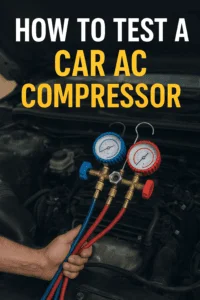
Step 7: Use a Manifold Gauge Set to Check High and Low Side Pressures
This is the most accurate method to judge compressor health.
Normal readings (varies by temperature):
- Low side: 25–45 psi
- High side: 200–250 psi
If both readings are low:
Weak compressor or low refrigerant.
If both readings are high:
Restricted system (clogged condenser, blocked expansion valve).
If high side is low but clutch is engaged:
Bad internal valves inside the compressor.
If the low side pressure climbs instead of dropping:
The compressor isn’t compressing at all.
Step 8: Feel the Condenser Lines
With the AC running:
- The high-pressure line should feel hot.
- The low-pressure line should feel cold.
If both lines feel almost the same, the compressor isn’t working correctly.
Step 9: Inspect the Serpentine Belt
The compressor can’t work if the belt can’t spin it.
Check for:
- Cracks
- Fraying
- Glazing or shiny spots
- Loose tension
If the belt is slipping, the compressor won’t run consistently.
Step 10: Check for Leaks With UV Dye (Optional but Helpful)
Most AC systems come with UV dye mixed into the refrigerant.
Using a UV flashlight:
- Look around hoses
- Compressor seals
- Condenser
- Service ports
If the compressor itself is leaking, it will often show glowing stains around the front seal or body.
How to Know if the Compressor Is Truly Bad
After testing all the above steps, a compressor is considered faulty if:
✔️ The clutch engages but the pressure readings are abnormal
✔️ The compressor makes loud mechanical noise
✔️ The compressor fails electrically
✔️ No temperature difference in AC lines
✔️ It leaks from the body or front seal
✔️ It locks up or causes the belt to squeal
If you confirm any of these, replacement is usually the only realistic fix.
Can You Drive With a Bad AC Compressor?
You technically can drive, but it depends on how the compressor failed.
Safe to drive if:
- The compressor clutch won’t engage
- The compressor is weak but spinning freely
- The AC simply blows warm air
Not safe to drive if:
- The compressor is seized
- The belt is slipping or smoking
- The compressor pulley is wobbling
- There is a burning smell
A seized compressor can break the serpentine belt, which may also power the water pump, alternator, or power steering.
Should You Repair or Replace the Compressor?
A compressor has several moving parts, and repairing it rarely lasts long.
Replacement is better if:
- Internal components are damaged
- Bearings are failing
- The clutch coil is dead
- It seized or locked up
You can repair if:
- The clutch plate is worn
- The coil is good but the clutch isn’t engaging
- The relay or wiring is faulty
Most shops recommend replacing the compressor along with:
- Receiver/drier
- Expansion valve or orifice tube
- O-rings
- Refrigerant recharge
This ensures the system stays clean and functional.
How Much Does It Cost to Replace a Car AC Compressor?
Prices vary based on vehicle type:
Parts
- Economy cars: $250–$500
- SUVs and trucks: $400–$900
- Luxury or imported vehicles: $800–$1500
Labor
- $150–$400 depending on difficulty
Total
Most people spend $500–$1,800 for a full replacement.
How to Maintain the Compressor to Avoid Future Failure
Here’s how to keep mine healthy:
✔️ Run the AC regularly
Even in winter—this keeps the seals lubricated.
✔️ Replace the cabin filter
A clogged filter forces the AC to work harder.
✔️ Check refrigerant levels annually
Low levels lead to overheating and failure.
✔️ Keep the condenser clean
Leaves and debris reduce cooling efficiency.
✔️ Fix small leaks early
Tiny leaks turn into major repairs when ignored.
Final Thoughts
Testing a compressor isn’t complicated—it just requires a bit of patience and the willingness to understand what’s happening under the hood. Once you know how the system works and what each part does, it becomes easy to spot early signs of trouble before they turn into expensive repairs.
If your AC isn’t blowing cold and you’re unsure where to start, this guide should give you all the clarity you need. And honestly, there’s something satisfying about diagnosing it yourself rather than guessing.