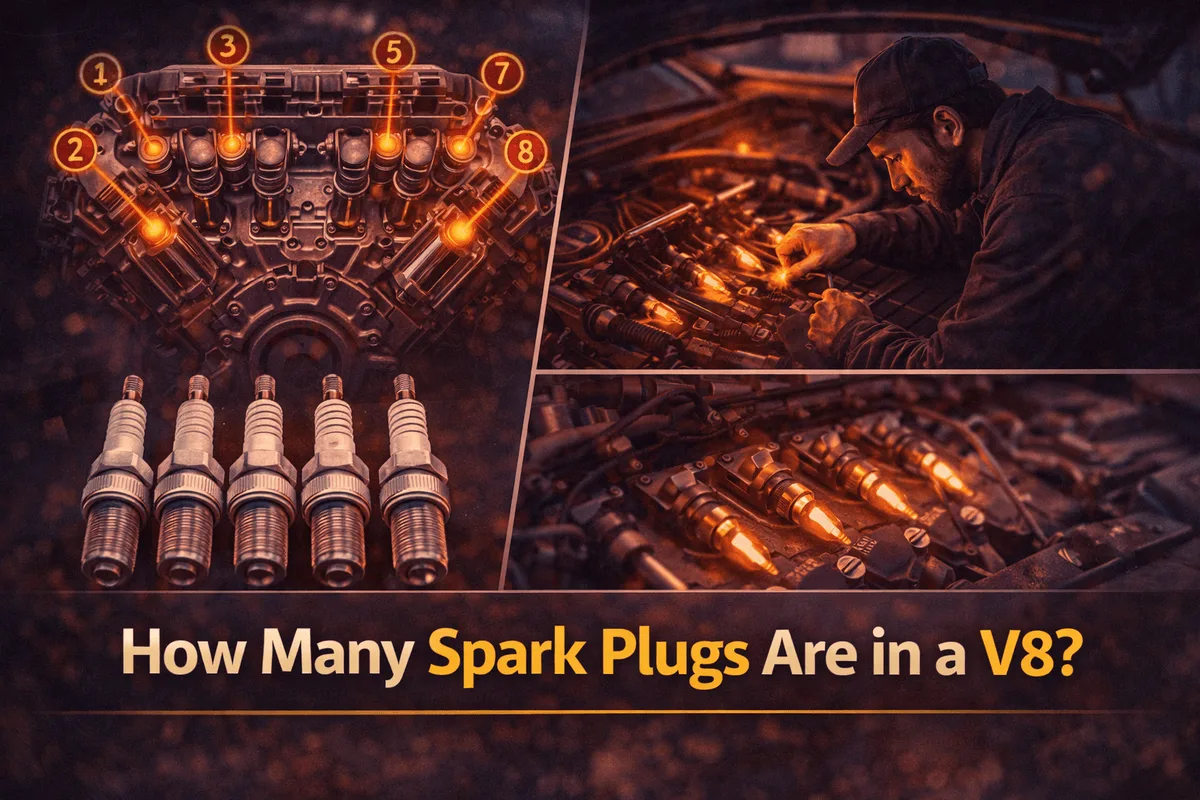
The term V8 engine is widely associated with power and performance, but the basic mechanics behind it are often taken for granted. One of the most common questions that comes up—especially during routine maintenance—is how many spark plugs a V8 engine actually uses. The answer seems obvious at first, yet confusion persists because engine layouts, ignition systems, and special configurations can change expectations.
Spark plugs play a direct role in combustion, and their count is tied closely to cylinder design and ignition strategy. While most V8 engines follow a predictable pattern, there are exceptions that lead to mixed answers and misunderstandings. Knowing the correct number matters for maintenance planning, parts purchasing, and troubleshooting ignition issues.
The explanation ahead lays out how many spark plugs a standard V8 engine uses, why that number aligns with its design, when variations exist, and how spark plugs fit into the overall operation of a V8. The focus is on clear mechanical logic rather than assumptions or shorthand labels.
The Short, Straight Answer
Let’s start simple.
A traditional V8 engine has 8 spark plugs.
That’s one spark plug for each cylinder.
Since a V8 engine has eight cylinders, and each cylinder needs a spark to ignite the fuel, the math is straightforward in most cases. Eight cylinders equals eight spark plugs.
But like most things with engines, there’s more context worth understanding.
Why Spark Plugs Matter in the First Place
Before going any further, it helps to understand why spark plugs exist at all.
A spark plug’s job is to:
- Ignite the air and fuel mixture inside a cylinder
- Start the combustion process
- Keep the engine running smoothly
Without spark plugs, a gasoline engine simply wouldn’t run. Each cylinder needs its own ignition source, which is why the number of spark plugs usually matches the number of cylinders.
What “V8” Actually Means
The “V8” name describes the engine’s layout and cylinder count.
- V refers to the shape of the engine
- 8 refers to the number of cylinders
Those eight cylinders are arranged in two banks of four, forming a “V” shape when viewed from the front.
Each of those cylinders is its own combustion chamber—and each one needs a spark plug.
How the Spark Plugs Are Arranged in a V8
In a typical V8:
- Four spark plugs are on one side of the engine
- Four spark plugs are on the other side
They’re usually threaded into the cylinder heads, with one plug sitting directly above or beside each cylinder.
This layout helps balance power and makes the engine more compact than a straight-eight design.
Why One Spark Plug Per Cylinder Is Usually Enough
In most gasoline engines, one spark plug per cylinder provides:
- Reliable ignition
- Efficient combustion
- Consistent power
Modern spark plugs are designed to last a long time and ignite fuel cleanly, even under high pressure and heat. For most engines, adding more plugs per cylinder isn’t necessary.
That’s why eight spark plugs have been the standard for V8s for decades.
When a V8 Can Have More Than 8 Spark Plugs
This is where some of the confusion comes from.
Some V8 engines use two spark plugs per cylinder instead of one. In those cases:
- 8 cylinders × 2 spark plugs = 16 spark plugs
This design isn’t common in everyday cars, but it does exist in certain engines.
Why Some V8 Engines Use Two Spark Plugs Per Cylinder
Engines with two spark plugs per cylinder usually do it for specific reasons, such as:
- Improving combustion efficiency
- Reducing emissions
- Helping large cylinders burn fuel more evenly
With two ignition points, the air-fuel mixture burns more completely, especially in wider cylinders.
This setup can improve smoothness and reduce unburned fuel.
How to Know Which Type of V8 You Have
If you’re not sure whether your V8 has 8 or 16 spark plugs, there are a few simple ways to find out.
You can:
- Check the owner’s manual
- Look up engine specifications
- Count the ignition coils or plug wires
- Physically inspect both sides of the engine
Most everyday V8s will have one spark plug per cylinder, but it’s always smart to confirm before doing maintenance.
Older vs Newer V8 Engines and Spark Plugs
Older V8 engines:
- Usually had one spark plug per cylinder
- Used thicker plug wires
- Required more frequent replacement
Newer V8 engines:
- Still commonly use one plug per cylinder
- Often use coil-on-plug systems
- Can have longer service intervals
Even though technology has improved, the basic spark plug count often stays the same.
Coil-On-Plug Systems and Spark Plug Count
Modern V8s often use coil-on-plug ignition.
That means:
- Each spark plug has its own ignition coil
- There are no traditional spark plug wires
- Each cylinder fires independently
This doesn’t change the number of spark plugs—it just changes how they’re powered.
Eight cylinders still mean eight spark plugs in most designs.
Why People Sometimes Think V8s Have More Plugs
I’ve noticed a few common reasons for confusion:
- Seeing two plugs per cylinder in some engines
- Mistaking ignition coils for spark plugs
- Hearing mixed advice online
Once you understand that spark plugs match cylinders in most cases, the confusion clears up quickly.
What Happens If a Spark Plug Fails in a V8
Each spark plug plays a specific role.
If one plug fails:
- That cylinder may misfire
- The engine can run rough
- Power and efficiency drop
In a V8, losing one cylinder doesn’t always stop the engine, but it does affect how smoothly it runs.
Do All Eight Spark Plugs Fire at the Same Time?
No—they fire in a specific sequence.
A V8 engine follows a firing order, which:
- Balances power
- Reduces vibration
- Protects internal components
Each spark plug fires at exactly the right moment for its cylinder.
Spark Plug Replacement and Why Count Matters
Knowing how many spark plugs you have is important when:
- Buying replacement parts
- Estimating maintenance cost
- Planning a tune-up
Replacing eight spark plugs is different from replacing sixteen, both in time and cost.
Why Some Spark Plugs Are Harder to Reach Than Others
In a V8, space can be tight.
Some plugs are:
- Easy to access on the outer edges
- Tucked behind components
- Closer to the firewall
This doesn’t change the count, but it does affect how easy the job feels.
How Spark Plug Design Has Improved Over Time
Modern spark plugs:
- Last longer
- Resist wear
- Handle higher temperatures
That’s why many V8 engines don’t need plug replacement as often as older ones did, even though the number of plugs hasn’t changed.
Do Diesel V8 Engines Have Spark Plugs?
This is an important distinction.
Diesel engines:
- Do not use spark plugs
- Rely on compression to ignite fuel
So a diesel V8 has zero spark plugs, but it may use glow plugs instead, which serve a different purpose.
Why Gasoline V8s Depend on Spark Plugs
Gasoline doesn’t ignite from compression alone.
It needs:
- A controlled spark
- Precise timing
- Consistent ignition
That’s why spark plugs are essential in gasoline V8 engines.
How Spark Plug Count Affects Maintenance Cost
More spark plugs generally mean:
- More parts to buy
- More time to replace
- Slightly higher labor cost
That’s another reason why knowing whether your V8 has 8 or 16 plugs matters before scheduling service.
Can a V8 Run With Fewer Spark Plugs?
Technically, it can run—but not well.
If one or more plugs aren’t working:
- The engine loses balance
- Performance drops
- Fuel efficiency suffers
A healthy V8 needs every cylinder firing correctly.
Why Spark Plug Count Rarely Changes
Engine designers stick with one spark plug per cylinder because:
- It works reliably
- It’s cost-effective
- It’s easy to maintain
Unless there’s a strong reason to add more, simplicity usually wins.
My Personal Way of Remembering It
Here’s how I keep it simple:
- One cylinder needs one spark
- A V8 has eight cylinders
- Most V8s have eight spark plugs
Only special designs break that rule.
Common Myths About V8 Spark Plugs
“More spark plugs mean more power.”
Not necessarily. Power comes from design, not just plug count.
“All V8s have 16 spark plugs.”
Only some do.
“Spark plugs don’t matter much.”
They matter more than most people realize.
Final Thoughts
So, how many spark plugs are in a V8? In most cases, the answer is eight—one for each cylinder. Some engines use more, and diesel V8s use none at all, but the standard gasoline V8 sticks to that simple formula.
Once you understand how cylinders and ignition work together, the whole idea becomes much easier to grasp. Spark plugs may be small, but they play a huge role in keeping a V8 smooth, powerful, and reliable.