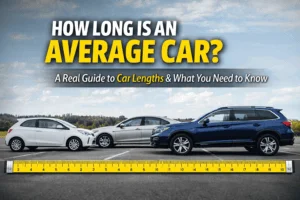
Vehicle length is one of the most overlooked dimensions in everyday driving, yet it plays a significant role in parking, maneuverability, garage fit, and overall road presence. While factors like engine performance and fuel efficiency receive most of the attention, physical size—especially length—often becomes relevant only when space feels limited.
Modern cars vary widely in length depending on their category. Compact cars, midsize sedans, SUVs, and trucks may look similar at a glance, but even small differences in length can affect how a vehicle fits into parking spaces, navigates tight streets, or compares to others on the road. What feels manageable from behind the wheel may be longer than expected when measured objectively.
The explanation ahead clarifies how long an average car typically is, how length differs across vehicle types, why this dimension matters in real-world use, and how to place a specific vehicle within that range. The focus is on clear comparisons and practical context rather than abstract numbers.
The Short Answer: How Long Is an Average Car?
If you’re looking for a simple answer, here it is:
The average car is about 14.5 to 15 feet long, which equals roughly 175 to 180 inches.
That measurement represents what most people drive every day—compact sedans, midsize sedans, and small crossovers. It’s the “middle ground” where comfort, space, and practicality meet.
But that number alone doesn’t tell the whole story. Cars come in many shapes and sizes, and even a difference of a foot can completely change how a vehicle feels to own and drive.
Why Car Length Matters More Than You Think
Before diving deeper into numbers, let us explain why car length is more than just trivia.
Length affects:
- Parking ease
- Garage fit
- Interior space
- Turning radius
- Maneuverability in cities
- Highway stability
- Visual presence on the road
Understanding length helps you choose a vehicle that fits your lifestyle—not just your driveway.
How Car Length Is Measured
Car length is measured from:
- The frontmost point of the bumper
- To the rearmost point of the bumper
It doesn’t include mirrors, antennas, or accessories. Just the body itself.
Manufacturers list this measurement in inches or millimeters, but most drivers find feet easier to visualize.
Average Car Length by Vehicle Type
This is where things get interesting. “Average” changes depending on the category.
Small Cars and Hatchbacks
Typical length: 12 to 13.5 feet (145–162 inches)
These cars are designed for cities and tight spaces. They’re easy to park and quick to maneuver.
From my experience, small cars feel light and responsive. The tradeoff is rear-seat space and cargo room.
Compact Sedans
Typical length: 14 to 15 feet (168–180 inches)
This category represents what many people think of as a “normal” car. It’s where the true average lives.
Compact sedans balance interior comfort with manageable size. For daily commuting, this length feels just right.
Midsize Sedans
Typical length: 15.5 to 16.5 feet (186–198 inches)
These cars are noticeably longer. You feel it in legroom, trunk size, and highway stability.
I’ve always found midsize sedans to be ideal for families who don’t want an SUV but still want space.
Large Sedans
Typical length: 16.5 to 18 feet (198–216 inches)
These are the road cruisers. They offer maximum comfort but require more attention in tight areas.
Parking one of these in a crowded city can feel like threading a needle.
SUVs and Crossovers
SUV length varies widely:
- Compact SUV: 14.5–15.5 feet
- Midsize SUV: 16–17 feet
- Full-size SUV: 17.5–18.5+ feet
Despite their height, many compact SUVs are close in length to average sedans.
Pickup Trucks
Typical length: 17 to 20+ feet
Trucks are in a category of their own. Even the “short” ones are longer than most cars.
Once you go truck-length, parking and garage fit become serious considerations.
What Makes One Car Feel Longer Than Another?
Two cars can have similar lengths but feel completely different.
Here’s why:
Hood Length
Long hoods make cars feel bigger, especially from the driver’s seat.
Overhangs
Short overhangs give a car a compact feel, even if the cabin is spacious.
Wheelbase
A longer wheelbase usually means better interior space, even without extra length.
Design Style
Sharp angles and stretched designs exaggerate size, while rounded shapes hide it.
How Long Is an “Average” Car Today vs the Past?
Cars have grown over time.
In the 1970s and 80s:
- Average car length was shorter, often under 14 feet
Today:
- Safety features, crash structures, and comfort have added inches
- Modern average cars are longer but safer
What surprised me most is that while cars are longer, they’re also better packaged. Interior space has improved without massive growth.
How Car Length Affects Parking and Garages
This is where real life kicks in.
Most standard residential garages are built for cars under 16 feet. Once you go beyond that, fit becomes tight.
We always recommend checking:
- Garage depth
- Parking space length
- Street parking rules
A few extra inches can make daily parking stressful—or effortless.
Is a Longer Car Always Better?
Not necessarily.
Benefits of Longer Cars
- More legroom
- Larger trunk
- Smoother ride at speed
Downsides
- Harder to park
- Wider turning circle
- Less city-friendly
The “best” length depends entirely on where and how you drive.
How to Find the Length of Your Own Car
If you’re curious about your car’s exact size:
- Check the owner’s manual
- Look at the manufacturer’s website
- Search the model specifications online
- Measure bumper to bumper yourself
Knowing this number helps with parking, transport, and future purchases.
Choosing the Right Car Length for Your Lifestyle
Here’s how to think about it:
- City driving → shorter is easier
- Highway commuting → longer feels calmer
- Family use → midsize length works well
- Tight parking → compact is king
There’s no perfect length—only what fits your daily routine.
Common Myths About Car Length
Myth: Bigger cars are always safer
Reality: Safety depends on design, not just size
Myth: Short cars are uncomfortable
Reality: Smart interiors can feel roomy
Myth: Longer cars handle worse
Reality: Wheelbase and suspension matter more
Final Thoughts: What “Average” Really Means
When people ask how long an average car is, they’re really asking something deeper: Will this car fit my life?
At around 14.5 to 15 feet, the average car sits right in the middle—easy to live with, easy to park, and comfortable enough for most people.
Understanding car length gives you confidence. It helps you choose smarter, park easier, and feel more at home behind the wheel.
If you’ve ever wondered whether your car is big, small, or somewhere in between—now you know exactly where it stands.