The Chevy 350 small-block engine is known for its simplicity, reliability, and wide availability of parts. Despite that reputation, correct ignition setup is critical, and the firing order is one of the most important fundamentals. An incorrect firing order can cause misfires, rough running, backfiring, or a complete no-start condition.
Understanding how the firing order works and how it is applied correctly ensures the engine runs smoothly and delivers the performance it is known for. This guide breaks down the Chevy 350 firing order in a clear, step-by-step way that’s easy to follow and apply.
What Firing Order Means (Without the Confusion)
Before memorizing numbers, it helps to understand what firing order actually is.
The firing order is the sequence in which each cylinder ignites its air-fuel mixture. That sequence matters because the crankshaft, camshaft, and valvetrain are all designed to work together in a specific rhythm.
When the firing order is correct:
- the engine runs smoothly
- power delivery is balanced
- vibration is minimized
- internal stress is reduced
When it’s wrong:
- the engine may not start
- it may backfire
- it may run rough or shake
- damage can occur over time
This isn’t about performance tuning. It’s about basic engine health.
The Chevy 350 at a Glance
The Chevy 350 is a small-block V8, which means:
- eight cylinders
- arranged in a V shape
- four cylinders per side
- single distributor (on traditional setups)
It has been used in:
- trucks
- muscle cars
- daily drivers
- boats
- race cars
One reason it’s so popular is that the design is consistent and easy to understand once you know the layout.
Cylinder Numbering on a Chevy 350
This is where most mistakes happen.
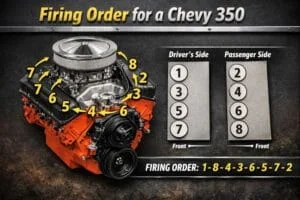
Cylinder numbering on a Chevy small-block does not alternate side to side. Instead, each side is numbered sequentially.
Here’s how it works when you’re standing in front of the engine:
- The driver’s side (left side) cylinders are 1, 3, 5, 7
- The passenger side (right side) cylinders are 2, 4, 6, 8
Cylinder number one is always:
- on the driver’s side
- closest to the front of the engine
Once you understand this layout, the firing order becomes much easier to follow.
The Chevy 350 Firing Order
Here’s the firing order for a standard Chevy 350:
1 – 8 – 4 – 3 – 6 – 5 – 7 – 2
That’s it. Those eight numbers are the heartbeat of the engine.
Each number represents a cylinder, and the order shows which one fires next as the crankshaft rotates. This order was chosen to balance engine forces and keep things running smoothly.
Why This Firing Order Was Chosen
This isn’t random.
Chevrolet engineers selected this sequence to:
- reduce vibration
- balance crankshaft loads
- improve durability
- smooth out power delivery
If cylinders fired in a poorly planned order, the engine would feel rough and wear out faster. The Chevy 350’s firing order is one reason these engines can run reliably for hundreds of thousands of miles.
Distributor Rotation Direction (Very Important)
Knowing the firing order isn’t enough. You also need to know which direction the distributor turns.
On a Chevy 350:
- the distributor rotates clockwise
That means when you’re routing spark plug wires, you follow the firing order around the cap in a clockwise direction.
This is one of the most common mistakes we see—people route the wires in the correct order but go the wrong direction.
Finding Cylinder #1 on the Distributor
Before you connect any wires, you need to locate where cylinder #1 is on the distributor cap.
Here’s how to do it:
- Rotate the engine until cylinder #1 is at top dead center on the compression stroke
- Check the position of the rotor
- The rotor tip points to the terminal for cylinder #1
Once you identify that spot, everything else follows from there.
Routing the Spark Plug Wires Correctly
After locating cylinder #1, routing wires becomes a simple process.
Starting at the #1 terminal:
- connect the wire to cylinder 1
- move clockwise to the next terminal for cylinder 8
- continue following the firing order
- connect each wire to its correct cylinder
Take your time. Crossing wires or skipping positions leads to misfires and frustration.
Common Mistakes That Owner Make
Even experienced people slip up with small-block Chevys. Here are the most common issues to run into:
- Mixing up cylinder numbering
- Routing wires counterclockwise
- Starting at the wrong distributor terminal
- Confusing top dead center on compression vs exhaust stroke
- Crossing wires too closely, causing interference
None of these mean the engine is damaged—but they do mean it won’t run right until corrected.
What Happens If the Firing Order Is Wrong
If the firing order is incorrect, symptoms can include:
- no start condition
- popping through the carburetor
- backfiring through the exhaust
- shaking at idle
- poor throttle response
In severe cases, raw fuel can ignite in the exhaust, which is not something you want to ignore.
Stock vs Modified Chevy 350s
Most Chevy 350 engines use the same firing order.
However, some high-performance camshafts are designed with a different firing order to:
- reduce crankshaft stress
- improve high-RPM balance
These are often referred to as “alternate firing order” cams and are not common in street engines.
If your engine is stock or lightly modified, the standard order applies.
Why the Chevy 350 Is So Forgiving
Even when something isn’t perfect:
- it often still starts
- it gives clear symptoms
- it’s easy to correct
That forgiving nature makes it a great engine to learn on, especially for people getting hands-on experience for the first time.
Tips That Make the Job Easier
Here are a few habits you should follow to save time and frustration:
- Label old wires before removing them
- Replace wires one at a time if possible
- Use proper wire separators
- Keep wires away from hot exhaust parts
- Double-check cylinder numbering before final installation
These small steps prevent big headaches.
Verifying Your Work Before Starting
Before turning the key, always:
- recheck firing order
- confirm distributor rotation
- inspect wire routing
- make sure wires are fully seated
It takes five extra minutes and saves a lot of troubleshooting.
Setting Timing After Wiring
Once the firing order is correct, ignition timing can be set accurately.
If the firing order is wrong, timing adjustments won’t fix the problem. The order must be right first.
Think of firing order as the foundation. Timing builds on top of it.
Why This Matters Even If You’re Not a Mechanic
Understanding firing order isn’t just for engine builders.
It helps you:
- communicate better with mechanics
- diagnose basic problems
- avoid unnecessary repairs
- feel more confident around your engine
Knowledge removes guesswork.
Why the Chevy 350 Is Still Loved Today
Even decades later, the Chevy 350 remains popular because:
- it’s simple
- parts are everywhere
- information is widely available
- it’s durable and adaptable
Knowing basics like firing order connects you to that legacy.
Final Thoughts
The firing order for a Chevy 350—1-8-4-3-6-5-7-2—isn’t just a sequence of numbers. It’s the rhythm that keeps one of the most iconic engines in history running smoothly.
Once you understand cylinder numbering, distributor rotation, and wire routing, the mystery disappears. What’s left is a straightforward system that rewards careful attention.
If you’re working on a Chevy 350, take your time, double-check your work, and trust the process. This engine has helped generations of people learn, build, and enjoy working on cars—and with the firing order set correctly, it’ll keep doing exactly that.