Formula 1 cars operate under a completely different mechanical philosophy than road cars. Every control, including the clutch, is designed to minimize time loss and maximize precision at extreme speeds.
Unlike conventional vehicles, F1 cars do not use a traditional clutch pedal during normal driving. Instead, the clutch system is integrated into the steering wheel and used only in specific situations such as race starts and pit exits.
Here we will explains how the F1 clutch works, why it is designed this way, and how it differs fundamentally from the clutch systems found in everyday cars.
Do F1 Cars Have a Clutch Pedal?
Let’s answer this right away: No, F1 cars do not have a clutch pedal.
At least, not in the way we think of a traditional three-pedal setup in a manual car.
There’s no pedal to the left of the brake, and the driver’s feet control only two pedals:
- Throttle (right foot)
- Brake (left foot)
So where does the clutch go?
It’s there—but it’s controlled in a completely different way.
F1 Cars Do Have a Clutch—Just Not a Pedal
Even though you won’t find a pedal, F1 cars still use a clutch mechanism, and it’s essential for:
- Starting from a standstill
- Leaving the pit box
- Low-speed control
- Preventing wheelspin at launch
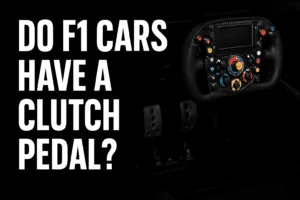
However, instead of being operated by the foot, the clutch is controlled using hand paddles mounted on the steering wheel.
These paddles look like smaller versions of the gear shift paddles and are usually located behind the wheel. Drivers pull them with their fingers, and the paddles act like a highly advanced, electronically assisted clutch system.
Why Remove the Clutch Pedal?
Once you understand the demands of F1 racing, it becomes obvious why a pedal isn’t practical. Here are the reasons:
1. Speed and Precision
Drivers must shift gears in milliseconds. Having a foot pedal would slow down the process and introduce unnecessary risk.
2. Consistency
Hand-controlled clutches allow for more precise engagement. In racing, even the slightest inconsistency in a manual clutch pedal could ruin a start.
3. Better Control Under Extreme G-Forces
In corners, drivers experience huge G-forces. Keeping both feet dedicated to throttle and braking creates stability and reduces mistakes.
4. Steering Wheel Integration
Modern F1 steering wheels are like computers—they control almost everything. Integrating clutch paddles keeps everything within hand reach.
How the Clutch Works in an F1 Car
If you imagine the manual car you drive, you push the clutch pedal, shift the gear, and release. But in F1, the process is split and controlled through electronics.
Here’s a simplified breakdown:
1. Gear Changes Are Semi-Automatic
When the driver pulls a gear paddle, the car processes the shift electronically.
The clutch only plays a role during:
- The initial launch
- Certain low-speed situations
But during normal racing, the clutch is not used for every gear shift.
2. Launch Control Is Manual—But Very Advanced
Even though “launch control” as a system is banned, the technique is incredibly advanced. Drivers:
- Hold the clutch paddle
- Increase throttle
- Release the paddle gradually
- Let the car’s electronics balance engine and wheelspin
This requires precise timing from the driver.
3. Dual-Paddle Clutch Design
Most modern F1 clutch systems use two paddles:
- A primary clutch paddle
- A secondary paddle for fine engagement
Drivers set them differently depending on the track and starting condition.
Do F1 Drivers Ever Stall the Car?
Yes—stalls can happen, especially during slow pit-lane movement or tricky starts. That’s why modern F1 cars have an anti-stall system.
If the car senses the engine about to stall, the electronics automatically open the clutch momentarily to save it.
This is crucial because stalling during a race can cost valuable seconds—or even cause a retirement.
Do F1 Cars Have a Manual Gearbox?
Not in the traditional sense.
They use a sequential semi-automatic gearbox, operated by paddles.
Drivers cannot skip gears (like downshifting from 7th to 3rd directly).
They must go one gear at a time, up or down.
Historical Perspective: F1 Cars Once Had Clutch Pedals
Before technology took over, early F1 cars did use a traditional 3-pedal setup. The shift from manual to semi-automatic systems started in the late 1980s and early 1990s.
Key timeline:
- 1950s–1970s: Fully manual gearboxes and foot clutches
- 1989: Ferrari introduces the first paddle-shift gearbox
- 1990s: Paddles dominate the grid
- 2000s onwards: Clutch pedals disappear completely
Now, the clutch pedal is an obsolete concept in the world of racing.
How Drivers Actually Use the Clutch at Race Start
This is one of the most technical parts of F1 driving.
Step-by-step process:
- Pull both clutch paddles to engage the bite point.
- Hold the car in place using the clutch and brake.
- When the lights go out, release the primary paddle gradually.
- Let the secondary paddle automatically fine-tune engagement.
- The driver manages throttle to avoid wheelspin.
A good launch can make or break the race.
Why a Foot Clutch Would Be a Disaster in Modern F1
Imagine taking off from a starting grid with 19 other cars around you, all launching at unbelievable speeds. A foot pedal would:
- Throw off the driver’s balance
- Decrease reaction times
- Reduce consistency
- Cause more stalls
- Make starts chaotic
Hand paddles simply make far more sense.
What Happens If the Clutch Fails During a Race?
It’s rare, but when it happens, it can be disastrous.
A clutch failure can lead to:
- Stalling in the pit lane
- Poor race starts
- Failure to select gears
- Complete retirement
Drivers heavily rely on electronics to prevent catastrophic issues.
Do F1 Cars Have an Automatic Transmission?
No, not in the traditional sense.
There is no fully automatic mode. Drivers still choose every gear.
However, the clutch only assists the launch and doesn’t operate during gear changes.
This makes F1 transmissions a unique hybrid between manual control and electronic support.
How F1 Technology Influenced Road Cars
Many features that seem normal today—like paddle shifters—came from F1 innovations.
Thanks to F1 tech:
- Sports cars now offer paddle gearboxes
- Dual-clutch transmissions became popular
- Launch control systems improved
- Electronic stability and traction systems evolved
Even if you’re not driving a race car, you’re benefiting from F1 advancements.
Frequently Asked Questions
1. Why don’t F1 cars use automatic transmissions?
Because driver control is essential. Automatic shifting would reduce skill and strategy.
2. Can an F1 car drive like a normal manual car?
Not at all. They’re not designed for everyday roads.
3. How many gears does an F1 car have?
Eight forward gears and one reverse.
4. Do drivers ever miss a gear?
Thanks to electronics, mis-shifts are extremely rare.
5. Do F1 drivers need to heel-and-toe?
No—clutchless paddle systems handle rev-matching automatically.
Conclusion
To put it simply:
- No clutch pedal exists in a modern F1 car.
- A clutch system still exists—but it’s controlled with hand paddles.
- Gear changes are electronically assisted, extremely fast, and don’t require clutch use.
- The clutch is only essential during starts and slow-speed situations.
F1 has evolved far beyond traditional manual driving. The goal is precision, speed, and total control—and that’s exactly what paddle-operated clutches provide.
If you ever get the chance to look closely at an F1 steering wheel, you’ll see just how much engineering goes into making these cars work. The absence of a pedal isn’t a missing feature—it’s a perfect example of how racing technology shapes the future of performance.