
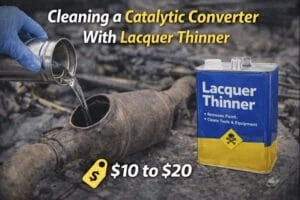
When engine performance drops and warning lights appear, attention often turns to the catalytic converter because of its cost and role in emissions control. Over time, a common claim has circulated suggesting that lacquer thinner or similar solvents can clean a failing converter and restore performance. The idea persists largely because it sounds inexpensive and simple compared to replacing a major exhaust component.
In reality, catalytic converters operate under specific chemical and thermal conditions, and their failure modes are frequently misunderstood. Introducing strong solvents into the fuel or exhaust system does not address most converter problems and can create additional risks to sensors, engine components, and emissions compliance.
The information that follows explains how catalytic converters actually function, why chemical “cleaning” methods like lacquer thinner are often suggested, what truly happens inside the exhaust system when these substances are used, and which legitimate options exist for diagnosing and resolving converter-related issues safely and effectively.
What a Catalytic Converter Actually Does
A catalytic converter isn’t a filter that you “wash out.” That misunderstanding causes a lot of bad advice.
Inside the converter is a honeycomb structure coated with precious metals. These surfaces trigger chemical reactions that transform harmful exhaust gases into less harmful ones. Nothing is meant to be poured into it. Nothing inside is designed to dissolve buildup the way people imagine.
When converters fail, it’s usually because:
- internal material has melted or broken
- surfaces are coated with contaminants
- heat damage has permanently altered the structure
Once that happens, no liquid can reverse it.
Why Lacquer Thinner Enters the Conversation
Lacquer thinner is a strong solvent. People associate strong solvents with cleaning power, so the idea spreads quickly: if it cleans paint or residue, maybe it can clean exhaust components too.
The logic usually sounds like this:
- poor acceleration or emissions codes appear
- someone assumes carbon buildup
- a harsh chemical is suggested to “burn it out”
The problem is that this logic doesn’t match how converters function — or fail.
What Really Happens When Harsh Solvents Are Introduced
Introducing aggressive solvents into a fuel or exhaust system doesn’t target just one component. It affects everything it touches.
Potential consequences include:
- damage to oxygen sensors
- contamination of fuel system components
- overheating of the catalytic core
- internal cracking from thermal shock
- unpredictable combustion behavior
Converters operate at extremely high temperatures. Adding substances that alter combustion chemistry can push temperatures beyond safe limits — sometimes silently.
The Safety Risks People Don’t Talk About
This is where you stopped considering the idea entirely.
Lacquer thinner is:
- highly flammable
- toxic when burned
- harmful to inhale
- not engineered for internal engine use
Using it improperly can result in:
- fire risk
- exhaust system damage
- engine misfires
- sensor failure
- personal injury
The absence of immediate damage doesn’t mean the process was safe — only that damage may show up later.
Legal and Emissions Concerns
This is another area many online discussions ignore.
Catalytic converters are federally regulated emissions components in many countries. Modifying how they operate — even unintentionally — can violate emissions regulations.
In some areas:
- chemical alteration of emissions systems is illegal
- failed emissions tests lead to registration issues
- fines can be significant
Professional repair shops avoid these methods for a reason.
Why Converters Become “Clogged” in the First Place
In our experience, converters don’t fail on their own. They are usually victims of another problem.
Common upstream causes include:
- misfires
- oil consumption
- coolant leaks
- rich fuel mixtures
- prolonged driving with warning lights on
If the underlying issue isn’t fixed, any attempt at cleaning is temporary at best — and damaging at worst.
Why Chemical Cleaning Rarely Works
Converters don’t store debris like a vacuum filter. When contamination coats the catalyst surface or melts the core, the reaction capability is gone.
Chemical treatments can’t:
- repair melted ceramic
- restore precious metal coatings
- fix collapsed honeycomb structures
At best, a temporary improvement masks the real issue.
Safer, Legitimate Alternatives
When faced with suspected converter problems, these approaches make far more sense:
Proper Diagnosis
Scan data, exhaust readings, and sensor behavior tell a much clearer story than guessing.
Address Root Causes
Fixing misfires, leaks, or oil burning often prevents further damage.
Professional Cleaning (When Appropriate)
Some specialized services remove converters and clean them using controlled processes — not household solvents.
Replacement When Necessary
It’s expensive, but sometimes it’s the only correct fix.
When a Converter Isn’t Actually the Problem
We’ve seen countless cases where:
- faulty sensors triggered false warnings
- exhaust leaks confused readings
- software updates resolved symptoms
Replacing or “cleaning” a converter without confirmation often wastes money.
Why We Don’t Recommend DIY Chemical Experiments
After researching this thoroughly, our conclusion is simple:
The risk is high.
The reward is uncertain.
The damage can be permanent.
When a repair method isn’t supported by manufacturers, professional technicians, or emissions engineers, that’s not innovation — it’s gambling.
Final Thoughts
We understand why people search for ways to clean catalytic converters cheaply. Repairs are expensive, and frustration pushes people toward shortcuts. But lacquer thinner isn’t a solution — it’s a misunderstanding of how modern emissions systems work.
If your vehicle is struggling, the best thing you can do is slow down, diagnose the issue correctly, and fix the cause instead of chasing quick fixes. It’s not the cheapest path upfront, but it’s the one that protects your engine, your safety, and your wallet in the long run.