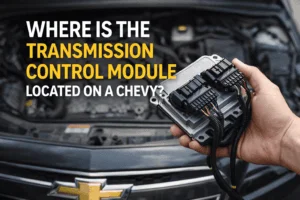
Locating the transmission control module on a Chevy isn’t always as straightforward as many people expect. Unlike components that live in the same place on nearly every vehicle, the transmission control module can be installed in different locations depending on the model, year, drivetrain, and transmission type.
This variation is a common source of confusion, especially when dealing with shifting problems, warning lights, limp mode, or diagnostic trouble codes related to transmission electronics. Searching under the hood alone often leads to frustration, because on many Chevy vehicles the module isn’t mounted there at all.
Understanding where to look starts with knowing what the transmission control module does and why Chevrolet places it where it does. Some models integrate it with other control units, while others mount it inside the cabin, under the dash, or near the transmission itself.
This guide explains what the transmission control module controls, why its location changes across Chevy vehicles, and how to find it efficiently without unnecessary disassembly or guesswork.
What the Transmission Control Module Actually Does
Before worrying about location, it helps to understand what the module is responsible for.
The transmission control module is the brain that manages how and when your Chevy shifts gears. It processes information from sensors that track speed, throttle position, engine load, and temperature.
Based on that data, it tells the transmission when to shift, how firm the shift should be, and how to adapt to driving conditions.
When this module doesn’t work correctly, the transmission often feels confused. Shifts become harsh, delayed, or unpredictable. Sometimes the vehicle gets stuck in one gear. Other times, warning lights appear even though the transmission itself is mechanically fine.
That’s why finding this module matters.
Why Chevy Doesn’t Use One Single Location
You should know that Chevy doesn’t put the transmission control module in the same spot across all vehicles. The location depends on:
- Model
- Year
- Transmission type
- Whether the vehicle uses a separate module or a combined unit
Older models often use a standalone module. Many newer models integrate transmission control into a larger computer system. This is where most confusion comes from.
Older Chevy Models With a Separate Transmission Module
On older Chevy cars and trucks, the transmission control module is often a standalone unit.
Common Places I’ve Found It
- Under the dashboard
- Behind the kick panel on the passenger side
- Beneath the glove box
- Near the firewall inside the cabin
In these vehicles, the module is usually mounted inside the car to protect it from heat and moisture. You may need to remove trim panels or carpeting to access it.
Always disconnect the battery before touching anything electrical.
Chevy Trucks: Where Usually Look First
On many Chevy trucks, especially older Silverados and Colorados, I’ve found the module:
- Behind the passenger-side kick panel
- Under the dash near the center console
- In rare cases, under the hood near the firewall
Trucks sometimes place electronics in slightly different spots due to space and airflow considerations.
Chevy Cars: Typical Locations
For sedans like the Malibu, Impala, or Cruze, the module is often:
- Behind the glove box
- Under the dashboard
- Integrated into another control unit
Removing the glove box is often the easiest way to check.
Newer Chevy Vehicles: Integrated Control Units
This is where things change significantly.
On many newer Chevy models, there is no separate transmission control module. Instead, the function is built into:
- The engine control module
- A combined powertrain control unit
In these cases, the transmission is still electronically controlled, but there isn’t a standalone box labeled “TCM.”
I’ve seen many people waste time searching for something that simply isn’t there.
How ItoTell If a Chevy Uses a Separate Module
Before tearing into panels, do a little homework.
Check:
- Model year
- Engine type
- Transmission type
- Service documentation or repair guides
This tells me whether I’m looking for a separate unit or a combined system.
Under the Hood: When the Module Is in the Engine Bay
Some Chevy vehicles place electronic control units in the engine compartment.
If that’s the case, usually find it:
- Near the battery
- Mounted to the firewall
- Inside a protective enclosure
These modules are sealed to handle heat and moisture, but they still require care when handling.
Inside the Cabin: Why Chevy Often Chooses This Spot
Placing the module inside the cabin keeps it away from:
- Heat
- Water
- Road debris
That’s why so many older Chevy models hide it behind interior panels. It’s inconvenient to access, but it improves longevity.
What the Module Looks Like
When to finally find it, the module usually:
- Is a rectangular metal or plastic box
- Has multiple wiring connectors
- Is bolted to a bracket or frame
- Is clearly labeled with part information
If you’re unsure, always recommend checking part numbers rather than guessing.
Symptoms That Point Toward a Module Issue
These symptoms led me to search for the module in the first place:
- Harsh or delayed shifting
- Stuck in one gear
- Warning lights related to transmission
- No obvious mechanical transmission problems
- Erratic behavior that comes and goes
Electronic problems often feel inconsistent, which is a key clue.
Why Location Matters for Diagnosis
Knowing where the module is helps with:
- Checking wiring connections
- Inspecting for moisture or corrosion
- Verifying power and ground
- Replacing or reprogramming the unit
I’ve seen many problems caused by loose connectors rather than failed modules.
Things Always Do Before Replacing the Module
Never replace the module immediately.
First, I:
- Check battery health
- Inspect grounds
- Look for damaged wiring
- Verify diagnostic codes carefully
Modules are expensive, and misdiagnosis is common.
Reprogramming and Replacement Considerations
If replacement is necessary, many Chevy modules require:
- Programming
- Vehicle-specific calibration
- Professional tools
This isn’t always a plug-and-play situation.
Common Mistakes to See People Make
Some mistakes I’ve learned to avoid:
- Assuming every Chevy has a separate module
- Ignoring wiring issues
- Replacing parts without confirming the problem
- Forgetting to disconnect the battery
Patience saves money here.
Why Online Answers Can Be Confusing
A lot of advice online mixes information across:
- Different years
- Different models
- Different transmission designs
That’s why always focus on vehicle-specific details.
How to Approach Finding the Module Step by Step
Here’s my simple approach:
- Confirm whether the vehicle uses a separate unit
- Check common interior locations first
- Inspect under the hood if needed
- Verify with part numbers before touching anything
This approach has never failed me.
Is It Safe to Drive With a Module Problem?
Sometimes yes, sometimes no.
If the vehicle:
- Goes into limp mode
- Loses gear control
- Shifts unpredictably
…don’t push it. Electronic transmission issues can escalate quickly.
Final Thoughts
Finding the transmission control module on a Chevy isn’t hard once you understand that there isn’t one universal location. The key is knowing your vehicle, understanding how Chevy designs its systems, and not assuming every model works the same way.
From my experience, most frustration comes from expecting a simple answer where there isn’t one. Once you accepted that, the process became much easier.
If you take your time, do a little research, and approach it methodically, finding the module — or confirming it’s integrated — becomes straightforward instead of stressful.