An engine that shuts off while idling but restarts immediately afterward points to a specific type of operating problem. Because the vehicle runs normally at speed and shows no obvious warning signs, the behavior is often dismissed as a fluke. In reality, stalling at idle usually indicates that the engine is unable to maintain stable operation when load is minimal and airflow, fuel delivery, or control inputs are at their lowest.
Idle conditions place unique demands on engine systems. Components responsible for air regulation, fuel metering, and idle control must work precisely to keep the engine running smoothly without driver input. When any of these systems fall slightly out of range, the engine can stall even though it performs well under acceleration or cruising.
The explanation ahead focuses on why stalling occurs specifically at idle, which systems are most often involved, and how recurring restart-after-stall behavior helps narrow the cause. The emphasis is on recognizing patterns and addressing the root issue logically rather than assuming the problem will resolve on its own.
Why cars are most vulnerable at idle
Idle is the most delicate state for an engine.
At idle:
- The engine is running at its lowest speed
- Airflow is minimal
- Fuel delivery is precise
- Small problems become big enough to matter
When you’re driving, momentum and higher engine speed can hide issues. At idle, there’s no buffer. If anything is slightly off—air, fuel, spark, or control—the engine can stall.
That’s why so many problems show up at stoplights, in traffic, or when you shift into park.
What it means when the car restarts easily
This detail is important.
If the car:
- Shuts off
- Then restarts without hesitation
That usually means:
- The engine isn’t mechanically damaged
- The battery isn’t completely dead
- The starter is functioning
Instead, the issue is often control-related—something that affects idle stability rather than full operation.
That’s good news, because these problems are usually fixable.
Common symptoms that go along with idle stalling
Before digging into causes, we always pay attention to what else the car is doing.
We’ve noticed idle-stall issues often come with:
- Rough idle before shutting off
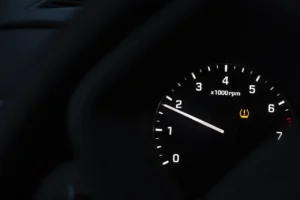
- RPMs dipping very low
- Slight shaking at stops
- Stalling when shifting into gear
- Stalling when the AC turns on
Each of these clues helps narrow the cause.
The most common cause: dirty throttle body
Why the throttle body matters
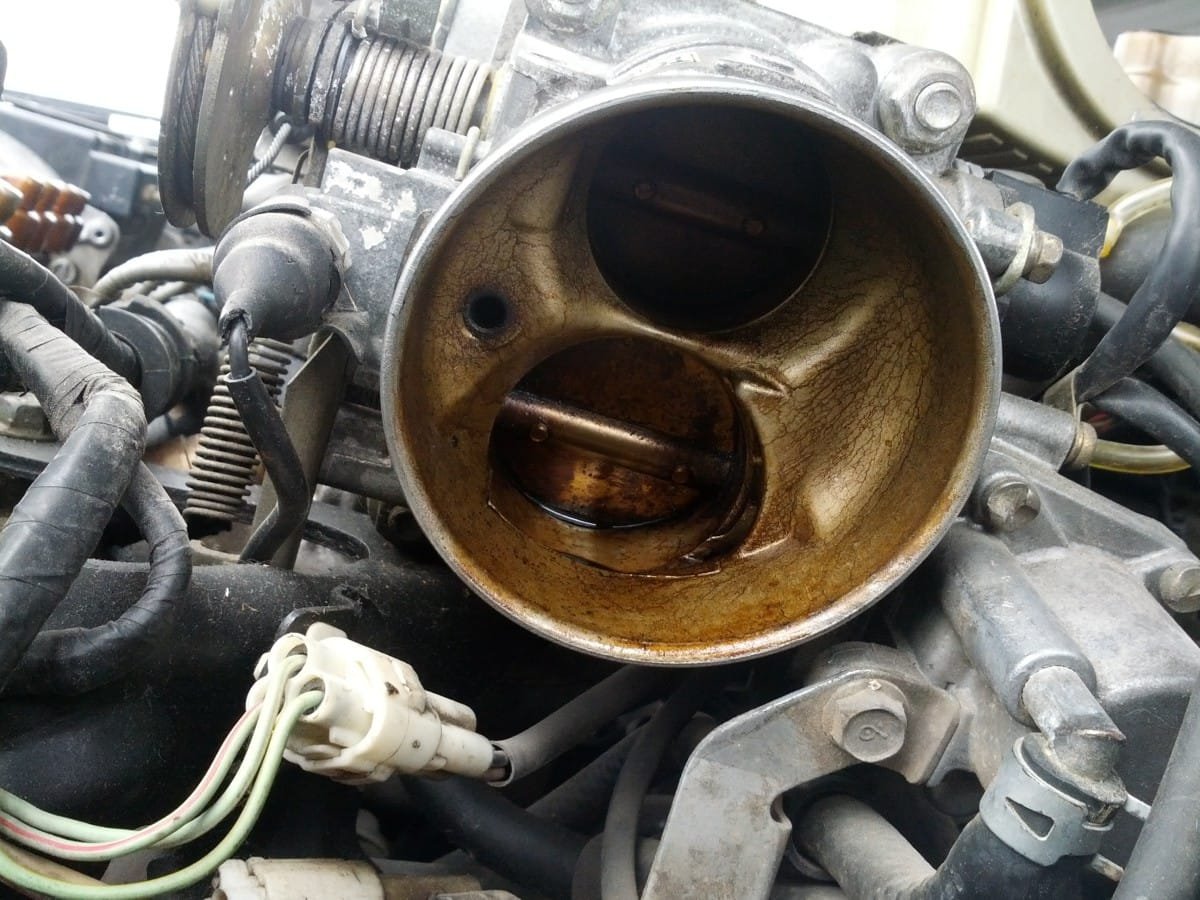
The throttle body controls how much air enters the engine at idle and low speeds. Over time, it collects:
- Carbon buildup
- Oil residue
- Dust
At idle, even a small restriction can reduce airflow enough to stall the engine.
What it feels like
- Engine struggles to maintain idle
- RPMs dip suddenly
- Car shuts off quietly
Cleaning the throttle body has fixed this issue more times than you can count.
Idle air control problems (especially in older cars)
Some cars use a dedicated component to manage idle speed.
What happens when it fails
- Idle speed becomes unstable
- Engine can’t compensate for load changes
- Stalling happens at stops
This is especially noticeable when:
- Turning the steering wheel
- Turning on the AC
- Shifting into gear
The engine needs to raise idle slightly during these moments. If it can’t, it stalls.
Vacuum leaks: small cracks, big problems
Engines are designed to pull in air in a very controlled way.
A vacuum leak allows extra air in through:
- Cracked hoses
- Loose fittings
- Aging rubber seals
Why this causes stalling at idle
At idle, the engine expects a precise air amount. Extra air throws off the balance, causing:
- Lean mixture
- Unstable combustion
- Sudden shutdown
Once RPMs rise, the effect becomes less noticeable—which is why the car runs fine while driving.
Fuel delivery issues that show up only at idle
Fuel problems don’t always cause hard starts or no-start conditions.
Common idle-related fuel issues
- Weak fuel pump at low demand
- Partially clogged fuel injectors
- Dirty fuel filter
At idle, the engine needs consistent, fine fuel delivery. Any interruption can cause a stall—but once restarted, the system recovers temporarily.
Sensors that can cause idle stalling
Modern engines rely heavily on sensors to manage idle.
Sensors I’ve seen cause this problem
- Airflow-related sensors
- Engine temperature sensors
- Throttle position sensors
When sensor data is inaccurate:
- The engine computer makes wrong adjustments
- Idle speed drops too low
- Engine shuts off
These problems don’t always trigger warning lights immediately.
Electrical issues that only appear at idle
This one surprised us the first time we encountered it.
Common electrical causes
- Weak battery
- Corroded battery terminals
- Poor ground connections
At idle, electrical output is lower. If the system voltage drops too far:
- Engine control can become unstable
- The car may stall
- Restarting works once voltage stabilizes
This is more common in older vehicles or those with neglected batteries.
Why the car stalls when stopped but not while driving
This is the question everyone asks—and it makes perfect sense.
While driving:
- RPMs are higher
- Alternator output is stronger
- Airflow increases
- Engine has momentum
At idle:
- Everything slows down
- Margins disappear
- Weak components show their limits
Idle exposes weaknesses that motion hides.
Stalling when the AC turns on
This is a classic clue.
Turning on the AC:
- Adds load to the engine
- Requires idle compensation
If the engine can’t adjust quickly:
- RPMs drop
- Engine shuts off
This almost always points toward idle control or airflow issues.
Why the problem can come and go
Intermittent stalling is frustrating, but it’s also informative.
This usually means:
- A component is failing gradually
- Buildup hasn’t reached critical level yet
- Temperature affects behavior
Intermittent issues are early warnings—not false alarms.
How to diagnose idle stalling step by step
Step 1: Observe patterns
- Does it stall only when warm?
- Only at stoplights?
- Only with AC on?
Patterns narrow causes quickly.
Step 2: Check airflow components
- Throttle body condition
- Air intake hoses
- Vacuum lines
Airflow problems are the most common cause.
Step 3: Listen and feel
- Idle sound
- Engine vibration
- RPM movement
Engines usually warn you before they stall.
Step 4: Inspect electrical basics
- Battery condition
- Terminal cleanliness
- Ground connections
Simple electrical issues cause surprisingly complex symptoms.
Why warning lights don’t always come on
Many people assume no warning light means no problem. That’s not true.
Some issues:
- Stay within acceptable limits
- Don’t fail completely
- Confuse the system without triggering alerts
Idle problems often fall into this category.
Is it safe to drive when this happens?
It depends on frequency and situation.
Usually okay short-term if:
- Stalling is rare
- Restart is immediate
- It only happens at idle
Not safe to ignore if:
- Stalling happens frequently
- It happens in traffic
- Power steering or braking is affected
If the engine shuts off unexpectedly, safety becomes a concern.
What usually does NOT cause idle-only stalling
These are often blamed, but rarely the real issue:
- Transmission failure
- Major engine damage
- Timing belt problems
Idle stalling is almost always a control or airflow issue.
How maintenance habits affect idle stability
- Air intake cleaning
- Throttle body inspection
- Timely battery replacement
- Addressing small symptoms early
Idle problems often start small and grow if ignored.
My biggest mistake (so you don’t repeat it)
I once ignored a mild idle stall for months because the car always restarted. Eventually, it stalled in traffic and wouldn’t restart immediately. What could’ve been a simple cleaning turned into a stressful situation.
Lesson learned:
Easy restarts don’t mean harmless problems.
Final thoughts
When a car shuts off at idle but restarts, it’s not being unpredictable—it’s reacting to something it can no longer manage at low speed. The engine is telling you it’s struggling to stay balanced.
The good news is that most causes are common, understandable, and fixable when addressed early. You don’t need to panic—but you shouldn’t ignore it either.