
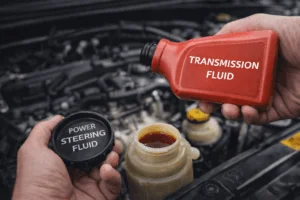
Running low on power steering fluid often raises a common question: can transmission fluid be used as a substitute? The confusion is understandable. Both fluids are hydraulic, both appear similar, and online advice frequently suggests they can be interchangeable.
The reality is more nuanced. While some vehicles are designed to use transmission fluid in the power steering system, others can suffer serious damage if the wrong fluid is added. Seals, pumps, and hoses are engineered for specific fluid properties, and using the incorrect type can lead to leaks, noise, steering stiffness, or long-term failure.
Because the consequences aren’t immediate in every case, this topic is often misunderstood. A choice that seems harmless in the short term can quietly shorten the life of the entire steering system.
This article explains how power steering fluid and transmission fluid differ, why some manufacturers allow overlap while others do not, and how to determine what is safe for a specific vehicle. By the end, you’ll know when using transmission fluid is acceptable, when it’s risky, and how to avoid costly mistakes caused by relying on generalized advice.
Why This Question Comes Up So Often
This question comes up because power steering fluid and transmission fluid:
- Look similar
- Feel similar
- Are both hydraulic fluids
At a glance, they seem interchangeable. That assumption is what gets people into trouble.
What Power Steering Fluid Actually Does
Power steering fluid isn’t just there to fill space. It:
- Transfers hydraulic pressure
- Lubricates internal components
- Protects seals and hoses
- Handles temperature changes
The system relies on consistent pressure and smooth flow to assist steering.
What Transmission Fluid Is Designed For
Transmission fluid has a different job.
It must:
- Handle friction from clutches
- Operate under higher temperatures
- Control hydraulic pressure precisely
- Protect internal metal components
It’s engineered for complex internal behavior, not just fluid movement.
Why They Sometimes Get Mixed Up
The confusion exists because some power steering systems were designed to use transmission fluid.
Yes — in certain vehicles, transmission fluid is not a substitute. It’s the specified fluid.
When Transmission Fluid Is Used in Power Steering Systems
This is the key detail many people miss.
Some manufacturers specifically designed power steering systems to use transmission fluid. In those cases:
- The seals are compatible
- The viscosity is correct
- The additives are expected
Using anything else would be wrong.
Why Older Vehicles Often Used Transmission Fluid
In older designs:
- Power steering systems were simpler
- Fluid requirements were less specialized
- Transmission fluid was readily available
Manufacturers used what worked reliably at the time.
Why Modern Systems Are More Sensitive
Modern power steering systems are more precise.
They often:
- Use lighter fluids
- Have tighter tolerances
- Depend on specific additives
Using the wrong fluid can affect performance quickly.
Why the Owner’s Manual Matters More Than Advice
The owner’s manual tells you:
- Exactly which fluid to use
- Whether transmission fluid is acceptable
- What type is required
No online advice overrides manufacturer specifications.
Why “Transmission Fluid” Isn’t Just One Thing
Another mistake people make is thinking all transmission fluid is the same.
There are:
- Different formulations
- Different additives
- Different viscosity levels
Using the wrong type can cause problems even if transmission fluid is allowed.
Why Additives Matter So Much
Fluids contain additives for:
- Anti-foaming
- Lubrication
- Seal conditioning
Power steering systems and transmissions don’t always need the same additives.
What Can Go Wrong If You Use the Wrong Fluid
Using an incorrect fluid can lead to:
- Swollen or hardened seals
- Pump noise
- Reduced steering assist
- Leaks over time
These issues don’t always appear immediately.
Why Damage Often Happens Gradually
The system may seem fine at first.
Over time:
- Seals degrade
- Fluid breaks down
- Pressure becomes inconsistent
By the time symptoms appear, damage may already be done.
Why Steering Noise Is an Early Warning Sign
Whining or groaning noises often mean:
- Fluid isn’t flowing correctly
- Pressure is uneven
- Lubrication is compromised
Noise is the system asking for attention.
Why Temporary Top-Offs Are Risky
Some people use transmission fluid as a temporary fix.
The problem with that approach is:
- Temporary solutions become permanent
- Fluids mix and circulate
- Draining later isn’t always complete
Mixing fluids can create unpredictable results.
Why Mixing Fluids Is Worse Than Being Slightly Low
Low fluid causes reduced assist.
Wrong fluid can cause:
- Seal damage
- Pump wear
- Long-term leaks
Low is usually reversible. Damage is not.
When Using Transmission Fluid Is Generally Safe
It’s generally safe only if:
- The manufacturer specifies it
- The correct type is used
- The system was designed for it
Anything outside that is a gamble.
Why Some Mechanics Say “It’s Fine”
Some mechanics base advice on experience.
They may have:
- Seen it work in certain vehicles
- Dealt mostly with older systems
- Observed no immediate failure
That doesn’t make it universally safe.
Why Immediate Results Can Be Misleading
Just because the steering feels normal doesn’t mean:
- The fluid is correct
- The system is protected
- Long-term damage isn’t occurring
Short-term performance isn’t the full picture.
Why Fluid Color Isn’t a Reliable Indicator
Color doesn’t tell you:
- Additive compatibility
- Seal safety
- Long-term effects
Two fluids can look identical and behave very differently.
Why Power Steering Systems Are More Fragile Than They Look
Power steering pumps rely on:
- Constant lubrication
- Clean fluid
- Proper viscosity
They don’t tolerate mismatches well.
What Happens If You Already Used Transmission Fluid
If it was specified, you’re fine.
If it wasn’t:
- Monitor for noise
- Watch for leaks
- Consider flushing the system
Early correction can prevent damage.
Why Flushing Is Sometimes Necessary
If the wrong fluid was used:
- Draining alone may not remove it
- Residue remains in lines
- A proper flush restores compatibility
This isn’t always urgent, but it’s often wise.
Why Electric Power Steering Changes Everything
Many newer cars use electric steering.
These systems:
- Don’t use hydraulic fluid
- Eliminate this issue entirely
- Require different maintenance
That’s why this question applies mostly to hydraulic systems.
Why Assumptions Are the Biggest Risk
Assuming “fluid is fluid” causes more damage than neglect.
Each system is engineered with intent.
How to Approach This
- Check the manual first
- Use exactly what’s specified
- Don’t rely on shortcuts
That approach has saved me money and stress.
Why Proper Fluid Is Cheaper Than Repairs
Correct fluid costs little.
Pump and hose repairs cost far more.
Final Thoughts
So, can transmission fluid be used for power steering fluid?
Sometimes — only when the manufacturer specifically says so.
Outside of that, it’s not worth the risk. Power steering systems depend on the right fluid to protect seals, maintain pressure, and ensure safe steering control. What works in one vehicle can quietly damage another.
From my experience, the safest approach is also the simplest: follow the specification written for your car. That small step prevents long-term problems and keeps your steering system working the way it should.
When it comes to fluids, guessing is expensive. Understanding is not.