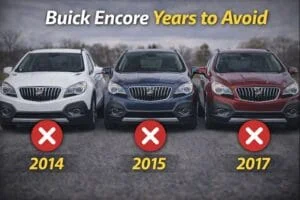
The Buick Encore appeals to many used-car shoppers because of its compact size, comfortable ride, and premium feel compared to other small crossovers. On the surface, it looks like a practical and refined option for city driving and everyday use. However, the Encore’s ownership experience can vary significantly depending on the model year.
Over its production run, certain years have developed patterns of recurring mechanical and reliability issues, while others have proven far more dependable. Understanding these differences is especially important when shopping on the used market, where maintenance history and model-year design changes matter more than appearance alone.
The information that follows highlights Buick Encore model years that tend to raise concern, explains the problems most commonly associated with them, and clarifies which issues are costly or disruptive versus those that are manageable with proper care. The goal is to help buyers make an informed decision based on long-term ownership realities rather than first impressions.
Why Some Buick Encore Years Are More Problematic
Reliability isn’t just about the brand—it’s about timing. Certain years are more vulnerable because of design changes, new engines, or early production issues that hadn’t been fully worked out yet.
With the Encore, several factors influenced problem years:
- early turbocharged engine designs
- transmission behavior in stop-and-go traffic
- electrical system quirks
- cooling and oil-related concerns
Some of these issues were improved over time, but early owners often paid the price while those fixes were being figured out.
Early Buick Encore Years (2013–2014): Proceed With Caution
The Encore debuted in the early 2010s, and the first couple of years are the most caution flags.
Common complaints we found:
- engine hesitation or stalling
- turbocharger performance issues
- premature coolant leaks
- electrical glitches
- rough shifting at low speeds
These problems don’t affect every vehicle, but they show up frequently enough in owner reports to make me pause. Many of these early cars were built before long-term data was available, which means early buyers unknowingly became test cases.
If you’re looking at a 2013 or 2014 model, we strongly recommend checking:
- service records
- recall history
- whether key updates were completed
A well-maintained example can still be acceptable, but it’s not where I’d start my search.
2015 Model Year: Slight Improvements, Still Not Ideal
By 2015, Buick had addressed some early complaints, but the Encore wasn’t completely sorted out yet.
Owners continued reporting:
- inconsistent turbo response
- cooling system problems
- warning lights with no obvious cause
- occasional transmission hesitation
What makes 2015 tricky is that it sits in a transition period. It’s not as problematic as the earliest years, but it doesn’t yet benefit from the refinements that came later.
If price is very attractive and the maintenance history is excellent, it may be worth consideration—but only with a thorough inspection.
2016–2017: Mixed Reliability, Depends on Usage
These years represent a turning point.
On one hand, Buick improved build quality and addressed several earlier mechanical concerns. On the other, some owners still reported:
- oil consumption issues
- sensor failures
- rough idle when cold
- transmission behavior that felt unpredictable
From what we’ve seen, these problems tend to appear more often in vehicles that:
- missed oil change intervals
- were driven aggressively
- experienced long periods of city driving
In other words, these years are highly dependent on how the vehicle was treated.
2018: One of the More Questioned Years
If there’s one year we see debated most often, it’s 2018.
This model year introduced updates that improved technology and comfort, but it also came with:
- continued engine hesitation complaints
- electrical system frustrations
- recurring check engine lights
- fuel system concerns reported by some owners
What stood out to me wasn’t just the number of complaints, but how repetitive they were. The same themes appeared again and again in owner feedback.
This doesn’t mean every 2018 Encore is a problem—but statistically, it’s a year I’d investigate very carefully before buying.
Later Years: Noticeable Improvement
From around 2019 onward, reliability data becomes more encouraging.
Buick addressed several known issues, and owner feedback improved significantly. Reports of major mechanical failures became less common, and the overall ownership experience smoothed out.
That said, even later models aren’t perfect. Any turbocharged engine requires consistent maintenance, and skipping services can still lead to expensive repairs.
The Turbo Engine Factor
A big part of the Encore’s story revolves around its turbocharged engine.
Turbo engines offer:
- good low-end torque
- improved fuel efficiency
- smoother highway performance
But they also:
- run hotter
- depend heavily on oil quality
- are less forgiving of neglect
In many problem years, engine complaints weren’t caused by flawed design alone—but by maintenance habits. That’s why service history matters so much with this vehicle.
Transmission Behavior: What Owners Notice
The Encore’s transmission has drawn mixed feedback over the years.
Some drivers describe it as:
- smooth once warmed up
- comfortable for daily use
Others report:
- hesitation from a stop
- delayed downshifts
- jerky movement at low speeds
While not always a sign of failure, this behavior can be annoying and sometimes points to software or mechanical wear issues, especially in earlier models.
Electrical and Sensor Issues
Another recurring theme is electrical gremlins.
These include:
- warning lights that appear randomly
- sensor failures triggering limp mode
- infotainment system glitches
- power accessory inconsistencies
Electrical problems can be frustrating because they’re not always easy to diagnose, and they don’t always leave clear evidence.
Cooling System and Oil-Related Concerns
Some Encore years are known for:
- coolant leaks
- thermostat failures
- oil leaks around seals
- higher-than-expected oil usage
These issues aren’t catastrophic on their own, but if ignored, they can lead to larger engine problems. Regular inspections make a huge difference here.
How to Decide Whether a Used Encore Is Worth Buying
When evaluating an Encore—especially one from a questionable year—focus on a few key things:
1. Maintenance Records
Consistent oil changes and documented repairs matter more than mileage alone.
2. Warning Light History
Any history of recurring engine or electrical warnings is a red flag.
3. Test Drive Behavior
Hesitation, rough idle, or delayed shifts deserve attention.
4. Inspection by a Trusted Mechanic
This is non-negotiable for turbocharged vehicles.
Years Approach With Caution
Based on owner data, repair patterns, and real-world experience, the years whivh are most cautious about are:
- early production years
- mid-generation years with repeated engine and electrical complaints
- years with unresolved cooling and oil-related reports
This doesn’t mean these cars are guaranteed to fail—it means the risk is higher compared to other years.
Years That Tend to Be Better Choices
Later production years benefit from:
- refined engine calibration
- improved component quality
- fewer widespread complaints
- better long-term data
If reliability is your top priority, these tend to offer a calmer ownership experience.
Why Some Owners Still Love Their Encore
Despite its flaws, many owners genuinely enjoy their Encore.
They appreciate:
- easy city maneuverability
- quiet cabin
- comfortable ride
- good fuel economy
- affordable entry into a premium-feeling vehicle
When maintained properly and purchased in the right year, the Encore can be a pleasant daily driver.
Final Thoughts
The Buick Encore isn’t a bad vehicle—but some years are clearly better than others. Knowing which model years to avoid can save you frustration, unexpected repair costs, and buyer’s remorse.
Take time to research the specific year, verify maintenance history, and get a professional inspection. A well-chosen Encore can be reliable and enjoyable, but a poorly chosen one can quickly become a headache.
If you’re willing to do your homework, the Encore can still be a smart buy. The trick is knowing where the trouble spots are—and now, you do.