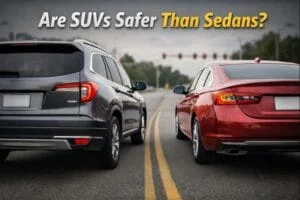
The idea that SUVs are inherently safer than sedans is widely accepted, but safety is more complex than vehicle size or ride height alone. Modern vehicle safety is determined by a combination of crash structure, center of gravity, active safety systems, and real-world crash performance.
While SUVs offer certain advantages in specific scenarios, sedans perform better in others. This article examines how safety is actually measured, where SUVs have strengths, where sedans hold an edge, and how to evaluate safety based on evidence rather than assumptions.
What “Safer” Really Means in the Real World
Before comparing SUVs and sedans, we need to define what safety actually means—because it’s not just about surviving a crash.
Safety includes:
- crash protection
- accident avoidance
- vehicle stability
- driver control
- injury risk to occupants
- injury risk to others
A vehicle can feel safe but still be involved in more accidents. Another can look small but protect occupants extremely well. Understanding this difference changes how you see the whole debate.
Why SUVs Feel Safer to Most People
SUVs create a strong psychological sense of safety, and there are clear reasons for that.
Higher Driving Position
One of the biggest advantages of an SUV is the elevated seating position. From behind the wheel, you:
- see further ahead
- feel more aware of surrounding traffic
- feel less vulnerable among larger vehicles
That extra visibility can help with anticipation, especially in heavy traffic.
Larger Size and Weight
In a collision between two vehicles, physics matters. Heavier vehicles generally absorb less force relative to their mass, which can benefit occupants.
This is where SUVs often gain their reputation:
- more mass
- larger crumple zones
- higher bumper alignment in some crashes
In multi-vehicle collisions, size can offer an advantage—but it’s not the whole story.
Where Sedans Quietly Excel in Safety
Sedans don’t always get credit for how safe they’ve become, especially in modern designs.
Lower Center of Gravity
Sedans sit lower to the ground, which improves stability. This reduces the likelihood of:
- rollovers
- sudden loss of control
- instability during sharp maneuvers
Rollover risk is one of the biggest safety challenges for taller vehicles. Sedans naturally avoid much of that risk.
Better Handling and Responsiveness
Because they weigh less and sit lower, sedans often:
- stop more quickly
- change direction more easily
- respond faster to steering input
This helps avoid accidents entirely, which is just as important as protection during a crash.
Advanced Safety Tech Is No Longer SUV-Exclusive
A decade ago, many advanced safety features appeared first on SUVs. That’s no longer the case.
Today, sedans commonly offer:
- automatic emergency braking
- blind-spot monitoring
- lane-keeping assistance
- adaptive cruise control
- pedestrian detection
In terms of technology, modern sedans and SUVs are far more equal than most people assume.
Crash Data: What It Actually Shows
SUVs and Collision Outcomes
SUVs tend to perform well in:
- head-on collisions
- multi-vehicle crashes
- impacts with smaller vehicles
Their size helps absorb energy and protects occupants in certain scenarios.
SUVs and Rollover Risk
Here’s the trade-off that doesn’t get discussed enough.
SUVs are more prone to rollovers because:
- they sit higher
- they have a higher center of gravity
- sudden maneuvers affect them more
Rollovers significantly increase injury risk, especially in single-vehicle accidents.
Sedans and Overall Stability
Sedans are involved in fewer rollover incidents. Their design:
- keeps all four wheels planted more consistently
- maintains stability during emergency maneuvers
That stability helps prevent some of the most dangerous types of crashes from happening at all.
Safety Isn’t Just the Vehicle—It’s the Environment
For example:
- highway commuters face different risks than city drivers
- rural roads create different hazards than urban streets
- winter climates change everything
An SUV may be safer in one environment, while a sedan may be safer in another.
Weather and Road Conditions
SUVs often handle poor conditions better due to:
- higher ground clearance
- available all-wheel drive
- better traction in snow or mud
That doesn’t automatically make them safer, but it can reduce the chances of getting stuck or losing control in certain situations.
Sedans, when equipped with proper tires, can still perform very well—but they don’t offer the same clearance advantage.
Family Safety: A Common Reason People Choose SUVs
SUVs often offer:
- more space for child seats
- easier access for loading kids
- higher seating that reduces bending
However, safety for families also depends on:
- proper child seat installation
- seatbelt use
- vehicle safety ratings
A sedan with excellent crash ratings and properly installed child seats can be just as safe for a family as an SUV.
The Role of Driver Behavior
This is something people rarely want to hear, but it matters.
Driver behavior affects safety more than vehicle type.
Factors like:
- speed
- attention
- fatigue
- impairment
- reaction time
have a bigger impact on outcomes than whether you’re in an SUV or a sedan.
A cautious driver in a sedan is often safer than a distracted driver in a larger vehicle.
Modern Design Has Changed the Game
It’s important to remember that today’s vehicles—both SUVs and sedans—are far safer than older ones.
Advancements include:
- stronger passenger cabins
- smarter airbag systems
- improved crash structures
- better electronic stability control
Comparing a modern sedan to an older SUV is not a fair comparison. Year and design matter more than body style alone.
Injury Risk to Others
This is a side of the discussion that often gets overlooked.
Because SUVs are heavier and taller, they:
- pose greater risk to pedestrians
- cause more damage to smaller vehicles in crashes
Safety isn’t only about protecting yourself. It also involves minimizing harm to others on the road.
Insurance Data and Risk Patterns
Insurance data shows that:
- SUVs may have lower injury claims for occupants
- sedans may have fewer single-vehicle accident claims
- driving patterns influence loss rates more than body style alone
This reinforces the idea that no vehicle is automatically safer in all situations.
What to Look At When Choosing Between an SUV and a Sedan
When helping friends decide—or deciding myself—focus on:
- safety ratings for specific models
- stability control systems
- crash test results
- driver assistance features
- real-world usage needs
Don’t assume safety based on size alone anymore.
Common Myths That Deserve Clearing Up
Let’s clear a few things up.
- Bigger doesn’t always mean safer
- Height increases rollover risk
- Sedans are not “unsafe” by default
- Technology matters more than shape
- Driver habits outweigh vehicle size
Once you understand these points, the decision becomes much clearer.
So… Are SUVs Safer Than Sedans?
Short answer: sometimes—but not always.
SUVs offer advantages in:
- multi-vehicle crashes
- poor road conditions
- visibility
Sedans offer advantages in:
- stability
- accident avoidance
- rollover prevention
- handling
Neither is universally safer. Each has strengths and weaknesses.
The Best Safety Choice Is the Right Match
Safety isn’t about choosing the biggest vehicle. It’s about choosing the right vehicle for your lifestyle.
The safest vehicle is one that:
- fits your driving environment
- matches your habits
- has strong safety ratings
- includes modern safety systems
- is driven attentively
When those pieces come together, both SUVs and sedans can be excellent choices.
Final Thoughts
Safety is layered. It’s about physics, technology, environment, and behavior working together.
SUVs can be safer in certain situations. Sedans can be safer in others. What matters most is understanding those differences rather than relying on assumptions.
If you’re choosing between an SUV and a sedan, don’t ask which one is safer in general. Ask which one is safer for you. That question leads to much better decisions—and a lot more peace of mind on the road.