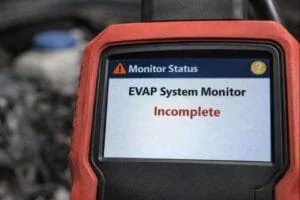
An “EVAP system monitor incomplete” status does not indicate a fault in the traditional sense, but it can still prevent a vehicle from passing an emissions inspection. This monitor reflects whether the onboard diagnostics system has successfully tested the evaporative emissions system under specific conditions.
Because those conditions are narrow and easy to interrupt, the EVAP monitor is often the last one to complete. Here will will breaks down what an incomplete EVAP monitor actually means, why it occurs even when no warning lights are present, and how to meet the requirements needed for the monitor to set properly.
What the EVAP System Does
Before talking about monitors, it helps to understand what the EVAP system is responsible for.
The EVAP system is designed to prevent fuel vapors from escaping into the air. Instead of letting gasoline fumes vent freely, the system captures them and routes them back into the engine to be burned.
It’s not about performance. It’s about emissions.
The system includes:
- a fuel tank
- hoses and vapor lines
- a charcoal canister
- control valves
- pressure sensors
Most of the time, you don’t notice any of this working. That’s why EVAP issues are so confusing when they show up.
What “Monitor Incomplete” Actually Means
An EVAP monitor being incomplete does not mean something is broken.
It means the vehicle hasn’t yet completed its self-test for that system.
Modern vehicles constantly run internal checks called readiness monitors. These tests verify that emissions-related systems are functioning correctly under real-world conditions.
When a monitor is marked incomplete, it simply means:
- the right conditions haven’t occurred yet
- the test hasn’t finished running
- the vehicle hasn’t confirmed the system’s status
This is very different from a fault or a failure.
Why the EVAP Monitor Is So Hard to Complete
Out of all emissions monitors, the EVAP system is one of the most finicky.
That’s because it requires very specific conditions to test properly. The system checks for tiny leaks and pressure changes, and even small variations can cancel the test.
Common reasons it stays incomplete include:
- recent battery disconnection
- recent repairs
- cleared diagnostic codes
- fuel level outside the acceptable range
- short trips only
- inconsistent driving patterns
Unlike other systems, EVAP testing usually doesn’t happen during everyday short drives.
Fuel Level: The Most Overlooked Requirement
Most vehicles require the fuel level to be within a specific range before the EVAP test will even attempt to run. Usually, that means:
- not too full
- not too empty
In many cases, the fuel level needs to sit roughly between one-quarter and three-quarters of a tank.
If the tank is completely full or nearly empty, the system won’t test itself. The computer simply waits.
Temperature and Time Matter More Than You Think
The EVAP test often runs when:
- the engine is fully warmed
- the vehicle has been sitting long enough
- outside temperatures are within a certain range
Some tests occur after the car has been parked for several hours. Others need a cold start followed by steady driving.
This explains why you can drive for days and still see the monitor incomplete—it may never see the right conditions.
Why Short Trips Prevent Completion
Short trips are one of the biggest reasons EVAP monitors stay unfinished.
If you:
- drive only a few miles at a time
- shut the engine off frequently
- never reach steady cruising speeds
the system never gets a chance to run its test.
The EVAP monitor prefers:
- longer drives
- steady speeds
- minimal throttle changes
City-only driving often delays completion indefinitely.
Clearing Codes Resets the Monitor
This one catches a lot of people off guard.
Any time codes are cleared—whether by:
- a repair shop
- a scan tool
- disconnecting the battery
all readiness monitors reset to incomplete.
Even if nothing is wrong, the car has to start the testing process all over again.
This is why people fix a small issue, clear the codes, and then fail emissions because monitors aren’t ready yet.
Why There’s No Check Engine Light
One of the most confusing things is seeing an incomplete monitor without a warning light.
That’s normal.
The EVAP system only triggers a warning when it detects a confirmed problem. An incomplete monitor just means the test hasn’t finished—not that it failed.
No light doesn’t mean ready. It just means no fault has been detected.
How to Check EVAP Monitor to Complete
- Keeping the fuel level in the correct range
- Letting the car sit overnight
- Taking a longer drive the next day
- Maintaining steady speeds
- Avoiding sudden acceleration or hard braking
- Letting the car idle briefly before shutting it off
It didn’t complete immediately, but after a few proper drive cycles, the monitor finally switched to ready.
What a Drive Cycle Really Means
A drive cycle isn’t just “drive around.”
It usually involves:
- a cold start
- smooth acceleration
- steady cruising
- deceleration without braking
- stopping and restarting later
The exact pattern varies by vehicle, but the idea is the same: give the system clean, predictable conditions.
Common Mistakes That Keep the Monitor Incomplete
The most common ones include:
- topping off the fuel tank
- clearing codes too often
- checking readiness too soon
- assuming one long drive is enough
- driving aggressively
- shutting the car off immediately after driving
Small habits can delay the process longer than you expect.
When an Incomplete Monitor Is a Problem
Most of the time, an incomplete EVAP monitor is just a timing issue.
However, it can indicate a real problem if:
- the monitor never completes after many proper drive cycles
- a warning light eventually appears
- fuel smells become noticeable
- codes related to vapor leaks show up later
In those cases, further diagnosis is needed.
Emissions Testing and Monitor Limits
Many emissions programs allow:
- one or two monitors to remain incomplete
- zero fault codes present
However, EVAP is sometimes excluded from that allowance, depending on local rules.
That’s why it’s important to check readiness before testing instead of assuming no light means a pass.
Why EVAP Problems Are Often Small but Annoying
EVAP systems deal with very small pressure changes. Even a loose cap or cracked hose can prevent testing.
The issue may be minor, but the system won’t mark itself ready until everything checks out perfectly.
That’s why patience matters.
How Long It Usually Takes
In my experience:
- some vehicles complete EVAP testing in a few days
- others take a week or more
- inconsistent driving can stretch it much longer
There’s no instant fix. It’s about conditions, not speed.
What to Do Now to Avoid This Problem
Do:
- avoid clearing codes unless necessary
- plan longer drives after repairs
- keep fuel levels moderate
- check readiness before emissions testing
- give the system time instead of forcing it
That approach saves stress later.
Final Thoughts
Seeing “EVAP system monitor incomplete” doesn’t mean your car is broken. It means the system hasn’t finished checking itself yet. That distinction matters.
If you’re facing the same message, don’t panic. Take a step back, drive with intention, and give the system what it needs. Most of the time, the monitor will complete on its own.
And when it finally does, it feels surprisingly satisfying—like checking off a task you didn’t realize had been hanging over you.