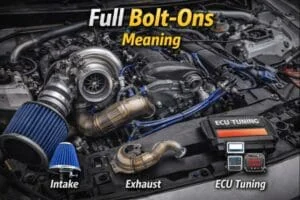
“Full bolt-ons” is a term commonly used in performance circles, but its meaning is often misunderstood. While it sounds informal, it actually refers to a specific level of modification that follows a clear boundary: upgrading components that attach to the engine without opening it or altering internal parts.
This stage sits between basic add-ons and more advanced engine work, and it represents a deliberate approach to increasing performance while preserving factory reliability.
Understanding what qualifies as full bolt-ons is important because expectations around power gains, cost, and drivability depend heavily on how the term is used.
Below is a clear explanation of what full bolt-ons really include, how they affect engine performance, what results are realistic, and whether this level of modification makes sense for a street-driven vehicle.
What “Bolt-On” Actually Means
Before we talk about full bolt-ons, we need to understand what a bolt-on is.
A bolt-on modification is a part that can be installed using factory mounting points without permanently altering the engine or structure. That means:
- no cutting
- no welding
- no internal engine disassembly
If the part can be removed and the car returned to stock, it’s usually considered a bolt-on.
These upgrades are popular because they’re relatively straightforward, reversible, and accessible to everyday enthusiasts.
So What Does “Full Bolt-Ons” Mean?
When someone says their car is full bolt-ons, they’re usually saying this:
“I’ve installed nearly all the major external performance upgrades available for my engine, without opening it up.”
It doesn’t mean every possible part has been replaced. It means the major airflow, exhaust, and supporting components have been upgraded to work together as a package.
Think of it as reaching the limit of what the engine can do externally.
Why the Phrase Is So Popular
“Full bolt-ons” became popular because it’s a convenient way to communicate build level.
Instead of listing every part, someone can say:
- stock
- lightly modified
- full bolt-ons
- built engine
It instantly gives others a general idea of:
- power potential
- reliability expectations
- tuning needs
- how far the car is from factory form
It’s shorthand—but informed shorthand.
Common Parts That Make Up a Full Bolt-On Setup
While the exact parts vary by platform, most full bolt-on setups include upgrades that improve how air moves into, through, and out of the engine.
Here’s what’s typically involved.
Intake System Upgrades
This usually includes:
- high-flow air intake
- smoother intake piping
- less restrictive air filters
The goal is to reduce resistance before air enters the engine.
Exhaust System Improvements
Exhaust upgrades are almost always part of a full bolt-on build.
These often include:
- headers or upgraded exhaust manifolds
- high-flow catalytic converters
- performance mid-pipes
- freer-flowing exhaust systems
Together, they allow exhaust gases to exit more efficiently.
Throttle and Intake Manifold Changes (Where Applicable)
Some platforms benefit from:
- larger throttle bodies
- upgraded intake manifolds
These help manage airflow at higher engine speeds.
Fuel System Support
Even without opening the engine, supporting fuel components are often upgraded, such as:
- higher-capacity fuel injectors
- improved fuel pumps
This ensures the engine gets the fuel it needs as airflow increases.
Cooling Enhancements
More airflow and power generate more heat.
That’s why full bolt-on setups often include:
- improved intercoolers (for forced induction)
- upgraded radiators
- better oil cooling
These upgrades protect reliability rather than directly adding power.
Engine Management and Tuning
This is one of the most important pieces.
Once airflow changes, the engine needs to be recalibrated. That usually means:
- custom tuning
- reflashed engine control software
- professional dyno tuning
Without proper calibration, bolt-ons don’t work together effectively.
What Full Bolt-Ons Does Not Include
This is where confusion often happens.
Full bolt-ons generally do not include:
- internal engine modifications
- forged pistons or rods
- camshaft swaps that require engine disassembly
- engine block machining
Once the engine is opened internally, most people stop calling it bolt-on and start calling it a built engine.
How Much Power Does Full Bolt-Ons Add?
This depends heavily on the engine design.
Naturally aspirated engines often see:
- modest but noticeable gains
- improved throttle response
- stronger mid-range performance
Forced-induction engines often see:
- more significant increases
- better boost efficiency
- improved consistency
What matters most isn’t just peak numbers, but how the engine delivers power.
Why Some People Feel Underwhelmed
Most of time people install full bolt-ons and feel disappointed—and usually it comes down to expectations.
Common reasons include:
- expecting dramatic gains without tuning
- comparing to built engines or boosted setups
- focusing only on peak numbers instead of overall performance
Full bolt-ons aren’t magic. They optimize what the engine already has.
Reliability: One of the Biggest Advantages
Since the engine internals remain untouched:
- factory tolerances stay intact
- long-term durability is usually preserved
- maintenance remains manageable
When done correctly, full bolt-ons don’t dramatically reduce engine life.
Cost: The Reality Check
Full bolt-ons are not cheap, but they’re usually more affordable than internal engine work.
Costs vary widely based on platform, but what surprises most people is that:
- parts add up quickly
- tuning is essential
- installation time matters
Spreading upgrades over time makes it more manageable.
Is “Full Bolt-Ons” the Same for Every Car?
No—and this is important.
What counts as full bolt-ons for one car may differ for another.
Some engines:
- respond extremely well to external upgrades
- have restrictive factory components
Others:
- are already well optimized
- show smaller gains from bolt-ons alone
That’s why platform-specific knowledge matters.
Why the Term Is Sometimes Misused
You’ll occasionally hear “full bolt-ons” used loosely.
Some people mean:
- intake and exhaust only
Others mean:
- intake, exhaust, fueling, cooling, and tuning
That’s why always ask follow-up questions when someone uses the term. The details matter more than the label.
How To Define Full Bolt-Ons
When you hear “full bolt-ons,” expect:
- upgraded intake
- improved exhaust flow
- proper fueling support
- cooling addressed
- professional tuning
- no internal engine work
That combination tells me the engine is pushed close to its external limit.
Who Full Bolt-Ons Is Best For
From our experience, this setup is ideal for:
- enthusiasts who want noticeable gains without rebuilding the engine
- daily drivers who still value reliability
- people learning how modifications interact
- owners who may go further later
It’s a great learning stage before more serious modifications.
Common Mistakes to Avoid
If you’re considering full bolt-ons, I’d avoid:
- mixing mismatched parts
- skipping tuning
- ignoring cooling
- chasing peak numbers only
- installing everything at once without planning
A thoughtful build always performs better than a rushed one.
What Comes After Full Bolt-Ons?
For many people, full bolt-ons is the end goal—and that’s perfectly fine.
For others, it’s a stepping stone toward:
- internal engine upgrades
- forced induction
- track-focused builds
Either way, full bolt-ons lay the groundwork.
Final Thoughts
“Full bolt-ons” isn’t just a phrase—it’s a milestone.
It represents the point where an engine has been fully optimized from the outside, without crossing into major mechanical surgery. It’s a balance of performance, reliability, and accessibility.
If you understand what it really means, you can set realistic expectations, build smarter, and avoid disappointment. And if you do it right, you end up with a car that feels sharper, more responsive, and more engaging—without sacrificing its core character.