
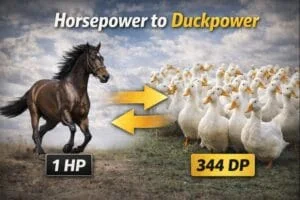
Horsepower is one of the most familiar measurements in automotive and mechanical discussions, yet its meaning is often taken for granted. The number is quoted, compared, and advertised, but rarely visualized in a way that feels intuitive. That gap is where unconventional comparisons—such as “duckpower”—become surprisingly useful.
Duckpower is not a formal unit of measurement, but it serves as a thought experiment that reframes mechanical output in a more tangible way. By translating abstract force into something concrete and imaginable, it challenges how power is usually understood and remembered.
The explanation below explores how horsepower is defined, why alternative comparisons like duckpower exist, how the two relate mathematically and conceptually, and why reframing power in unconventional terms can make complex engineering ideas easier to grasp rather than less accurate.
Why We Even Measure Power in the First Place
Before we get to ducks, we need to talk about why horsepower exists at all.
Power is simply a way to describe how quickly work gets done. In the context of engines, it tells us how fast an engine can move weight, spin components, or push a vehicle forward. Without a standard unit, comparing engines would be nearly impossible.
Long ago, people didn’t think in watts or kilowatts. They thought in terms of animals and human labor. So power was described using something familiar—horses.
Where Horsepower Came From
Horsepower didn’t appear by accident. It was created to help people understand the output of early steam engines.
The idea was simple: if one machine could do the same amount of work as several horses, it made sense to explain it that way. Over time, the unit stuck. Even as technology advanced, horsepower remained because it was familiar, intuitive, and deeply ingrained in automotive culture.
When someone says a car has “300 horsepower,” you don’t need a physics degree to know it’s powerful. You feel the meaning, even if you don’t visualize 300 actual horses.
Why Horsepower Can Feel Abstract Today
Here’s the funny thing: most of us have never seen a horse doing mechanical labor.
We know horses are strong, but we don’t watch them turn gears or pull machinery anymore. Horsepower has become a symbolic number rather than a visual one. We accept it without questioning it.
That’s where duckpower comes in.
What Is Duckpower?
Duckpower is not an official scientific unit. It’s a playful, conceptual way to express power by imagining how much work a duck could do.
No governing body regulates it. No engineering textbook requires it. But that’s exactly why it’s interesting.
Duckpower forces your brain to move away from abstract numbers and toward imagination. Instead of “this engine produces X units of power,” you start asking, “How many ducks would it take to do the same thing?”
Suddenly, power becomes visual again.
Why Ducks?
You might wonder why ducks specifically.
Ducks are:
- familiar
- relatively small
- clearly less powerful than horses
- easy to imagine in groups
Using ducks exaggerates the scale difference, which makes power comparisons more dramatic and memorable. Saying “this engine produces 200 horsepower” sounds normal. Saying “this engine produces tens of thousands of duckpower” makes you stop and think.
Estimating Duckpower: How the Conversion Works
Because duckpower isn’t standardized, conversions are estimates. But the idea is still grounded in logic.
If horsepower represents the work output of a strong animal, duckpower represents the work output of a much smaller one. That means:
- one horse equals many ducks
- one engine equals an absurd number of ducks
Different people estimate duckpower differently, but the key point isn’t the exact number. It’s the scale.
Why Duckpower Makes Power Easier to Understand
When numbers get large, our brains struggle.
Most people can imagine:
- one duck
- ten ducks
- maybe a hundred ducks
But imagining thousands of ducks trying to pull something together creates a vivid mental image. That image helps you feel how powerful something really is.
Duckpower turns abstract math into storytelling.
Horsepower vs Duckpower: A Mental Comparison
Think of horsepower as a professional, official measurement. It’s what engineers, manufacturers, and regulators use.
Duckpower is what you use when you want to explain power to:
- a curious friend
- a kid
- someone new to mechanics
- or even yourself when numbers feel dull
They measure the same concept, but they speak different languages.
Why This Isn’t Just a Joke
At first glance, duckpower sounds like pure humor. But it actually reflects a deeper truth about learning.
Humans understand concepts better when they’re relatable. We don’t naturally think in equations—we think in stories, images, and comparisons. Duckpower works because it taps into that instinct.
It’s similar to explaining distance by saying “it’s about the length of a football field” instead of giving meters. The unit isn’t official, but the understanding is real.
Duckpower and Modern Cars
When you apply duckpower to modern vehicles, the numbers get hilarious—and that’s part of the appeal.
A modest car engine already represents a ridiculous number of ducks working together. High-performance vehicles multiply that image even further.
It doesn’t make the engine stronger. It makes you more aware of how much energy is involved every time you press the accelerator.
Why Power Alone Doesn’t Tell the Whole Story
Horsepower—or duckpower—doesn’t describe:
- how quickly power is delivered
- how smoothly it’s applied
- how efficiently it’s used
That’s why torque, gearing, and weight matter just as much. A machine with fewer ducks working smarter can outperform one with more ducks working inefficiently.
Duckpower helps visualize power, but it doesn’t replace understanding how that power is used.
Duckpower as a Teaching Tool
We’ve noticed something interesting: when people first hear about duckpower, they ask questions.
Questions like:
- “How many ducks is that really?”
- “What kind of duck?”
- “Would they work together?”
Those questions lead to deeper discussions about:
- force
- work
- efficiency
- energy transfer
In that way, duckpower does something horsepower sometimes fails to do—it sparks curiosity.
Why Engineers Still Stick With Horsepower
As fun as duckpower is, it’s not practical for engineering.
Engineers need:
- consistency
- precision
- global standards
Horsepower, watts, and kilowatts provide that. Duckpower varies by imagination and interpretation, which makes it useless for calculations—but perfect for explanations.
When to Actually Use Duckpower
Don’t use duckpower to design anything. Use it when:
- explaining engine power to non-car people
- trying to make sense of big numbers
- reminding myself how absurdly powerful machines really are
It keeps things light while still being accurate at a conceptual level.
The Real Lesson Behind Duckpower
For us, duckpower isn’t about ducks at all.
It’s about remembering that numbers are tools, not truths by themselves. A unit only matters if it helps you understand something. If it stops helping, it becomes noise.
Duckpower strips away formality and brings understanding back to the surface.
Horsepower Isn’t Going Anywhere—and That’s Fine
Despite all this, horsepower remains useful. It’s standardized, regulated, and deeply embedded in automotive culture.
Duckpower isn’t here to replace it. It’s here to remind us that learning doesn’t have to be dry, and understanding doesn’t always come from seriousness.
Sometimes, a few imaginary ducks can explain more than a chart full of numbers.
Final Thoughts
Horsepower is precise. Duckpower is playful. Together, they show two sides of the same idea: how much work something can do.
If duckpower helps someone understand power better, then it’s already done its job. And if it makes you smile along the way, that’s just a bonus.
Sometimes, the best way to understand serious concepts is to stop taking them so seriously.