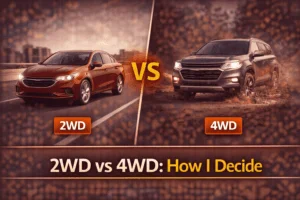
Choosing between two-wheel drive and four-wheel drive is one of the most common—and misunderstood—vehicle decisions. Both systems are designed to move a vehicle efficiently, but they serve different purposes depending on road conditions, climate, and how a vehicle is actually used day to day. The confusion comes from the fact that strong claims are often made for both, even though neither option is universally better.
Two-wheel drive is simpler, lighter, and sufficient for many driving situations. Four-wheel drive adds traction and capability in specific conditions, but it also brings added cost, complexity, and maintenance considerations. Without clear context, it’s easy to overestimate what is needed or underestimate what is already adequate.
The discussion ahead compares how 2WD and 4WD systems operate, where each provides real advantages, where those advantages disappear, and how to decide which setup fits practical needs rather than assumptions. The emphasis is on real-world use, not marketing claims or worst-case scenarios.
What 2WD and 4WD Actually Mean
Before comparing anything, we like to strip the terms down to basics.
2WD (Two-Wheel Drive) means power is sent to two wheels only.
4WD (Four-Wheel Drive) means power can be sent to all four wheels.
That’s the foundation. Everything else is about how and when that power is delivered.
The Two Types of 2WD
Most people don’t realize there are two forms of 2WD.
Front-Wheel Drive (FWD)
- Power goes to the front wheels
- Very common in cars and crossovers
- Good traction for daily use
Rear-Wheel Drive (RWD)
- Power goes to the rear wheels
- Common in trucks, sports cars, and older sedans
- Better balance for towing and performance
Both are still considered 2WD.
How 2WD Feels in Everyday Driving
In normal conditions:
- The car feels light and efficient
- Steering is predictable
- Fuel consumption stays reasonable
For daily commuting, city driving, and highways, 2WD feels completely natural.
What 4WD Really Is (And What It’s Not)
4WD is often misunderstood.
4WD is a system that:
- Sends power to all four wheels
- Is usually driver-controlled
- Is designed for low-traction situations
It’s not meant to be active all the time on dry roads.
Part-Time vs Full-Time 4WD
This is where confusion grows.
Part-Time 4WD
- Driver turns it on and off
- Used only on slippery or loose surfaces
- Common in trucks and off-road vehicles
Full-Time 4WD
- Power goes to all wheels all the time
- Uses differentials to manage traction
- Less common, more complex
Most people are dealing with part-time 4WD.
How 4WD Feels When It’s Engaged
With 4WD on:
- The vehicle feels more planted
- Wheel slip is reduced
- Power delivery feels heavier
It doesn’t make the vehicle faster—it makes it more controlled.
Why 4WD Exists at All
4WD exists for one reason: traction.
It helps when:
- Roads are muddy
- Snow or ice is present
- Loose gravel is involved
- Uneven terrain needs control
It’s about getting moving and staying moving.
The Biggest Myth About 4WD
“4WD makes you safer in all conditions.”
That’s not entirely true.
4WD helps you move, but it doesn’t help you stop or turn better on slippery surfaces. Tires and driver awareness still matter most.
2WD on Dry Roads: Where It Wins
On dry pavement, 2WD has major advantages.
From my experience:
- It’s smoother
- It’s quieter
- It uses less fuel
- It requires less maintenance
For normal driving, 2WD simply makes more sense.
Fuel Efficiency: A Major Difference
This is one of the clearest differences.
2WD vehicles:
- Weigh less
- Have fewer moving parts
- Lose less energy to drivetrain drag
4WD vehicles:
- Carry extra components
- Use more fuel, even when not engaged
- Cost more to operate over time
If fuel cost matters, 2WD usually wins.
Maintenance and Long-Term Costs
Always factor this in.
2WD systems:
- Are simpler
- Have fewer parts to fail
- Cost less to maintain
4WD systems:
- Have transfer cases
- Extra driveshafts
- More seals and fluids
More parts means more things that can wear out.
When 4WD Is Actually Worth It
Despite the extra cost, 4WD makes sense in certain lives.
We’d seriously consider 4WD if:
- You live in heavy snow regions
- You regularly drive on dirt or mud
- You go off-road often
- You tow on uneven terrain
In these cases, 4WD isn’t luxury—it’s practicality.
Snow Driving: 2WD vs 4WD
Snow is where most people focus this debate.
2WD in snow:
- Works fine with good tires
- Requires gentle throttle control
- Demands more attention
4WD in snow:
- Helps with starting and climbing
- Reduces wheel spin
- Feels more confident
But good tires matter more than drivetrain choice.
Ice: Where 4WD Doesn’t Perform Miracles
Ice is slippery no matter what.
On ice:
- 4WD doesn’t shorten stopping distance
- Steering grip still depends on tires
- Overconfidence becomes dangerous
Always remind myself: 4WD helps traction, not physics.
Rainy Conditions: Do You Need 4WD?
In our experience, no.
Modern 2WD cars:
- Handle rain just fine
- Have stability systems
- Manage traction well
4WD isn’t necessary for rain alone.
Off-Road Use: This Is 4WD Territory
This is where 4WD truly shines.
On:
- Rocks
- Sand
- Mud
- Uneven trails
2WD struggles quickly, while 4WD remains composed and capable.
Towing: Does 4WD Matter?
It depends.
2WD:
- Handles light to moderate towing well
- Is more efficient on highways
4WD:
- Helps when launching on ramps
- Provides stability on loose surfaces
- Is useful for off-road towing
For regular towing on pavement, 2WD is usually enough.
Weight Distribution and Traction
Weight plays a role here.
RWD trucks in 2WD:
- Can lose traction when unloaded
- Benefit from weight over the rear axle
4WD helps distribute power regardless of weight balance.
Why Some People Never Use Their 4WD
Many owners:
- Buy 4WD “just in case”
- Never engage it
- Pay extra for something they don’t use
That’s not wrong—but it’s worth thinking about.
How Often Would You Actually Use 4WD?
If the answer is:
- A few days a year → 2WD may be enough
- Weekly or monthly → 4WD makes sense
Honesty here saves money and regret.
Driving Skill Matters More Than Drivetrain
We’ve seen skilled drivers in 2WD outperform unprepared drivers in 4WD.
Why?
- Smooth inputs
- Proper tires
- Situational awareness
Drivetrain choice doesn’t replace good driving habits.
Tire Choice: The Real Game-Changer
If there’s one thing we’ve learned, it’s this:
Good tires matter more than 2WD vs 4WD.
A 2WD car with proper tires:
- Outperforms 4WD on bad tires
- Stops better
- Turns more predictably
Never choose a drivetrain without thinking about tires.
City Living: 2WD Makes More Sense
In urban environments:
- Roads are maintained
- Snow is cleared quickly
- Off-road use is rare
For city life, 2WD is lighter, cheaper, and easier.
Rural and Mountain Areas: 4WD Shines
In rural or mountainous areas:
- Roads may be unpaved
- Weather changes quickly
- Assistance is farther away
Here, 4WD adds real peace of mind.
Highway Driving: No Advantage to 4WD
At highway speeds:
- 4WD offers no benefit
- 2WD is smoother and more efficient
That’s why many highway-focused vehicles stick with 2WD.
Complexity vs Simplicity
This matters more as vehicles age.
2WD:
- Fewer failure points
- Easier diagnostics
- Lower long-term risk
4WD:
- More complexity
- Higher repair costs
- Requires proper use
Simple systems age more gracefully.
Misusing 4WD: A Common Problem
Using 4WD incorrectly can cause damage.
Mistakes include:
- Engaging 4WD on dry pavement
- Turning sharply in locked modes
- Forgetting to disengage
4WD requires understanding—not just ownership.
Learning Curve: 2WD vs 4WD
2WD:
- Intuitive
- No special controls
- Easy for new drivers
4WD:
- Requires awareness
- Needs correct engagement
- Demands understanding of conditions
Some people love that control—others don’t.
Weather Confidence vs Overconfidence
4WD can create a false sense of security.
Remind yourself:
- Traction helps acceleration, not stopping
- Overconfidence causes accidents
- Awareness matters more than hardware
Confidence should be informed, not assumed.
Cost at Purchase Time
4WD almost always:
- Costs more upfront
- Adds to resale value in some regions
Whether that’s worth it depends on where and how you drive.
Resale Value Differences
In snow-heavy regions:
- 4WD often holds value better
In warm climates:
- 2WD is easier to sell
- Buyers don’t want extra complexity
Location matters here.
Why There’s No “Best” Choice
After years of driving both, here’s what you believe:
There is no universally better option—only a better fit.
2WD fits:
- Daily commuting
- Budget-conscious drivers
- Warm or urban areas
4WD fits:
- Challenging conditions
- Outdoor lifestyles
- Rough terrain
Common Myths to Ignore Now
“Everyone needs 4WD.”
No, most people don’t.
“2WD is unsafe.”
Not with proper tires and awareness.
“4WD means not getting stuck.”
It reduces risk, not eliminates it.
Final Thoughts
The debate between 2WD vs 4WD isn’t about which one is better—it’s about which one fits your real life. I’ve driven both, trusted both, and respected both. 2WD offers simplicity, efficiency, and lower cost. 4WD offers traction, confidence, and capability when conditions demand it.