
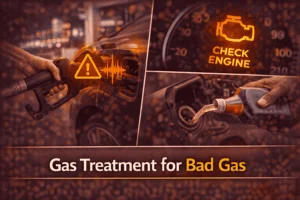
Fuel-related problems often show up immediately after refueling, which makes them easier to notice but harder to interpret. Rough running, hesitation, uneven acceleration, or misfires that appear suddenly can point to an issue with fuel quality rather than a mechanical failure. Because modern engines rely on precise fuel delivery, even small contamination or incorrect fuel composition can disrupt normal operation.
“Bad gas” is a broad term that covers several different problems, including water contamination, degraded fuel, incorrect octane, or improper storage before it ever reaches the pump. Each of these affects an engine differently, which is why symptoms and solutions are not always the same. This is also where fuel treatments are often suggested—sometimes correctly, sometimes not.
The explanation ahead looks at what bad gas actually means, how it interferes with engine performance, when fuel treatments can help stabilize or clean the system, and when they offer little benefit. The focus is on practical decision-making so problems are addressed effectively without unnecessary expense or added risk.
What People Mean When They Say “Bad Gas”
Bad gas isn’t always one single thing.
Bad gas can mean:
- Contaminated fuel
- Old or stale fuel
- Fuel with too much water
- Poor-quality fuel that burns unevenly
All of these can cause similar symptoms, but they don’t all respond to treatment the same way.
How Bad Gas Gets Into the Tank
Most of the time, it’s not your fault.
Bad gas can come from:
- Underground storage tanks with water contamination
- Fuel that has been sitting too long
- Delivery issues at the station
- Condensation buildup
Even reputable stations can occasionally have problems.
Why the Car Feels Fine Before Refueling
This is what makes bad gas so confusing.
Before refueling:
- The engine runs smoothly
- No warning signs appear
Right after:
- Rough idle
- Hesitation
- Loss of power
That sudden change is often the biggest clue that fuel quality is involved.
Common Symptoms to Notice With Bad Gas
When bad gas is the culprit, usually notice:
- Engine stumbling or hesitation
- Rough idle
- Hard starting
- Poor throttle response
- Occasional misfire
These symptoms often show up together, not alone.
Why Bad Gas Affects Modern Cars So Quickly
Modern engines are precise.
They rely on:
- Exact fuel delivery
- Clean combustion
- Accurate sensor feedback
Even small fuel issues can throw everything off, which is why bad gas often causes immediate symptoms.
How Bad Is the Bad Gas?
Before reaching for any treatment, ask yourself:
- Is the car barely running, or just a little off?
- Did it start right after refueling?
- Is there water or debris involved?
The severity determines whether treatment is enough—or if more action is needed.
When Gas Treatment Actually Helps
Fuel treatments work best when:
- The fuel is slightly contaminated
- There’s small amounts of moisture
- Combustion quality is inconsistent
- The engine still runs reasonably well
If the car can still drive, treatment may help stabilize things.
What Gas Treatment Is Designed to Do
Most fuel treatments aim to:
- Absorb small amounts of water
- Improve fuel burn quality
- Clean injectors lightly
- Restore smoother operation
They are helpers, not miracle fixes.
Water in Gas: The Most Common Scenario
This is the most frequent type of bad gas run into.
Water gets into fuel through:
- Condensation
- Leaking storage tanks
- Temperature changes
Small amounts of water can cause rough running and hesitation.
Why Water Causes Engine Problems
Water doesn’t burn like fuel.
When water enters the combustion process:
- The fuel-air mixture becomes unstable
- Combustion becomes uneven
- The engine struggles to run smoothly
That’s where treatment can sometimes help.
How Gas Treatment Handles Moisture
Many treatments contain additives that:
- Bind with small amounts of water
- Allow it to pass through safely
- Reduce separation inside the tank
This works only if the water amount is limited.
When Water Contamination Is Too Severe
If the fuel is heavily contaminated:
- The engine may stall
- Starting may be difficult
- Treatment won’t be enough
In these cases, draining the tank becomes the only real solution.
Old or Stale Gas and Its Effects
Old gas loses volatility over time.
This often happens when:
- A car sits unused
- Fuel sits for months
- Seasonal storage is involved
Stale fuel doesn’t ignite properly, causing rough operation.
Why Old Gas Feels Like Weak Performance
With old fuel:
- Combustion is slower
- Power output drops
- The engine feels lazy or hesitant
Treatment can help improve burn quality if the fuel isn’t too far gone.
Poor-Quality Gas vs Contaminated Gas
This distinction matters.
Poor-quality gas:
- Burns unevenly
- Lacks consistency
Contaminated gas:
- Contains water or debris
Treatments are more effective for poor-quality fuel than heavily contaminated fuel.
What Gas Treatment Can’t Fix
Gas treatment cannot:
- Remove large amounts of water
- Fix debris in the fuel
- Repair clogged fuel filters
- Solve mechanical issues
If the problem isn’t fuel-related, treatment won’t help.
How to Decide Whether to Use Gas Treatment
Here’s simple checklist:
- Car runs, but poorly → try treatment
- Symptoms appeared after refueling → try treatment
- No severe stalling → try treatment
- Engine barely runs or won’t start → skip treatment
The Right Way to Use
Use this procedure:
- Add treatment to the tank
- Fill with fresh, high-quality fuel
- Drive gently at first
- Allow time for circulation
Fresh fuel is just as important as the treatment.
Why Topping Off With Good Fuel Matters
Adding clean fuel:
- Dilutes bad fuel
- Improves combustion
- Helps treatment work more effectively
Treatment alone isn’t enough without dilution.
How Long It Takes to Feel Improvement
This varies.
Sometimes:
- Improvement shows within a few miles
Other times:
- It takes a full drive cycle
- Or an entire tank
Patience matters here.
Signs That Gas Treatment Is Working
Watch for:
- Smoother idle
- Better throttle response
- Reduced hesitation
- More stable engine behavior
Gradual improvement is a good sign.
When to Stop Using Treatment and Change Strategy
If:
- Symptoms don’t improve
- Engine behavior worsens
- New issues appear
Stop and reassess. Continuing blindly doesn’t help.
Fuel Filters: The Overlooked Victim
Bad gas often affects the fuel filter.
Contaminants can:
- Clog the filter
- Restrict fuel flow
- Cause symptoms that persist after treatment
Sometimes the filter needs attention too.
Why Misfires Can Follow Bad Gas
Uneven combustion from bad fuel can:
- Trigger misfires
- Cause rough running
- Set warning lights
Treatment may help, but misfires should always be monitored closely.
What to Avoid Doing With Bad Gas
Never:
- Rev the engine aggressively
- Drive hard immediately
- Add multiple treatments at once
Those actions can make things worse.
Why Overusing Treatment Is a Bad Idea
More isn’t better.
Too much treatment can:
- Change fuel properties
- Affect sensor readings
- Cause new drivability issues
Always follow recommended amounts.
Mixing Different Treatments: A Mistake to Avoid
Combining products can:
- Create unpredictable chemistry
- Reduce effectiveness
- Cause new problems
One treatment at a time is the safest approach.
When Draining the Tank Is the Best Option
As frustrating as it is, sometimes draining is necessary.
Consider draining when:
- The car stalls repeatedly
- Water contamination is obvious
- Treatment has no effect
It’s more work—but it solves the problem properly.
Why Ignoring Bad Gas Can Cause Long-Term Issues
Bad fuel doesn’t always fix itself.
Ignoring it can lead to:
- Injector problems
- Fuel system contamination
- Ongoing performance issues
Early action prevents bigger repairs.
How to Prevent Bad Gas Problems in the Future
A few habits help a lot:
- Refuel at busy stations
- Avoid filling during fuel deliveries
- Don’t let fuel sit too long
- Keep the tank reasonably full
Prevention is easier than treatment.
Why Busy Gas Stations Are Safer
High turnover means:
- Fresher fuel
- Less chance of contamination
- Fewer storage issues
It’s a simple but effective habit.
Seasonal Storage and Fuel Care
If a car sits for extended periods:
- Fuel quality becomes important
- Moisture buildup increases
Preparation helps avoid bad gas later.
Why Modern Cars Are Less Forgiving
Modern engines:
- Run tighter tolerances
- Depend on clean fuel
- React quickly to problems
That’s why fuel quality matters more now than it used to.
Common Myths About Gas Treatment
“Gas treatment fixes everything.”
It doesn’t.
“If the car runs, the gas is fine.”
Not always.
“One bottle will undo severe contamination.”
It won’t.
When to Seek Professional Help
If:
- The car won’t run properly
- Warning lights appear
- Treatment doesn’t help
It’s time to look deeper. Fuel issues sometimes uncover other problems.
Why Acting Early Saves Money
Small fuel issues:
- Are easier to correct
- Cause less system damage
Waiting often turns a simple fix into an expensive one.
Final Thoughts
Gas treatment for bad gas can be incredibly helpful—but only when used for the right reasons and in the right situations. When the fuel problem is mild, treatment combined with fresh gas can restore smooth running and peace of mind. When it’s severe, knowing when to stop and take stronger action saves time, money, and frustration.
Bad gas happens, even when you do everything right. The key is responding calmly, logically, and with realistic expectations.