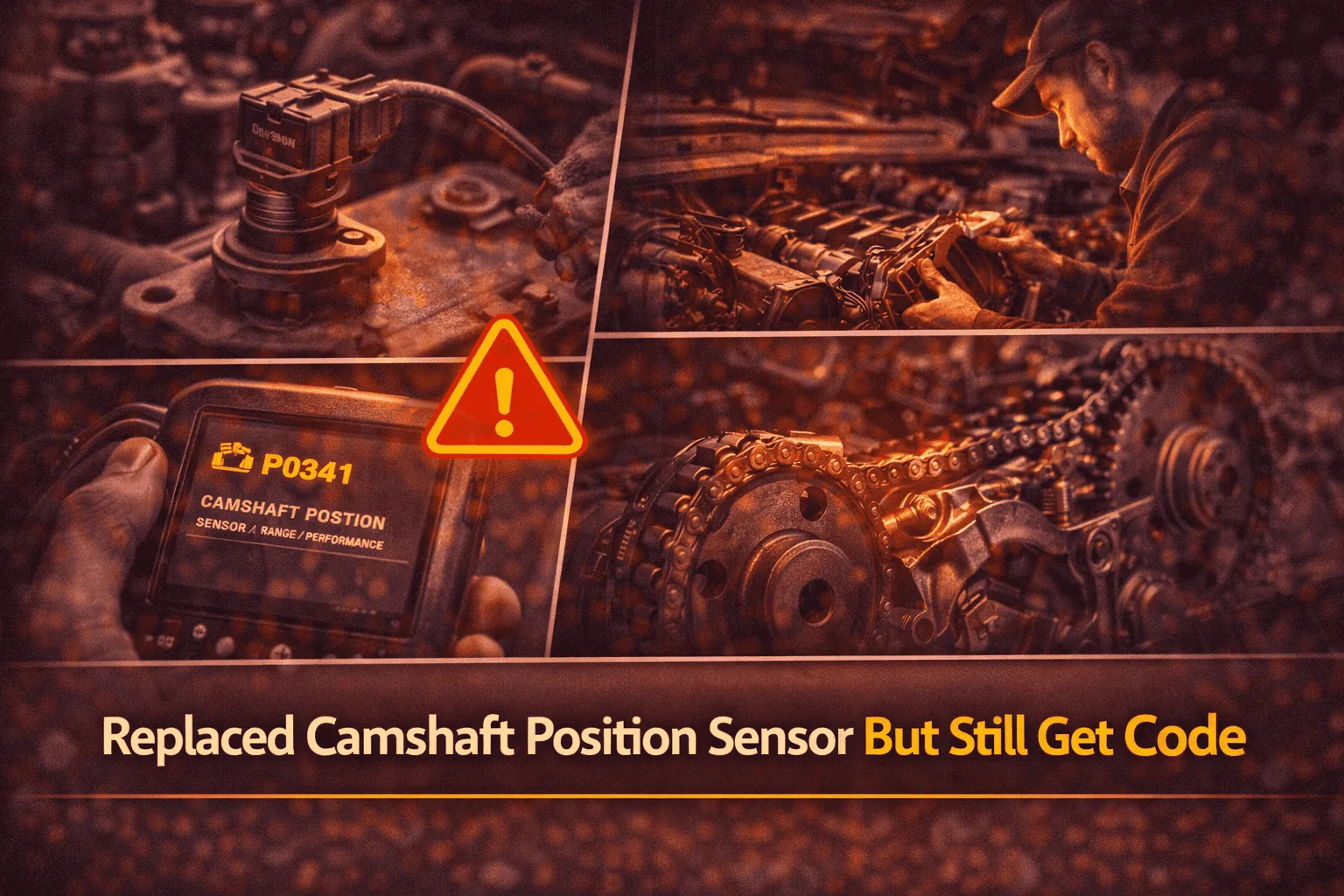
The trouble code P0341 often causes confusion because it can return even after the camshaft position sensor has been replaced. When the same fault reappears with a new sensor installed, it’s natural to question whether the part was defective or if something else is being missed. In most cases, the issue lies elsewhere in the system rather than with the sensor itself.
P0341 does not simply indicate a failed component. It points to a problem with camshaft signal performance or timing accuracy, which can be affected by wiring issues, improper sensor installation, mechanical timing faults, tone wheel problems, or engine control logic. Because multiple conditions can disrupt the signal without triggering other obvious symptoms, the code is frequently misdiagnosed.
The explanation ahead breaks down what P0341 actually represents, why replacing the camshaft sensor alone does not always resolve it, and which related areas are most commonly responsible when the code persists. The focus is on methodical diagnosis—identifying the real cause instead of repeating part replacements that don’t address the underlying fault.
What Code P0341 Really Means (In Plain English)
P0341 doesn’t simply mean “bad camshaft position sensor.”
What it actually means is:
- The signal from the camshaft position sensor is out of range
- Or it doesn’t match what the engine computer expects
In other words, the computer is saying:
“I’m getting camshaft information, but it doesn’t line up with engine timing the way it should.”
That’s an important difference—and it explains why replacing the sensor alone often doesn’t solve the problem.
Why Replacing the Sensor Is Only Step One
The camshaft position sensor is just one part of a bigger system.
That system includes:
- The camshaft itself
- The crankshaft signal
- Timing components
- Wiring and connectors
- The engine computer
If any part of that chain sends confusing information, the computer sets P0341—even if the sensor is brand new.
Why the Code Comes Back Immediately
One thing I noticed early on is how fast the code returns.
If P0341 comes back:
- Immediately after startup
- Or within a short drive
That usually means the issue is constant, not intermittent. The computer is seeing something wrong every time it compares cam and crank signals.
New Sensor Does Not Mean Good Sensor
This one surprised me.
Not all new sensors are created equal.
I’ve seen cases where:
- A brand-new sensor was defective
- The sensor was the wrong type
- The sensor didn’t match the original signal characteristics
Just because it’s new doesn’t guarantee it’s sending a clean, accurate signal.
Why Sensor Brand and Quality Matter
Some engines are very sensitive to signal quality.
Low-quality sensors can:
- Produce weak signals
- Send noisy or unstable data
- Be slightly out of spec
The computer doesn’t care that the sensor is new—it only cares whether the signal looks right.
The Relationship Between Cam and Crank Signals
This is the heart of the issue.
The engine computer constantly compares:
- Camshaft position
- Crankshaft position
If those two signals don’t line up properly, P0341 appears.
Even if:
- The cam sensor works
- The crank sensor works
…if their relationship is off, the code sets.
Why Timing Issues Trigger P0341
This is one of the most common causes after sensor replacement.
If engine timing is off—even slightly—the cam signal arrives at the wrong moment compared to the crank signal.
Causes include:
- Stretched timing chain
- Worn timing components
- Timing belt misalignment
The sensor reports accurately, but the mechanical timing is wrong.
Why the Engine May Still Run Fine
This part is confusing.
Many engines with P0341:
- Start normally
- Idle reasonably well
- Drive without obvious problems
That’s because the timing may only be slightly out of range—enough to confuse the computer, but not enough to cause severe symptoms yet.
Wiring Problems That Mimic a Bad Sensor
After replacing the sensor, wiring becomes my next focus.
Common wiring issues include:
- Broken wires inside insulation
- Corrosion in connectors
- Poor ground connections
- Stretched or pinched harnesses
The sensor may be perfect, but the signal never reaches the computer cleanly.
Why Visual Inspection Isn’t Always Enough
Wiring problems aren’t always visible.
A wire can:
- Look fine from the outside
- Be broken internally
- Fail only when hot
That’s why P0341 can be stubborn and inconsistent in some cases.
Connector Fit and Pin Tension Issues
This is a small detail that causes big headaches.
If connector pins are:
- Loose
- Spread apart
- Slightly corroded
The signal becomes unstable. That instability alone can trigger P0341.
Why the Code Can Appear After Other Repairs
I’ve seen P0341 show up after:
- Engine work
- Timing-related repairs
- Head removal
- Oil leaks near the sensor
Any time something near the camshaft area is disturbed, the risk goes up.
Oil Contamination and Sensor Signals
Some camshaft sensors are sensitive to oil.
If oil:
- Leaks into the sensor
- Contaminates the connector
- Coats the reluctor wheel
Signal quality drops—even with a new sensor installed.
The Role of the Reluctor Wheel (Often Overlooked)
Behind the scenes, the cam sensor reads a physical target—often called a reluctor wheel or trigger.
If that target is:
- Damaged
- Misaligned
- Loose
The sensor can’t produce a clean signal, and P0341 follows.
Why This Is Missed So Often
The reluctor wheel is:
- Hidden inside the engine
- Not replaced during sensor swaps
- Easy to forget
But it’s just as important as the sensor itself.
When the Crankshaft Sensor Is the Real Problem
Here’s something I learned the hard way.
P0341 doesn’t always mean the cam sensor system is at fault.
If the crankshaft signal:
- Is weak
- Is noisy
- Drops out briefly
…the computer can’t correctly compare cam timing, and it flags P0341.
Why Replacing the Cam Sensor Doesn’t Fix Crank Signal Problems
The computer only sees:
- Two signals that don’t match
It doesn’t care which one is wrong. Replacing the cam sensor won’t help if the crank signal is unstable.
Engine Computer Logic (Why It’s So Picky)
Modern engine computers are extremely precise.
They expect:
- Signals at exact intervals
- Consistent timing relationships
- Clean voltage patterns
Anything outside those expectations—even slightly—can trigger a fault.
Why Clearing the Code Doesn’t Help
Clearing the code only resets the warning.
As soon as the engine runs and:
- The cam and crank signals are compared
- The mismatch appears again
…the code comes right back.
When the Code Only Appears at Certain Times
Sometimes P0341:
- Only appears when cold
- Only appears when hot
- Shows up during acceleration
That usually points to:
- Heat-related wiring issues
- Expanding metal affecting timing
- Weak signal strength
Patterns matter a lot here.
How I Narrow Down the Cause Step by Step
When the sensor is already replaced, this is my logical path:
- Confirm the correct sensor is installed
- Inspect the connector and wiring closely
- Look for oil contamination
- Consider timing component wear
- Evaluate crankshaft signal health
This keeps me from guessing and throwing parts at the problem.
Why Timing Chain Stretch Is a Big Suspect
Over time, timing chains:
- Stretch gradually
- Change cam timing slightly
- Stay within drivability limits
But the computer notices the shift long before the driver does.
Why the Engine Doesn’t Always Rattle or Misfire
People expect timing problems to be obvious.
In reality:
- Early timing wear can be quiet
- Performance loss can be subtle
- The code is often the first warning
P0341 is sometimes the engine asking for attention before things get worse.
Software Updates and Relearn Procedures
In some cases, the computer needs:
- A relearn procedure
- Updated calibration
If the engine computer hasn’t adapted to changes, it may continue flagging incorrect timing data.
Why Battery Voltage and Grounds Matter
Low or unstable voltage affects sensors.
Poor grounds or weak voltage can:
- Distort sensor signals
- Create false timing errors
This is especially common after battery replacement or electrical work.
Why This Code Can Be So Frustrating
P0341 is frustrating because:
- It sounds simple
- It rarely is
- It overlaps multiple systems
Replacing the sensor feels logical—but the code often demands deeper thinking.
Common Mistakes I See (And Avoid Now)
Here’s what I no longer do:
- Assume new parts are good
- Ignore wiring because it “looks fine”
- Clear the code repeatedly hoping it disappears
Those approaches waste time and money.
When It’s Safe to Keep Driving (And When It’s Not)
If the engine:
- Runs smoothly
- Starts normally
- Has no severe symptoms
Short-term driving may be okay.
But if you notice:
- Hard starting
- Stalling
- Rough running
It’s time to stop and investigate further.
Why Ignoring P0341 Can Lead to Bigger Problems
Left unchecked, the root cause can worsen.
Timing issues can eventually lead to:
- Poor fuel economy
- Misfires
- Hard starting
- Engine damage in severe cases
The code is an early warning—not something to ignore indefinitely.
A Simple Way I Think About P0341 Now
Here’s how I simplify it:
“The sensor is reporting what it sees—but the engine timing system isn’t matching expectations.”
That mindset shifts focus from parts to systems.
Final Thoughts
Replacing the camshaft position sensor and still seeing P0341 is incredibly frustrating—but it’s also very common. The code isn’t accusing the sensor; it’s questioning the timing relationship inside the engine. Once I understood that, everything changed. I stopped guessing, started checking signals and timing, and finally made progress.
If you’re stuck with this code, don’t feel like you failed by replacing the sensor. You simply completed step one. The next steps are about understanding how the engine communicates with itself—and where that conversation is breaking down.
If you want, I can also help you:
- Narrow down whether it’s wiring, timing, or signal-related
- Decide what to check next based on your symptoms
- Understand why