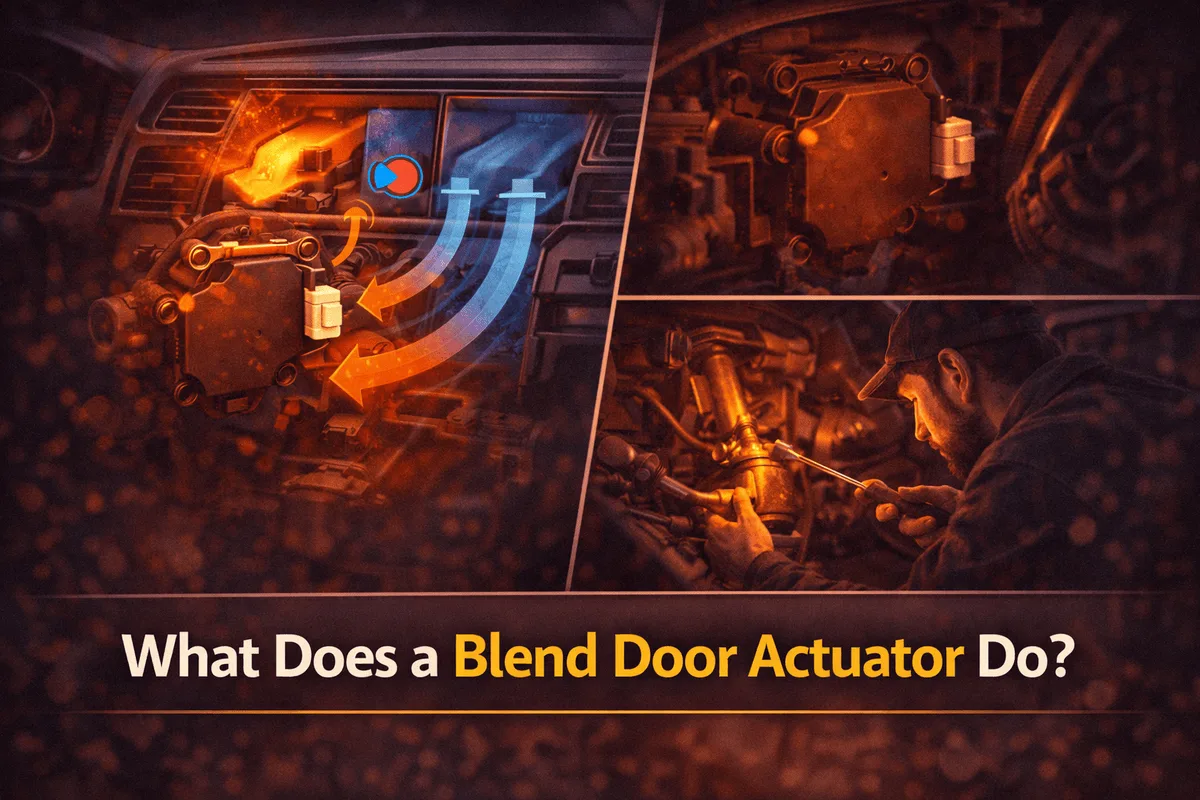
Inconsistent cabin temperatures are often traced back to a small but critical component hidden behind the dashboard: the blend door actuator. When this part fails, the climate system may blow hot air one moment and cold air the next, refuse to change temperature, or produce repetitive clicking or knocking sounds from inside the dash.
Because the engine and air conditioning system can otherwise appear to function normally, the cause is frequently overlooked. The blend door actuator controls how air flows across the heater core and evaporator, determining whether warm or cool air enters the cabin.
When it stops moving correctly—or loses its position feedback—the climate system can no longer respond accurately to temperature settings. This leads to symptoms that feel random but are actually very consistent once the role of the actuator is understood.
The explanation ahead breaks down what a blend door actuator does, how it interacts with the heating and cooling system, the common signs of failure, and why these issues occur. The focus is on clear cause-and-effect so the problem can be recognized early and addressed correctly without unnecessary repairs.
What a Blend Door Actuator Is
A blend door actuator is a small electric motor that controls airflow temperature inside your car.
Its job is simple:
- It moves a door inside the HVAC system
- That door controls how much hot or cold air enters the cabin
When you turn the temperature knob or press the climate buttons, the blend door actuator responds by adjusting that door.
In short, it’s the part that makes your car listen when you ask for warmer or cooler air.
Why It’s Called a “Blend” Door
The name sounds more complicated than it needs to be.
Inside your car’s dashboard is a box that handles air:
- Cold air from the AC system
- Warm air from the heater core
The blend door sits between those two air sources and blends them together to reach the temperature you select.
More cold air = cooler cabin
More warm air = warmer cabin
The actuator moves that door to control the mix.
Where the Blend Door Actuator Is Located
The blend door actuator is usually:
- Behind the dashboard
- Attached to the HVAC housing
- Hidden from view
Depending on the vehicle, it may be:
- Near the center of the dash
- On the driver’s side
- On the passenger side
You usually can’t see it unless panels are removed, which is why many people don’t know it exists until it fails.
What Happens When You Change the Temperature Setting
When you adjust the temperature control:
- The climate system sends a signal
- The blend door actuator receives that signal
- The actuator rotates or slides
- The blend door moves to a new position
- Air temperature changes inside the cabin
All of this happens quietly in the background—until something goes wrong.
Why the Blend Door Actuator Is So Important
Without a working blend door actuator:
- You can’t control cabin temperature properly
- The AC may blow hot air
- The heater may blow cold air
- Temperature changes become unpredictable
The rest of the heating and cooling system can be perfectly fine, but if this actuator fails, comfort disappears.
How Many Blend Door Actuators Does a Car Have?
This surprises a lot of people.
Many cars have:
- More than one blend door actuator
Some systems use:
- One for driver temperature
- One for passenger temperature
- Additional actuators for airflow direction
That’s why one side of the car can blow hot air while the other side blows cold.
Why Dual-Zone Climate Systems Depend on Them
If your car has dual-zone climate control, blend door actuators are working constantly.
Each side:
- Has its own door
- Has its own actuator
- Responds independently
When one actuator fails, only one side may lose temperature control.
Common Symptoms of a Failing Blend Door Actuator
From my experience, these signs show up most often:
- Clicking or knocking noise behind the dashboard
- Air stuck on hot or cold
- Temperature changes don’t respond to controls
- One side of the car feels different from the other
- Airflow works, but temperature doesn’t
These symptoms usually appear gradually, not all at once.
Why the Clicking Noise Happens
That clicking sound is one of the biggest clues.
Inside the actuator are small plastic gears. Over time:
- Gears wear down
- Teeth strip
- The motor keeps trying to move
When it can’t reach the desired position, it clicks repeatedly. That sound often continues every time the car starts or the temperature is adjusted.
Why Airflow Can Be Strong but the Temperature Is Wrong
This confuses many people.
The fan and AC system may be working perfectly, but:
- The blend door is stuck
- Air can’t pass through the right channel
So you get plenty of air—just not the temperature you asked for.
Why the Problem Can Feel Random
A failing actuator may:
- Work sometimes
- Fail other times
- Change behavior with temperature
That’s because worn gears don’t fail cleanly. They slip, catch, and release unpredictably.
What Causes a Blend Door Actuator to Fail
Several factors contribute over time:
- Normal wear and tear
- Heat behind the dashboard
- Cheap plastic internal gears
- Constant small movements
It’s not usually caused by neglect—it’s just a part that eventually wears out.
Why This Part Fails More Often Than You’d Expect
Blend door actuators work constantly:
- Every temperature adjustment
- Every startup in some cars
- Every climate mode change
That constant movement adds up over years of use.
How a Bad Actuator Affects Comfort (Not Safety)
This is important to understand.
A failed blend door actuator:
- Affects comfort
- Does not usually affect engine operation
- Does not make the car unsafe to drive
That’s why people often delay fixing it, even though it’s annoying.
Why Some Cars Blow Hot Air When AC Is On
If the actuator is stuck in a warm position:
- Cold air can’t fully reach the vents
- Warm air mixes in constantly
The AC system may be working hard, but the blend door prevents proper cooling.
Why Some Cars Blow Cold Air When Heat Is On
The opposite happens too.
If the door is stuck in the cold position:
- Hot air from the heater core is blocked
- Cabin never warms up
Again, the system is fine—the door just won’t move.
How to Confirm It’s the Blend Door Actuator
Before assuming anything, We look for patterns:
- Does the noise come from behind the dash?
- Does airflow direction work but temperature doesn’t?
- Does one side behave differently than the other?
When these signs line up, the actuator is usually the culprit.
Can a Blend Door Actuator Be Reset?
In some cases, yes—temporarily.
Disconnecting the battery can:
- Reset actuator positions
- Stop clicking for a while
But if gears are worn, the problem almost always comes back.
Why Replacing the Actuator Fixes the Problem
When replaced:
- New gears move smoothly
- Door positions correctly
- Temperature control returns
The system suddenly feels “normal” again, often immediately.
Why Replacement Can Be Simple or Very Difficult
This depends entirely on the vehicle.
In some cars:
- The actuator is easy to reach
- Replacement is straightforward
In others:
- Dash panels must be removed
- Space is extremely tight
That’s why labor time varies so much.
Can You Drive Without Fixing It?
Yes, you usually can.
But you’ll deal with:
- Uncomfortable temperatures
- Foggy windows in cold weather
- Constant clicking noises
It’s not dangerous, just frustrating.
Why This Part Is Often Misdiagnosed
Because it’s hidden, people often assume:
- The AC is bad
- The heater core is failing
- The climate control module is broken
In reality, the blend door actuator is often the simplest explanation.
What the Blend Door Actuator Does Not Do
It’s also important to be clear about what it doesn’t control:
- It doesn’t cool the air
- It doesn’t heat the air
- It doesn’t control fan speed
It only decides how much hot and cold air mix together.
Why the Name Sounds Scarier Than It Is
“Blend door actuator” sounds complex, but the concept is simple.
It’s just:
- A motor
- Moving a door
- To control temperature
Once you picture that, everything else makes sense.
My Personal Way of Explaining It
Here’s how I explain it to friends:
“The blend door actuator is the part that decides how warm or cold the air coming out of your vents actually feels.”
That one sentence clears up most confusion.
When It’s Time to Fix It
I usually recommend addressing it when:
- The noise becomes constant
- Temperature control is unusable
- Comfort is seriously affected
Waiting won’t usually damage other parts, but it will test your patience.
Final Thoughts
The blend door actuator may be small and hidden, but it plays a huge role in everyday comfort. When it works, you never think about it. When it fails, it quickly becomes impossible to ignore. Understanding what it does—and why it fails—takes a lot of the mystery and frustration out of climate control problems.
Once you know this part exists, many strange heating and cooling symptoms suddenly make sense.