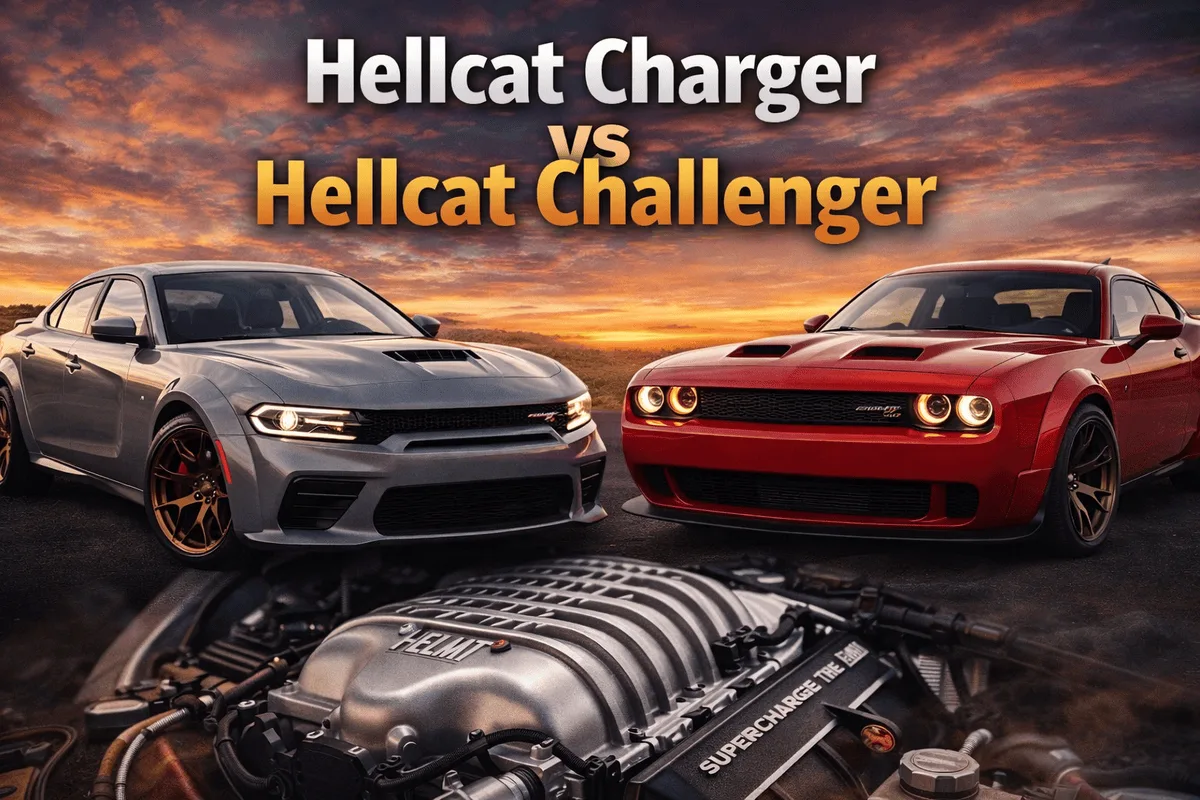
The Hellcat versions of the Dodge Charger and Dodge Challenger sit at the top of modern American muscle, but they appeal to different kinds of drivers. On paper, they appear closely related—both powered by the same supercharged 6.2-liter HEMI V8 and built to deliver extreme straight-line performance. In practice, their personalities diverge in meaningful ways.
The Charger Hellcat approaches performance with a more versatile mindset. Its four-door layout, longer wheelbase, and sedan proportions make it feel suited to daily use, road trips, and carrying passengers without giving up speed. The Challenger Hellcat, by contrast, leans heavily into traditional muscle car identity, emphasizing presence, aggressive styling, and a more focused driving experience.
Beyond body style, differences show up in handling balance, interior space, visibility, ride behavior, and how each car fits into real-world ownership. These factors matter just as much as horsepower when choosing between them.
The comparison that follows breaks down where the Charger Hellcat and Challenger Hellcat align, where they differ, and how those differences influence comfort, performance feel, practicality, and long-term satisfaction—so the choice is based on lifestyle and priorities rather than horsepower alone.
A Brief Look at Their Common Heart
Before diving into differences, it helps to understand the core both cars share. Whether it’s the Charger or the Challenger in Hellcat form, they’re powered by the same supercharged 6.2-liter V8 engine.
Depending on the exact year and variant, this engine typically makes well over 700 horsepower straight from the factory. That means blistering acceleration, huge torque, and a soundtrack that’s unmistakably American performance.
Because they share the same engine and many of the same components, a lot about how they feel when they accelerate is similar.
However, the way that power gets translated into motion and emotion varies once you start driving, due in large part to their body styles, weight distribution, and design intentions.
How They Look and Feel Outwardly: Personality on Wheels
If you park a Hellcat Charger next to a Hellcat Challenger, they don’t look like siblings. The Charger’s stance is wider, lower, and more mature. It blends aggression with a kind of practical athleticism.
The four doors add a sense of utility and everyday readiness. People walking by tend to respect it with a nod, especially when the widebody package fills the wheel arches.
The Challenger, on the other hand, looks like a muscle car from the moment you see it. Its long hood, short rear deck, and squat shoulders give it a classic, almost retro vibe.
Even though it’s built with modern engineering, it wears its muscle car heritage proudly. The Challenger doesn’t pretend to be subtle. It wants attention.
They are equally striking, but in different ways. The Charger is more poised and purposeful, while the Challenger is bold and unapologetic.
Size, Doors, and Everyday Practicality
One of the first real differences you notice is size and accessibility. The Charger’s four doors make it much easier to live with day to day, especially if you have people joining you regularly. Getting in and out of the back seat is simple, and there’s space for cargo that’s actually useful beyond a weekend trip.
The Challenger’s two doors mean you have to get creative when helping passengers in the back, and the rear seats themselves can feel tighter depending on your height. However, that doesn’t make them useless.
They’re adequate for short trips with friends or family, but long rides back there aren’t as comfortable as in the Charger.
If your daily life involves ferrying people or you simply enjoy convenience without compromise, the Charger wins that category. If you’re someone who prioritizes style and you don’t mind the trade-off, the Challenger still delivers plenty of space for most situations.
How They Drive: More Than Power, It’s the Feel
Both cars deliver monstrous power, but how they apply it feels different on the road and track.
The Hellcat Charger
The Charger feels planted right from the start. Its wider footprint and four-door layout give it a sense of grounded confidence. On highways and long sweeping roads, it feels stable.
The steering is direct and composed, and you can feel the car’s mass balanced between performance and composure.
We often describe driving the Charger as being in command of a powerful machine that knows its limits. It invites confident handling and doesn’t feel restless, even when you push it.
The added weight from the larger body doesn’t dull its performance; it actually gives it a stable, heavy-machine feel that many drivers appreciate.
The Hellcat Challenger
The Challenger feels more like a traditional muscle car—raw and eager. It doesn’t hide the fact that it’s there to perform.
Because of its two-door body and slightly different weight distribution, it feels more playful in straight-line acceleration. On winding roads, it doesn’t turn in as quickly as the Charger, but that’s not really the point of its design.
When you nail the throttle in the Challenger, you feel that power surge with a kind of visceral excitement that’s hard not to love. It feels like a classic American muscle car with modern refinement. If the Charger’s driving feel is measured strength, the Challenger’s is unfiltered energy.
Seating Position: A Subtle but Important Feeling
Inside the Charger, you sit with a sense of space and visibility that’s closer to a large sedan. You have a commanding view ahead, with controls that feel natural and easy to reach.
The interior feels roomy, and the layout reinforces the idea that this is a car you can live with as well as drive hard.
In the Challenger, you sit lower and the cabin feels more intimate. It reinforces the feeling that you’re in a performance car first and foremost.
The space is comfortable, but the seating position and interior proportions make it feel more like a driver-oriented cockpit than a blend of performance and practicality.
Every person feels comfort differently, but most find the Charger easier to settle into for longer drives, while the Challenger keeps you engaged and close to the machine.
Performance Numbers: Close, But With Character
On paper, both cars are very close in performance. They accelerate blisteringly, reach high top speeds, and handle power that most cars only dream of. However, when you look deeper at real-world testing, you can see slight tendencies:
- Acceleration: Both cars rocket forward, often hitting 0–60 in the same ballpark depending on tires, conditions, and driver skill. The Challenger sometimes feels that split second quicker because of its weight distribution and shorter wheelbase.
- Quarter-mile times: Again, nearly identical. Some tests favor the Challenger by a fraction, some favor the Charger. It’s close enough that experience and conditions matter more than raw numbers.
- Handling: The Charger’s extra size and weight give it a steadier feel in fast, sweeping corners. The Challenger feels more playful, but it’s not as composed in tight, technical sections.
These differences aren’t huge, but they’re enough that you feel them in daily driving or spirited runs.
Interior Quality and Comfort: Muscle Meets Modernity
Both cars bring a surprisingly refined interior compared to classic muscle cars of old. Modern Hellcats feel like premium vehicles inside, with big screens, intuitive controls, and supportive seats. Still, there are subtle differences.
The Charger’s interior feels more spacious. Rear legroom is genuinely usable for adults, and the overall layout feels like a performance sedan that’s grown up. The trunk space is also more accommodating thanks to the four-door design.
The Challenger’s interior leans more toward a classic coupe feel. It’s comfortable, supportive, and stylish, but the space behind the front seats is better suited for occasional passengers or shorter trips.
The Challenger’s trunk is still useful, but not as easy to access or as large as the Charger’s.
When we take long journeys in the Charger, Notice less fatigue and more cargo room for bags and gear. In the Challenger, long drives feel more engaging, but the space trade-off becomes noticeable.
Fuel Use and Daily Life
Neither car is what you’d call “efficient,” but in everyday life the Charger’s larger body and slightly different aerodynamics can lead to fuel figures that are just a touch less thirsty than the Challenger in similar driving. It’s not a big gap, but over time it becomes noticeable at the pump.
Both cars drink premium fuel and both lose mileage quickly when you enjoy the engine’s capabilities. If low fuel cost is a priority, neither of these will feel friendly.
But if you balance spirited driving with calm cruising, the Charger’s slightly smoother power delivery can help conserve fuel just a bit more.
Noise, Vibration, and That Signature Soundtrack
One of the joys of both Hellcats is the sound. That supercharged V8 has a roar, bark, and rumble that most performance cars would envy. But the way that soundtrack presents itself differs slightly.
In the Challenger, the sound feels more direct and raw. It’s like the engine is in the room with you, proudly announcing itself. On acceleration, it rises with excitement.
In the Charger, the sound is still thrilling, but it blends more smoothly with the rest of the cabin experience. You hear the growl, but it feels a bit more integrated into the overall driving environment.
Some people prefer the unfiltered noise of the Challenger. Others like the Charger’s balance between drama and refinement. I’ve found myself enjoying both, depending on my mood.
Handling Everyday Life: Parking, Visibility, and Ease
Because of their body styles, these cars behave differently in traffic and tight spaces.
The Charger, with its four doors and wider footprint, feels a little easier to place in parking lots. Visibility is strong in most directions, and the rear doors make it simple to load people or gear.
The Challenger’s wider stance and lower roofline can make it feel larger than it actually is when you’re navigating tight spots. I’ve found that the Challenger asks a bit more attention from the driver in parking lots and crowded streets.
Both cars have parking aids and sensors that help, but the Charger’s design feels more natural for everyday life without constant correction.
Insurance, Costs, and Practical Considerations
Because these cars have similar performance capabilities, insurance costs for both are typically high compared to average vehicles. The Challenger sometimes edges a bit higher simply because two-door cars with high performance are statistically more likely to be in spirited scenarios that insurers don’t favor.
Maintenance costs, fuel, and tires are similar for both. They use performance tires and premium brakes, and both benefit from careful servicing. Neither feels “expensive to own” in the way exotic cars do, but they are performance cars, and that comes with predictable costs.
Resale and Long-Term Ownership
Both Hellcats hold value better than many muscle cars because they’re iconic and beloved. The Charger’s four-door practicality appeals to a broader set of buyers, which can help resale down the road. The Challenger appeals strongly to enthusiasts and collectors who prize the coupe form.
If long-term value is important to you, consider how you’ll use the car and who might want it after you. The Charger may attract buyers who want performance with practicality, while the Challenger attracts purists who want pure muscle car form.
Choosing Between Them
When friends ask me which one to buy, start by asking about lifestyle and personality.
If you want:
- Practicality with insane power
- Easier everyday use
- More space for passengers and cargo
Then the Charger usually makes more sense.
If you want:
- A classic muscle car aura
- Two-door coupe presence and drama
- That visceral “this looks and feels like a performance machine” vibe
Then the challenger often wins.
There’s no wrong choice here. They’re both remarkable cars. But the right one for you depends on how you live and what feels right when you sit in the driver’s seat.
Bottom Line
At the end of the day, the Hellcat Charger and Hellcat Challenger are variations on a theme of unbridled power, bold design, and unapologetic performance. They share the same beating heart, but they express it in ways that suit different tastes and needs.
I’ve driven both in quiet moments and in moments of pure exhilaration. I’ve felt the Charger’s composed strength and the Challenger’s raw energy.
Neither disappointed. Each made me appreciate the thought that goes into building performance cars that are both capable and entertaining.
Whether you choose four doors or two, practicality or pure style, you’re choosing a car that stands out—not because it tries to, but because it simply is. And that’s a rare thing in the automotive world.
If you’d like to go deeper on specific years, packages, or what it’s like to live with one of these on a daily basis, just let me know. I’d be glad to dig into that with you.