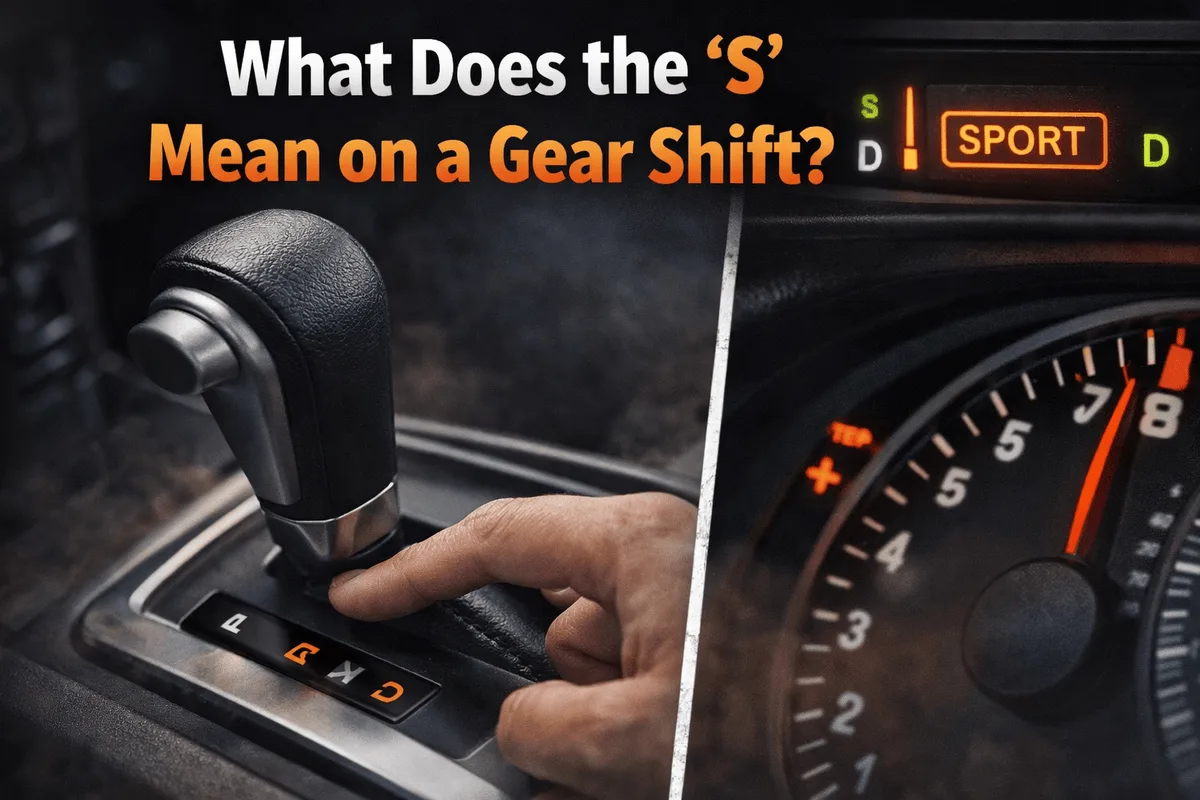
Many automatic vehicles include an “S” position on the gear selector, yet it’s one of the least explained features in modern cars. Drivers often notice it sitting beside Drive, but few are told what it actually does or when it’s meant to be used. As a result, it’s frequently ignored or misunderstood.
The “S” setting is not decorative, nor is it reserved for performance enthusiasts. It alters how the transmission behaves by holding gears longer, allowing higher engine speeds, and changing throttle response. These adjustments can make the car feel more responsive in certain situations—but they can also be unnecessary or counterproductive in others.
Knowing when to use this mode matters. It affects fuel use, engine braking, acceleration behavior, and overall drivability depending on road conditions and driving goals.
The explanation that follows clarifies what the “S” position means, how it changes transmission behavior, where it provides real benefits, and when it’s better left unused. The focus is on practical use, not myths or assumptions, so drivers can decide whether it fits their everyday driving needs.
The short answer: what “S” stands for
In most cars, S means “Sport.”
But that one word doesn’t tell the full story. Sport mode doesn’t magically turn your car into a race machine. It changes how the transmission and engine behave, prioritizing responsiveness instead of efficiency.
Think of it as switching your car’s mindset from relaxed to alert.
Why manufacturers include S mode at all
Cars are designed to balance comfort, fuel efficiency, and performance. Normal Drive mode (D) is tuned for smoothness and lower fuel use. It shifts early, keeps engine speed low, and avoids unnecessary stress.
S mode exists because:
- Drivers sometimes need quicker response
- Certain conditions benefit from holding gears longer
- Some people want more control without going fully manual
It’s a middle ground between everyday driving and full manual control.
What actually changes when shift into S
This is where things get interesting. When move the shifter into S, several subtle but important changes happen behind the scenes.
Higher engine revs
The transmission delays upshifts. Instead of changing gears early, it lets the engine rev higher before shifting.
Why this matters:
- More power is available instantly
- Throttle response feels sharper
Quicker downshifts
In S mode, the car downshifts more eagerly when we press the accelerator.
This means:
- Faster acceleration without waiting
- Less hesitation during overtakes
Engine braking increases
When you lift your foot off the accelerator, the car slows down more noticeably.
This helps:
- Maintain control on downhill roads
- Reduce brake usage in some situations
Throttle sensitivity changes
The pedal often feels more responsive. Small inputs create quicker reactions.
It doesn’t add power—it changes how quickly power is delivered.
What S mode does NOT do
This is just as important as what it does.
S mode does not:
- Increase engine horsepower
- Modify the engine mechanically
- Damage the transmission by itself
- Override safety systems
It works within the car’s normal operating limits.
Is S mode the same as manual mode?
Not exactly.
Some cars have:
- S mode only
- S mode + manual shifting
When manual shifting is available, S mode often allows the driver to choose gears using paddles or the shifter, while still preventing harmful mistakes.
Without manual control, S mode still shifts automatically—it just uses a sportier logic.
Why the car feels louder in S mode
Many drivers think something is wrong the first time they use S.
Here’s why the engine sounds louder:
- Higher RPM means more engine noise
- Exhaust note becomes more noticeable
- The engine stays in lower gears longer
This is normal behavior, not strain.
When to use S mode
Highway merging
This is my favorite use case. S mode gives instant response without flooring the pedal.
Overtaking slower vehicles
Faster downshifts make passing smoother and safer.
Hilly or winding roads
Holding gears helps maintain momentum and control.
Occasional spirited driving
Sometimes just want the car to feel more connected—and S mode delivers that.
When to avoid using S mode
There are times when S mode offers no real benefit.
Heavy traffic
Constant stop-and-go makes higher revs unnecessary and annoying.
Long, relaxed cruising
At steady speeds, D mode is smoother and quieter.
When fuel efficiency matters
S mode almost always uses more fuel because the engine runs at higher speeds.
Does S mode hurt fuel economy?
Yes—usually.
Because:
- The engine stays in lower gears
- RPM stays higher
- Fuel is burned more aggressively
The difference may be small on short drives but noticeable over time.
Can using S mode damage my car?
This is one of the most common fears—and one of the biggest myths.
Using S mode:
- Does not harm the engine
- Does not wear out the transmission abnormally
- Does not void warranties
Manufacturers design it to be used safely. Problems only arise from aggressive driving habits, not the mode itself.
S mode vs Eco mode: opposite philosophies
If your car has Eco mode, it’s the complete opposite of S.
Eco mode:
- Upshifts early
- Reduces throttle sensitivity
- Focuses on fuel savings
S mode:
- Holds gears longer
- Sharpens response
- Focuses on performance
Neither is better—they’re just tools for different needs.
Why some cars label it differently
Not every car uses the letter S, but the idea is similar.
You might see:
- Sport
- Dynamic
- Performance
- Drive Mode selector
The behavior is usually the same: quicker response and longer gear holding.
What happens if You leave the car in S all the time?
Technically, nothing bad happens. Practically, a few things change.
You may notice:
- Slightly higher fuel costs
- Louder engine sounds
- More frequent gear changes
Some drivers enjoy this. Others find it tiring. It’s a personal choice.
S mode in automatic vs CVT transmissions
S mode behaves a little differently depending on transmission type.
Traditional automatic
- Holds actual gears longer
- Delays upshifts
CVT
- Simulates gear steps
- Keeps engine in higher power range
The feeling is different, but the goal is the same.
Is S mode useful in bad weather?
This depends on the situation.
Pros:
- Better engine braking
- Improved control on descents
Cons:
- More aggressive response can reduce traction on slippery surfaces
Common myths about S mode
“S stands for snow.”
No. Snow mode is different and usually labeled separately.
“S mode is only for racing.”
Not true. It’s for responsiveness, not racing.
“Using S mode stresses the engine.”
Engines are built to operate safely at higher RPMs.
Why so many drivers never use it
From what I’ve seen, most drivers:
- Don’t know what it does
- Are afraid of damaging the car
- Don’t feel the need
Once you understand it, S mode becomes less mysterious and more useful.
How to try S mode safely for the first time
If you’ve never used it, here’s how we suggest trying it:
- Choose an open road
- Shift from D to S smoothly
- Drive normally at first
- Notice throttle response and engine behavior
- Switch back to D when you’re done
No aggressive driving required.
Does S mode affect engine life long-term?
Used responsibly, no.
What affects engine life more:
- Poor maintenance
- Skipping oil changes
- Overheating
- Aggressive driving habits
S mode itself is neutral—it’s how you drive that matters.
Final thoughts: it’s not a mystery button
The S on your gear shift isn’t something to fear or ignore. It’s simply another way your car adapts to different driving needs. Once you understand what it changes—and what it doesn’t—you can decide when it makes sense for you.
If you want, you can tell me your car model and transmission type, and I’ll explain exactly how S mode behaves in your vehicle and when it’s most useful.