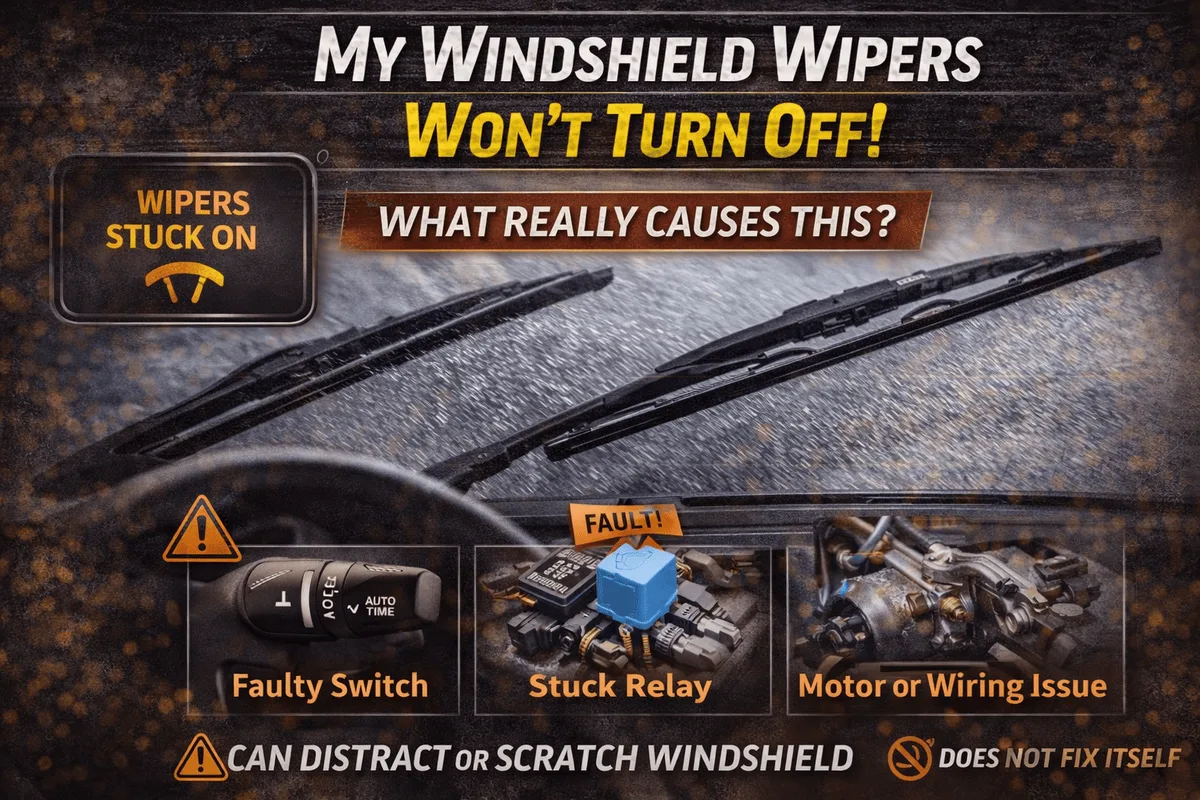
Windshield wipers are designed to operate only when commanded, so when they continue moving on a dry windshield, it immediately signals a control or electrical fault. Even though the issue may seem minor at first, constant wiper operation can quickly become distracting, damage the wiper blades, and scratch the glass—especially during night driving or long trips.
This behavior is usually caused by a malfunction in the wiper switch, relay, control module, or motor circuitry rather than the blades themselves. Because multiple components work together to control wiper timing and parking position, a single failure can cause the system to ignore off commands entirely.
The explanation that follows outlines the most common reasons windshield wipers won’t turn off, how each component contributes to the problem, and which checks can be done safely before seeking professional repair. The focus is on restoring proper operation while preventing unnecessary damage or guesswork.
First, Let’s Be Clear — This Is a Common Problem
If your windshield wipers won’t turn off, you’re not dealing with something rare or strange.
I’ve seen this happen on:
- Older cars
- Newer cars
- Cars with basic wipers
- Cars with rain-sensing wipers
The reason it feels alarming is because the wipers are electrically controlled, and when electronics act up, it feels unpredictable. But in reality, there are only a handful of common causes.
How Windshield Wipers Are Supposed to Work (Simple Explanation)
Before diagnosing the problem, it helps to understand how the system normally works.
A windshield wiper system includes:
- A wiper switch or stalk
- A control module or simple wiring circuit
- A relay
- A wiper motor
- Sometimes a rain sensor
When you turn the switch off:
- Power to the motor should stop
- The motor parks the wipers in their resting position
- Everything goes quiet
If the wipers won’t turn off, something in that chain is still sending power when it shouldn’t.
The Most Common Reasons Windshield Wipers Won’t Turn Off
Let’s go through the real-world causes, starting with the ones we see most often.
1. Faulty Wiper Switch (Very Common)
This is the most frequent culprit.
The switch you use to control the wipers can wear out internally over time. Inside that switch are small electrical contacts. When they fail:
- The switch may send power even when set to “off”
- The system thinks you’re still asking for wipers
Signs it’s the switch:
- Wipers keep running no matter the setting
- Changing speeds doesn’t behave normally
- Turning the switch feels loose or inconsistent
This problem often starts intermittently before becoming constant.
2. Bad Wiper Relay
The relay acts like an electrical gate. It opens and closes to send power to the motor.
When a relay fails:
- It can get stuck in the “on” position
- Power keeps flowing even when the switch is off
Clues pointing to a relay issue:
- Wipers stop only when the car is turned off
- Wipers run at one speed only
- Problem appears suddenly
Relays are small but powerful troublemakers.
3. Wiper Motor Park Switch Failure
Inside the wiper motor is something called a park switch. Its job is to tell the motor when to stop and return the wipers to their resting position.
When this switch fails:
- The motor doesn’t know when to stop
- Wipers continue cycling endlessly
Symptoms often include:
- Wipers won’t stop until the ignition is off
- Wipers stop in odd positions
- Wipers behave worse over time
This issue is more common as vehicles age.
4. Wiring Problems or Short Circuits
Wiring issues are less common, but they do happen.
Possible causes include:
- Chafed wires
- Moisture intrusion
- Corrosion in connectors
When wires short:
- Power bypasses the switch
- The motor receives constant voltage
This often happens after:
- Heavy rain
- Car washes
- Engine bay work
Electrical problems can feel random, but they usually follow a pattern.
5. Rain-Sensing Wiper System Malfunction
If your car has automatic or rain-sensing wipers, things get a little more complex.
These systems use sensors and control modules. When something goes wrong:
- The system may think it’s always raining
- Wipers turn on automatically and won’t stop
Common triggers:
- Dirty or damaged windshield sensor area
- Software glitches
- Sensor calibration issues
Turning off the automatic wiper setting sometimes helps confirm this.
6. Body Control Module (Less Common, More Serious)
On newer cars, the wipers are often controlled by a central computer.
If this module malfunctions:
- Wipers may behave unpredictably
- Other electrical oddities may appear
This is less common, but when it happens, professional diagnosis is usually required.
What to Do First When Wipers Won’t Turn Off
Before panicking or booking a repair, go through a simple checklist.
Step 1: Turn the Car Completely Off
If the wipers stop when the car is off, that tells me:
- The motor isn’t mechanically stuck
- The issue is electrical
Step 2: Try All Switch Positions
Move the switch through:
- Off
- Intermittent
- Low
- High
If nothing changes, the switch becomes suspect.
Step 3: Disable Automatic Wiper Mode
If the car has rain-sensing wipers, turn that feature off completely and test again.
Can Pulling a Fuse Stop the Wipers Temporarily?
Yes—and sometimes this is a lifesaver.
If the wipers won’t turn off:
- Pulling the wiper fuse stops them
- This prevents windshield damage
- It buys time until repairs
However, this is a temporary solution, not a fix.
Is It Safe to Drive Like This?
Short answer: not ideal.
Driving with wipers stuck on can:
- Scratch a dry windshield
- Wear out wiper blades quickly
- Distract you while driving
If it’s raining and you need them, it’s manageable. If it’s dry, it’s better to stop the wipers temporarily.
Why This Problem Often Gets Worse Over Time
Many people tell me:
“At first it only happened sometimes.”
That’s normal.
Electrical components often fail gradually:
- Contacts degrade
- Resistance increases
- Failure becomes constant
Ignoring early signs usually leads to full-time malfunction.
Why Turning the Car Off and On Sometimes “Fixes” It
This temporary fix happens because:
- Power resets briefly
- Modules reboot
- A stuck relay may release
But if the problem keeps returning, it’s only a matter of time before it becomes permanent.
Can Weather Trigger This Problem?
Absolutely.
Common weather-related triggers include:
- Heavy rain
- Snow
- Freezing temperatures
- High humidity
Moisture and temperature changes stress electrical parts more than most people realize.
When It’s Most Likely the Wiper Motor
Suspect the motor when:
- Wipers won’t park correctly
- They stop in random positions
- They only stop when power is cut
The motor isn’t just a motor—it contains internal logic.
What a Repair Shop Usually Checks
When you take the car in, a technician typically:
- Tests the wiper switch
- Checks the relay
- Verifies motor operation
- Inspects wiring
- Scans control modules if needed
The goal is to find where power is being sent when it shouldn’t be.
Typical Repair Outcomes
Based on what I’ve seen, repairs usually fall into these categories:
- Wiper switch replacement
- Relay replacement
- Wiper motor replacement
- Sensor recalibration
- Wiring repair
Most of these are straightforward once diagnosed correctly.
Why Guessing Can Get Expensive
Replacing parts without diagnosis can lead to:
- Wasted money
- Repeat repairs
- Ongoing frustration
Electrical issues require logic, not guesswork.
How to Prevent Wiper Problems Now
Here’s what to do to reduce the risk:
- Avoid forcing frozen wipers
- Keep the windshield clean
- Replace worn blades promptly
- Address electrical issues early
Small habits go a long way.
Common Myths About Stuck Windshield Wipers
Let’s clear a few things up.
- “The motor is always bad” — Not true
- “It’s just a fuse issue” — Rarely
- “It will fix itself” — Usually not
- “New cars don’t have this problem” — They do
Understanding helps you respond calmly.
My Honest Advice If Your Wipers Won’t Turn Off
If your windshield wipers won’t turn off:
- Don’t ignore it
- Don’t panic
- Don’t keep driving on a dry windshield
Take a few minutes to observe the behavior. Those details make diagnosis much easier and cheaper.
Final Thoughts — Annoying, But Fixable
When windshield wipers won’t turn off, it feels like the car is misbehaving on purpose. But in reality, it’s usually a simple electrical issue with a logical cause. I’ve learned that once you understand how the system works, the problem becomes far less intimidating.
This issue is rarely dangerous, rarely catastrophic, and very often fixable without major expense—especially if caught early. The key is paying attention to patterns, responding calmly, and fixing the root cause instead of living with the annoyance.