Modern vehicles use several hydraulic fluids that appear similar at a glance but serve very different purposes. Power steering fluid and brake fluid are two of the most commonly confused, largely because they’re both stored under the hood, both influence vehicle control, and both play critical roles in how a car responds to driver input.
Despite those surface similarities, these fluids are engineered for entirely different systems with different temperatures, pressures, and material requirements. They are not interchangeable. Using the wrong fluid—even once—can damage seals, compromise braking performance, and create serious safety risks that aren’t always obvious immediately.
This explanation clarifies what power steering fluid and brake fluid actually do, how their properties differ, why mixing them causes harm, and how to identify each reservoir correctly. The focus is on prevention and understanding, helping drivers avoid a costly and potentially dangerous mistake before it happens.
The Short, Clear Answer
Let me get straight to the point first:
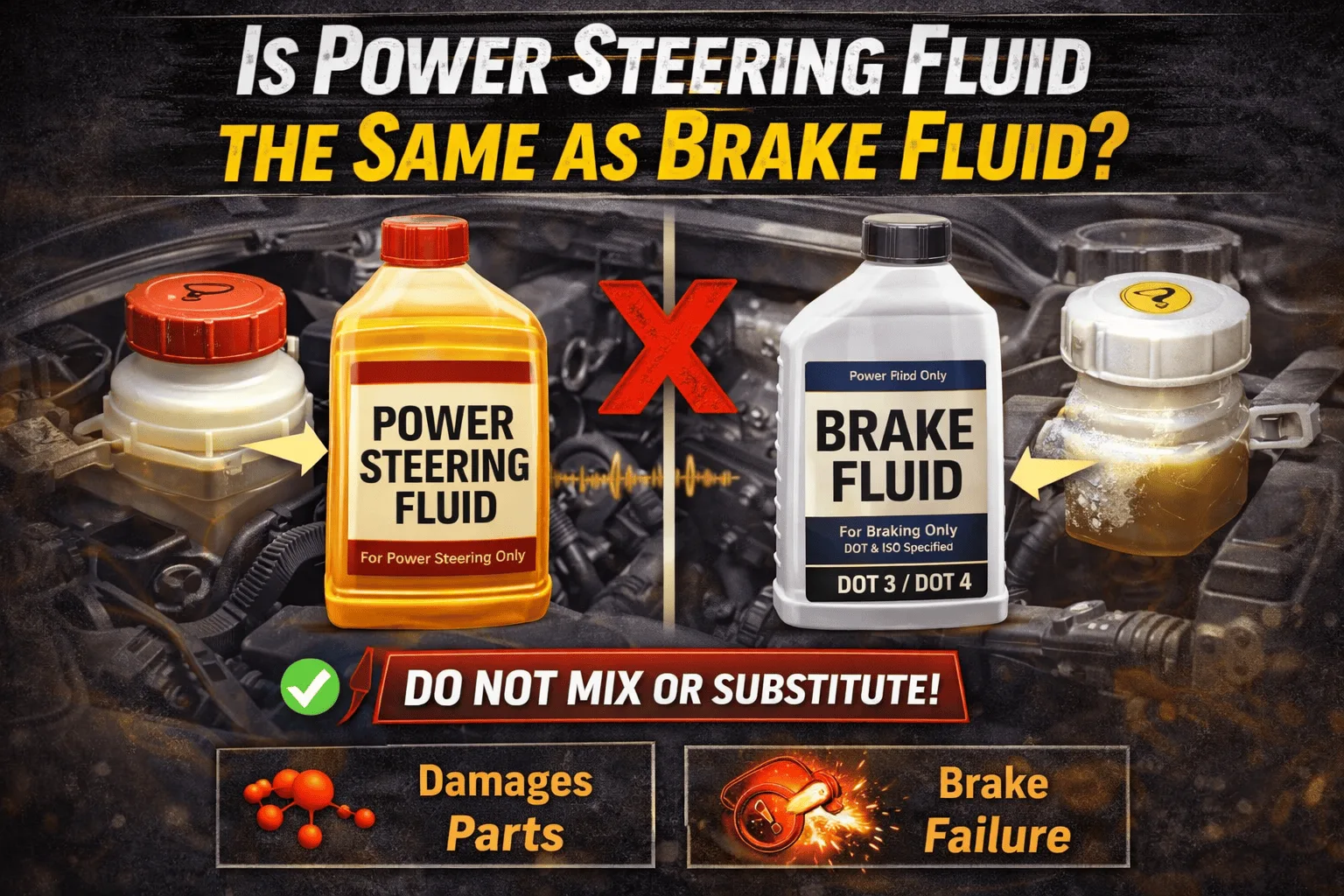
No, power steering fluid and brake fluid are NOT the same, and they should never be mixed or substituted for one another.
Even though both are hydraulic fluids, they are designed for completely different systems, pressures, temperatures, and materials.
Now let’s slow down and explain why.
Why This Question Comes Up So Often
Don’t blame anyone for being confused. Here’s why this mix-up happens:
- Both fluids are liquids used in hydraulic systems
- Both live in small plastic reservoirs
- Both affect how the car responds to driver input
- Both are often clear or light-colored
From the outside, they look similar. Inside the car, they live in very different worlds.
What Power Steering Fluid Actually Does
Power steering fluid exists to make steering easier.
Its job is to:
- Transfer hydraulic pressure
- Assist steering movement
- Lubricate internal components
- Protect seals and pumps
When you turn the steering wheel, this fluid helps reduce the effort needed, especially at low speeds.
Power steering systems:
- Operate at relatively lower pressures
- Are designed for smooth, constant movement
- Depend heavily on lubrication
The fluid is part lubricant, part hydraulic medium.
What Brake Fluid Actually Does
Brake fluid has a much more serious responsibility.
Its job is to:
- Transfer braking force instantly
- Withstand extreme pressure
- Handle very high temperatures
- Remain stable under stress
When you press the brake pedal, brake fluid transfers that force directly to the brakes at each wheel.
Brake systems:
- Operate under extremely high pressure
- Generate intense heat
- Must respond instantly, every time
Brake fluid is designed for precision and safety, not lubrication.
The Biggest Difference: Pressure and Heat
This is where things really separate.
Power Steering Fluid
- Designed for moderate pressure
- Focused on lubrication and smooth motion
- Works at lower temperatures
Brake Fluid
- Designed for extreme pressure
- Built to resist boiling
- Must perform perfectly in emergencies
Brake fluid can reach temperatures that power steering fluid was never designed to handle.
Why Power Steering Fluid Cannot Replace Brake Fluid
Putting power steering fluid into a brake system is dangerous.
Here’s why:
- It can boil under braking heat
- It compresses differently
- It can cause brake fade
- It can damage seals
If brake fluid boils, you lose braking force. That’s not an inconvenience—it’s a safety risk.
Why Brake Fluid Cannot Replace Power Steering Fluid
The reverse is just as bad.
Brake fluid:
- Is more aggressive chemically
- Can damage power steering seals
- Lacks proper lubrication
- Can cause pump failure
Power steering systems rely on lubrication to survive. Brake fluid doesn’t provide that protection.
The Chemistry Difference (In Simple Terms)
Won’t go deep into chemistry, but here’s the easy version.
Power steering fluid is:
- Oil-based or synthetic
- Designed to lubricate moving parts
Brake fluid is:
- Glycol-based (in most cars)
- Designed to resist heat and moisture
They are chemically incompatible.
What Happens If You Mix Them (Real-World Consequences)
This is where things get expensive.
If power steering fluid enters the brake system:
- Rubber seals can swell
- Internal components degrade
- Braking performance becomes unpredictable
- The entire system may need flushing or replacement
If brake fluid enters the power steering system:
- Seals can break down
- Pumps can fail
- Steering may become noisy or stiff
In many cases, a full system rebuild is required.
Why Brake Fluid Is Hygroscopic (And Why That Matters)
Brake fluid absorbs moisture from the air. This is intentional.
Why?
- It prevents water pooling
- It keeps braking consistent
- It protects internal components
Power steering fluid does not behave this way.
If moisture entered a power steering system, it would cause corrosion and failure.
Why Power Steering Fluid Needs Lubrication Properties
Power steering systems have:
- Pumps
- Bearings
- Moving vanes
- Seals under constant motion
Without lubrication:
- Components wear quickly
- Noise increases
- Failure follows
Brake fluid isn’t designed to lubricate like this.
How the Reservoirs Are Different (Visual Clues)
Power Steering Reservoir
- Often labeled “Power Steering”
- May have a dipstick
- Usually near the belt-driven pump
Brake Fluid Reservoir
- Mounted on the master cylinder
- Usually near the firewall
- Often labeled DOT specification
If you’re ever unsure, stop and read the cap.
Why “Universal Fluids” Add to the Confusion
Some power steering fluids say they’re compatible with:
- Multiple systems
- Different manufacturers
This does not mean they are compatible with brake systems.
Brake fluid is never “universal” with other fluids.
Can Using the Wrong Fluid Be Fixed?
Sometimes—but not always easily.
If caught immediately:
- System may be flushed
- Damage might be limited
If driven after mixing:
- Rubber components swell
- Internal damage spreads
- Replacement becomes necessary
Time matters a lot here.
Why This Mistake Happens Most Often During Top-Ups
I’ve noticed this usually happens when:
- Fluid levels are low
- People rush
- Caps aren’t clearly marked
- Advice comes from guesswork
Topping up without confirming the fluid type is risky.
What to Do Before Adding Any Fluid
This is my personal routine now:
- Read the reservoir cap
- Check the owner’s manual
- Confirm fluid specification
- Use only sealed, correct fluid
It takes two extra minutes and saves hundreds of dollars.
Why Manufacturers Make These Fluids So Specific
Cars are engineered systems.
Each fluid is:
- Designed for specific materials
- Tested under specific conditions
- Chosen for safety and longevity
Mixing fluids defeats that engineering.
Common Myths You Hear All the Time
Let’s clear these up.
- “They’re both hydraulic, so they’re the same” — False
- Topped it off once and nothing happened” — Damage can be delayed
- “Color tells you everything” — Colors can change
Always trust labels, not assumptions.
How This Affects Modern Cars vs Older Cars
Older cars sometimes used:
- Automatic transmission fluid for steering
Even then:
- Brake fluid was always separate
- Mixing was never acceptable
Modern cars are even more sensitive.
What to Do If You’re Not Sure What’s in the System
If there’s any doubt:
- Don’t drive aggressively
- Avoid hard braking or steering loads
- Have the system inspected
- Ask for a fluid analysis or flush
Guessing is the worst option.
Why This Is a Safety Topic, Not Just Maintenance
This isn’t about convenience or cost.
Brake fluid directly affects:
- Stopping distance
- Emergency response
- Vehicle control
Using the wrong fluid can put lives at risk—not just your own.
Final Thoughts — One Question That Can Save You a Lot of Trouble
Power steering fluid and brake fluid may look similar, but they serve completely different purposes in your car. One helps you steer comfortably. The other helps you stop safely. Mixing them is never harmless, and substituting one for the other is never acceptable.
I’ve learned that understanding what each fluid does removes the fear and confusion. Once you see how different these systems are, the answer becomes obvious.
If you ever hesitate while holding a bottle of fluid over an open reservoir, that’s your sign to stop, double-check, and make sure you’re using the right one. That small pause can save your car—and possibly much more.