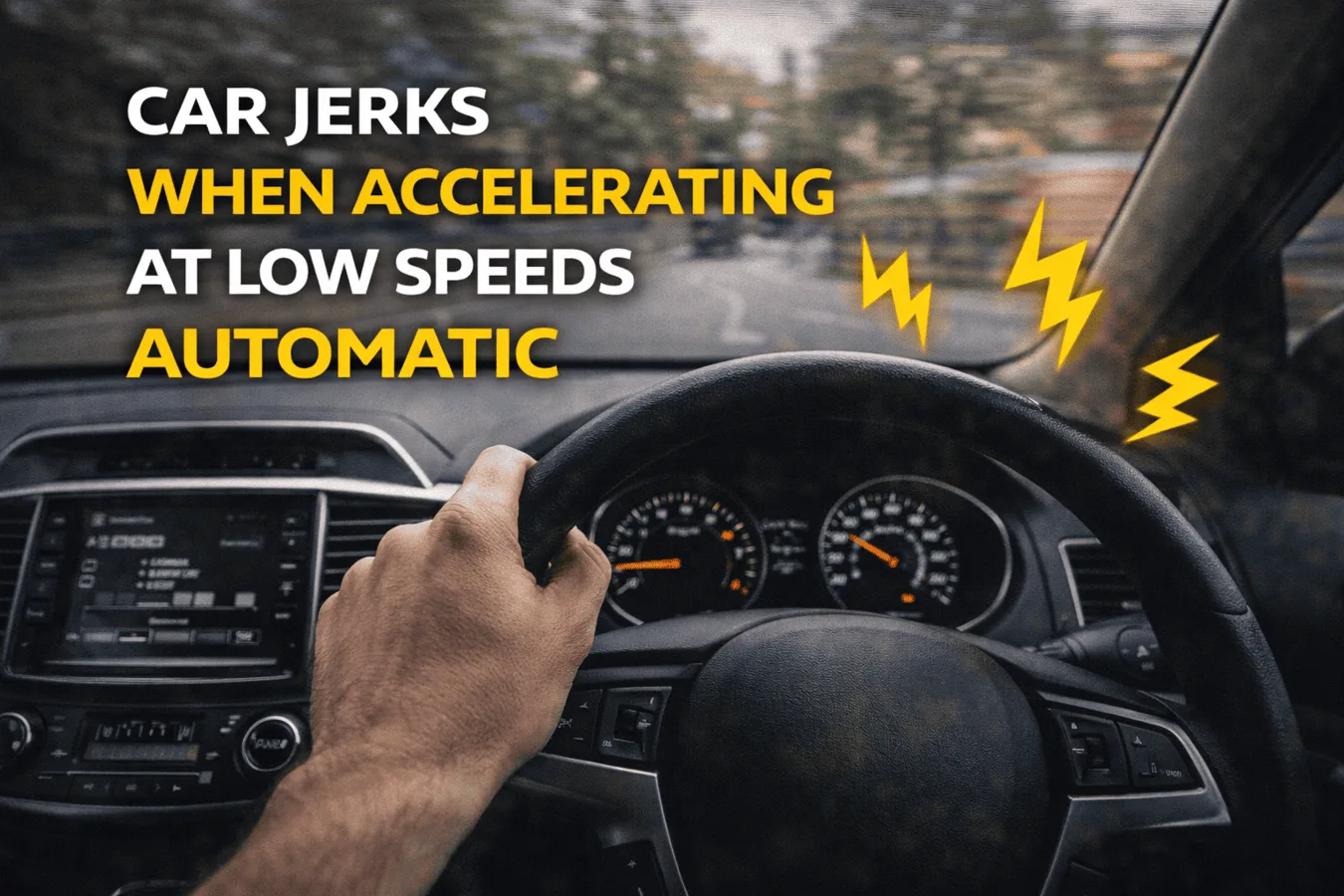
A car that jerks at low speed can make you doubt yourself before you ever blame the vehicle. It often starts subtly—an odd lurch when pulling away from a stop, a hesitation while creeping through traffic, a moment where the car doesn’t respond the way your foot expects it to. It’s easy to assume it’s just how automatics behave at slow speeds.
The problem is the inconsistency. One moment everything feels smooth, the next the car jumps forward like it’s unsure what it wants to do. There’s no warning light, no loud clunk, no obvious failure—just enough awkward movement to make city driving tense and uncomfortable.
Low-speed jerking is one of those issues that sits in a gray area. It’s common, it’s often misdiagnosed, and it doesn’t always mean the same thing from one car to the next. The cause can be simple or more involved, depending on how and when it shows up.
What follows breaks down why automatic cars tend to jerk at low speeds, which systems are usually responsible, how the symptoms evolve, and how to think through the problem logically instead of replacing parts at random.
What Low-Speed Jerking Actually Feels Like
This type of jerking isn’t violent, but it’s noticeable.
It often feels like:
- A sudden tug forward
- A brief hesitation followed by a lurch
- Uneven power delivery
- A stop-and-go sensation during gentle acceleration
The key detail is that it happens at low speeds, not when driving fast.
Why It’s More Noticeable at Low Speeds
Low speeds are where automatic transmissions work the hardest.
At slow movement:
- Gears shift more frequently
- Torque management is sensitive
- Small inconsistencies become obvious
At higher speeds, momentum smooths things out.
Why This Problem Is So Common in Automatic Cars
Automatic transmissions constantly adjust.
They:
- Decide when to shift
- Balance power and efficiency
- Respond to throttle input
When something isn’t perfectly aligned, the car can feel jerky instead of smooth.
Why Gentle Acceleration Triggers It More Than Hard Acceleration
This confused me at first.
Hard acceleration often feels smoother because:
- The transmission commits to a gear
- Shifts are more decisive
- Power delivery is continuous
Gentle acceleration requires constant adjustment, which exposes problems.
The Role of Transmission Behavior
Automatic transmissions are designed to shift early at low speeds.
If shifting isn’t smooth:
- Power delivery becomes uneven
- The car feels like it’s tugging
- Movement loses fluidity
This is often where low-speed jerking begins.
Why Gear Changes Feel More Noticeable in Traffic
Stop-and-go driving forces repeated transitions.
Every time you:
- Slow down
- Roll forward
- Accelerate again
…the transmission has to re-engage smoothly. Any weakness shows up clearly.
Why This Doesn’t Always Trigger a Warning Light
This surprises many people.
Low-speed jerking often:
- Stays within “acceptable” ranges
- Doesn’t cross fault thresholds
- Develops gradually
That’s why the car may never warn you directly.
Why the Car Feels Fine at Highway Speeds
At steady speeds:
- The transmission stays in one gear
- Power flow stabilizes
- Minor issues stay hidden
That’s why highway driving often feels normal.
How Throttle Sensitivity Plays a Role
Modern cars use electronic throttle control.
If throttle response is inconsistent:
- Power delivery feels delayed
- Acceleration becomes jerky
- Small pedal inputs cause uneven movement
This is especially noticeable at low speed.
Why the Car Feels Like It Can’t Decide What to Do
That’s often exactly what’s happening.
The system may be:
- Adjusting between gears
- Limiting power briefly
- Correcting sensor data
Those micro-adjustments feel like jerks.
Fuel Delivery Issues Can Cause Low-Speed Jerking
Fuel delivery problems don’t always cause stalling.
Instead, they can cause:
- Uneven combustion
- Momentary power drops
- Surging at low speeds
This results in jerky motion rather than complete failure.
Why Fuel Issues Show Up First at Low Speeds
Low speeds require precise fuel control.
Small inconsistencies matter more when:
- Engine speed is low
- Load changes frequently
- Combustion is less forgiving
At higher speeds, fuel flow stabilizes.
Airflow Irregularities Can Create the Same Feeling
The engine needs clean, consistent airflow.
If airflow is inconsistent:
- Power delivery fluctuates
- Throttle response feels uneven
- Acceleration becomes choppy
This often feels like jerking rather than hesitation.
Why Sensors Play a Big Role in Smooth Movement
Modern cars rely on sensor input.
If data is:
- Delayed
- Inconsistent
- Slightly inaccurate
…the system compensates, and that compensation feels like jerking.
Why Low-Speed Jerking Feels Worse When the Engine Is Cold
Cold engines operate differently.
During warm-up:
- Fuel mixtures change
- Shifting behavior adjusts
- Systems are more sensitive
That’s why many people notice the problem first thing in the morning.
Why Heat Can Also Make It Worse
Once the car is hot:
- Fluid behavior changes
- Electrical resistance increases
- Marginal components struggle
That’s why the issue can appear after longer drives too.
Why Restarting the Car Sometimes Helps
Restarting can:
- Reset adaptive behavior
- Clear temporary inconsistencies
- Restore default responses
If restarting helps temporarily, the issue is likely conditional rather than mechanical failure.
Why the Problem Keeps Returning
Temporary relief means:
- The system is compensating
- The root cause still exists
- Conditions eventually repeat
That’s why the jerking comes back.
Why Transmission Fluid Condition Matters
Automatic transmissions rely heavily on fluid behavior.
If fluid:
- Is old
- Is degraded
- Is at the wrong level
shifts become less smooth, especially at low speeds.
Why Low or High Fluid Levels Both Cause Problems
Too little fluid:
- Reduces hydraulic pressure
- Causes delayed engagement
Too much fluid:
- Causes foaming
- Disrupts pressure
Both can result in jerky movement.
Why This Problem Often Gets Blamed on the Transmission
The sensation feels transmission-related, so that’s where blame goes.
In reality, low-speed jerking often involves:
- Multiple systems interacting
- Throttle control
- Fuel and air balance
It’s rarely just one part failing.
Why Electrical Issues Can Feel Mechanical
Electrical inconsistencies don’t always shut things down.
They can:
- Delay responses
- Alter timing
- Create uneven behavior
That translates into jerky movement rather than a hard fault.
Why Driving Style Changes Don’t Fix It
Driving gently may hide the issue, but it doesn’t solve it.
The underlying inconsistency remains and usually worsens over time.
Why Ignoring the Jerking Is Risky
Even mild jerking signals imbalance.
Ignoring it can lead to:
- Increased wear
- Reduced reliability
- Escalation into more serious problems
Early attention usually prevents bigger repairs.
How to Identify Patterns
Instead of guessing, start noticing:
- When it happens
- Whether the engine is cold or warm
- Road conditions
- Throttle input
Patterns reveal the system involved.
Why Frequency Matters More Than Severity
A mild jerk that happens often is more concerning than a strong one that happens once.
Repetition indicates progression.
Why This Issue Is Often Misdiagnosed
Because:
- The car still drives
- No warnings appear
- Symptoms vary
People replace parts randomly instead of understanding the behavior.
Why Automatic Cars Mask Problems Longer
Automatic systems are designed to adapt.
They:
- Compensate for wear
- Smooth inconsistencies
- Hide issues until limits are reached
That’s why the problem feels subtle at first.
Why This Feels Worse in Parking Lots
Parking lots require:
- Constant speed changes
- Gentle throttle control
- Tight maneuvering
These conditions highlight inconsistencies immediately.
Why Confidence Drops When Jerking Starts
Jerky movement breaks trust.
You stop knowing:
- How the car will respond
- When it will surge
- Whether it’s safe to accelerate
That mental stress matters.
How To Decide When It’s Time to Act
Take action when:
- Jerking becomes frequent
- Smooth starts disappear
- Traffic driving feels stressful
- The behavior worsens
Waiting rarely improves things.
Why Writing Down Symptoms Helps
Clear descriptions help pinpoint causes.
Noting:
- Speed
- Temperature
- Conditions
makes troubleshooting far easier.
Why This Problem Feels So Annoying
It doesn’t strand you.
It doesn’t break suddenly.
It just makes every slow drive uncomfortable — and that constant irritation adds up.
Final Thoughts
If your automatic car jerks when accelerating at low speeds, trust that sensation. It’s not your imagination, and it’s not “just how automatics are.” This behavior usually means one or more systems are struggling to deliver smooth power under delicate conditions.
Pay attention to patterns. Don’t panic — but don’t ignore it either. Low-speed jerking is often an early warning, not a final failure. Addressing it early protects your car, your confidence, and your peace of mind.
Once you understand what the car is telling you, the road feels smooth again — and that’s how it should be.