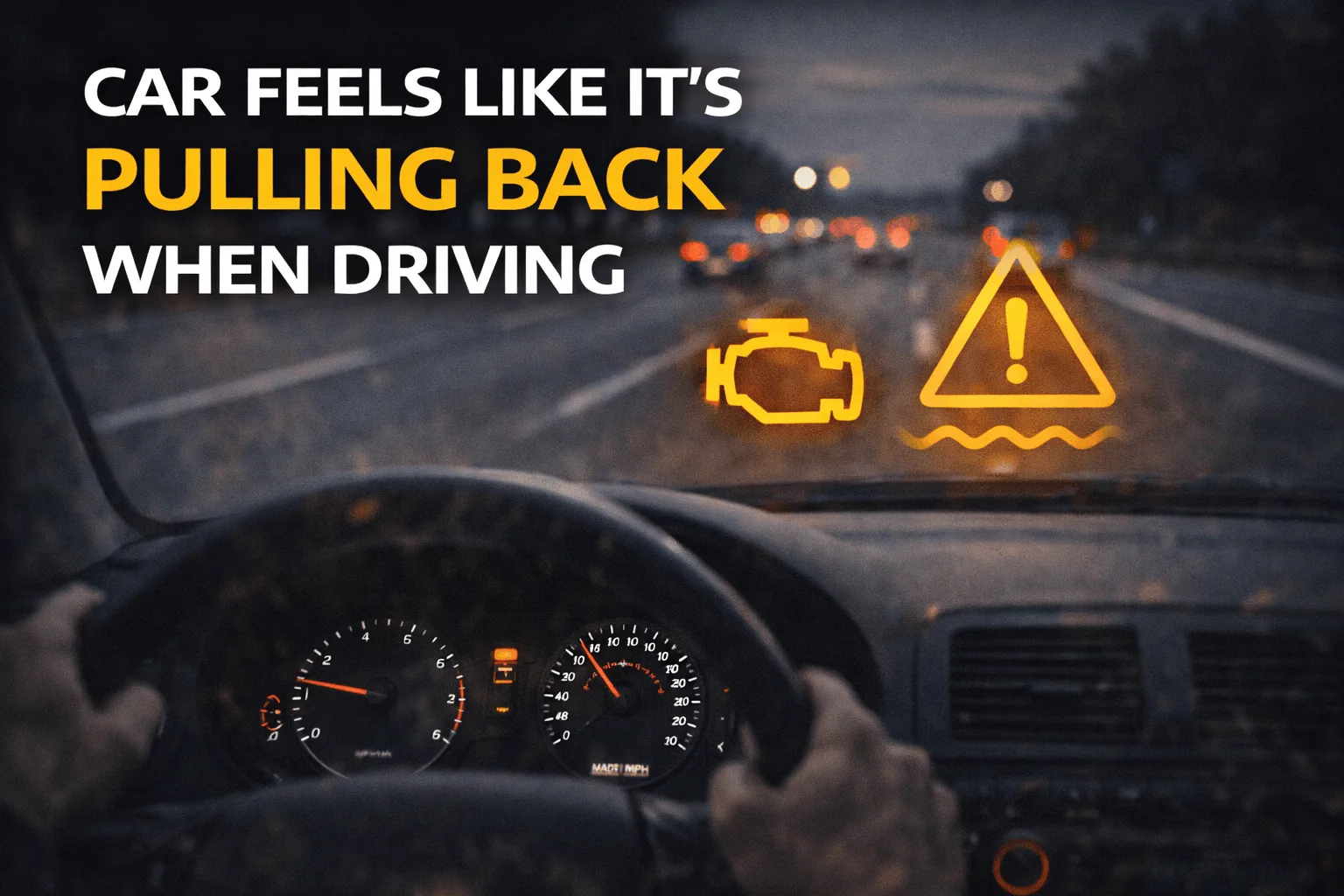
A car that feels like it’s pulling back while driving can be difficult to describe, but the sensation is unmistakable once it happens. Acceleration feels restricted, forward movement isn’t as smooth as expected, and the vehicle seems to resist input even though the engine sounds normal.
This behavior often appears subtly. There may be no sudden jerks, no dramatic loss of power, and no immediate warning lights. Instead, the car feels held back, as if something is limiting performance behind the scenes. The sensation can show up while cruising, during acceleration, or only under specific conditions, which makes the issue especially frustrating to pinpoint.
Because the car may still run and drive, the problem is frequently overlooked or misdiagnosed. In many cases, it’s linked to systems designed to control airflow, fuel delivery, emissions, or drivetrain protection rather than an outright mechanical failure.
The sections below break down the most common reasons a car can feel like it’s pulling back, how those symptoms tend to change over time, and how to approach diagnosis logically instead of guessing. The focus is on clarity, cause-and-effect explanations, and practical next steps.
What “Pulling Back” Really Feels Like
- Resistance while accelerating
- A brief loss of forward momentum
- The engine responding, but the car not matching it
- A subtle hesitation that repeats
It’s a sensation of restriction rather than failure.
Why This Feeling Is So Confusing
The most frustrating part is that the car still runs.
- It starts normally
- It idles fine
- It doesn’t stall
- It still moves
Because nothing completely fails, the brain keeps trying to rationalize it away. But persistent resistance is never normal.
Why This Problem Is Often Intermittent
One reason people struggle to diagnose this issue is because it doesn’t always happen consistently.
It may show up:
- At highway speeds
- While climbing hills
- When accelerating from a stop
- After the engine warms up
That inconsistency points to systems that adjust dynamically, not fixed mechanical breaks.
The Role of Engine Load
The pulling-back sensation almost always becomes clearer when the engine is under load.
Load increases when:
- You accelerate
- You drive uphill
- You carry extra weight
- You drive at higher speeds
Under load, the engine needs more air, fuel, and clean signals. Any restriction shows up immediately.
Why the Car Feels Fine at Light Throttle
At steady speeds or gentle throttle:
- Demand is low
- Systems compensate easily
- Problems stay hidden
That’s why the car may feel normal one moment and restricted the next.
Fuel Delivery Issues: One of the Most Common Causes
If the engine doesn’t get enough fuel:
- It can’t produce expected power
- Acceleration feels weak
- The car feels like it’s being held back
This doesn’t always cause stalling — it often causes hesitation instead.
Why Fuel Problems Feel Like Resistance
Fuel issues don’t shut the engine down instantly.
Instead, the engine:
- Struggles to keep up
- Reduces output
- Feels constrained
That “pulling back” feeling is the engine protecting itself.
Airflow Restrictions Can Create the Same Feeling
The engine needs air just as much as fuel.
If airflow is restricted:
- Combustion weakens
- Power drops
- Response feels delayed
Air-related problems often appear gradually, which is why they’re easy to overlook.
Why Air and Fuel Problems Feel Similar
Air and fuel work together.
When either one is limited:
- Power delivery becomes uneven
- The engine feels strained
- Acceleration loses smoothness
That’s why the sensation feels the same even when the root cause differs.
Sensors That Influence Engine Behavior
Modern cars rely heavily on sensors.
If sensor data becomes unreliable:
- The engine reduces output as a precaution
- Throttle response changes
- Power feels limited
This is often described as the car “holding itself back.”
Why the Car May Be Protecting Itself
Modern vehicles are designed to avoid damage.
When something seems off:
- Power is reduced
- Response becomes conservative
- Acceleration feels restricted
This protective behavior feels exactly like resistance.
Why This Doesn’t Always Trigger Immediate Warnings
Some issues don’t cross warning thresholds right away.
That means:
- No immediate dashboard alerts
- Subtle symptoms first
- Escalation over time
By the time warnings appear, the problem has often progressed.
Transmission Behavior Can Add to the Feeling
Even when the engine is healthy, transmission behavior can change how power feels.
If the transmission:
- Delays shifting
- Holds gears longer
- Hesitates between changes
…the car may feel like it’s pulling against itself.
Why Gear Changes Matter So Much
Gear selection determines how power reaches the wheels.
If timing is off:
- Power delivery feels uneven
- Acceleration feels restrained
- The car feels hesitant
This is often mistaken for engine trouble.
Why This Feeling Is Worse on Hills
Hills demand more power.
When climbing:
- Weakness becomes obvious
- Restrictions are magnified
- Hesitation becomes pronounced
That’s why many people notice the problem on inclines first.
Why Heat Makes It Worse
Heat affects:
- Fuel behavior
- Electrical resistance
- Sensor accuracy
As temperatures rise, marginal systems struggle more.
That’s why the issue may appear after driving for a while.
Why Restarting Sometimes Helps
Restarting can:
- Reset temporary errors
- Restore default behavior
- Clear minor inconsistencies
This doesn’t fix the root cause, but it can temporarily relieve symptoms.
Why the Problem Keeps Coming Back
If restarting helps but doesn’t solve it, that’s a clue.
It means:
- The issue is conditional
- The system is compensating
- The cause still exists
Temporary relief is not a resolution.
Why Electrical Issues Can Feel Like Power Loss
Electrical problems don’t always shut systems down.
They can:
- Reduce signal clarity
- Cause delayed responses
- Trigger protective modes
This results in subtle but persistent resistance.
Why Driving Style Changes Don’t Fix It
Many people try to drive around the problem.
Gentler throttle may:
- Hide the symptom
- Reduce stress on the system
…but the underlying issue remains.
Why Ignoring the Feeling Is Risky
The car is communicating discomfort.
Ignoring it can lead to:
- Reduced reliability
- Sudden worsening
- More expensive repairs
Early attention usually means simpler solutions.
Why Frequency Matters More Than Intensity
A mild issue that happens often is more concerning than a strong one that happens once.
Repetition signals progression.
Why This Problem Often Gets Misdiagnosed
Because it feels vague, people often:
- Replace random parts
- Chase unrelated issues
- Spend money without results
Understanding the symptom first saves frustration.
Why the Car Feels Like It’s Fighting You
That’s exactly what’s happening — internally.
The engine management system is trying to:
- Maintain balance
- Prevent damage
- Compensate for inconsistencies
That internal struggle becomes external resistance.
Why This Is More About Systems Than Parts
This sensation usually involves:
- Interaction between systems
- Data interpretation
- Protective adjustments
It’s rarely just one broken part acting alone.
Why Older and Newer Cars Experience This Differently
Older cars:
- Show symptoms more directly
- Lack protective limitation
Newer cars:
- Reduce power smoothly
- Mask problems longer
That’s why modern cars feel restrained rather than broken.
How to Decide When It’s Time to Act
Act when:
- The sensation becomes frequent
- Acceleration confidence drops
- Hills become stressful
- The feeling worsens over time
Waiting too long rarely helps.
Why Writing Down Symptoms Helps Diagnosis
Clear descriptions speed up troubleshooting.
Noting:
- Speed
- Temperature
- Road conditions
Helps professionals pinpoint causes faster.
Why This Issue Feels Mentally Draining
The uncertainty is exhausting.
The car isn’t broken enough to stop, but not healthy enough to trust. That mental tension is often worse than a clear failure.
Final Thoughts
If your car feels like it’s pulling back while driving, trust that feeling. It’s not normal, and it’s not your imagination. This sensation usually comes from systems limiting power due to restrictions, inconsistencies, or protective behavior.
Pay attention to patterns. Notice when it happens. Don’t panic — but don’t ignore it either. Understanding the symptom is the first step toward resolving it.
Once you recognize what your car is trying to tell you, that uneasy feeling turns into clarity — and that makes all the difference.