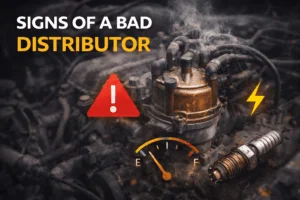
A failing distributor rarely causes an immediate breakdown. In many cases, the engine still starts, the vehicle still drives, and nothing appears completely broken at first. Instead, the problem shows up as hesitation, stumbling during acceleration, uneven power delivery, or an overall feeling that the engine isn’t responding the way it should.
Because these symptoms aren’t dramatic, they’re often mistaken for fuel issues, worn spark plugs, or normal aging. That’s what makes distributor problems so tricky. The component can degrade quietly, causing inconsistent spark timing that slowly affects performance without triggering obvious warning signs right away.
As the condition worsens, those subtle issues tend to stack up—hard starts, misfires, rough acceleration, or unpredictable engine behavior that becomes harder to ignore.
The sections below break down the most common signs of a bad distributor, why those symptoms occur, how they typically progress, and how to recognize when the issue has moved beyond guesswork and needs direct attention.
What the Distributor Actually Does (In Simple Terms)
The distributor’s role is simple in concept but critical in execution: it sends spark to the right place at the right time. If that timing is off, even slightly, the engine doesn’t behave the way it should.
It acts as a traffic controller for ignition. When everything is aligned, the engine runs smoothly. When it’s not, chaos starts quietly and grows over time.
Why Distributor Problems Feel Random at First
One of the most frustrating things about distributor issues is how inconsistent they feel.
At first, the car might:
- Run fine one day
- Act up the next
- Fix itself temporarily
- Get worse without warning
This happens because distributor components wear gradually. Contacts degrade, connections weaken, and internal parts lose precision. The engine compensates — until it can’t.
Rough Idle That Comes and Goes
At idle, the engine felt uneven. Not violent, not dramatic — just slightly shaky. Sometimes it smoothed out on its own. Other times, it felt like it might stall, even though it never quite did.
This happens when spark timing becomes inconsistent. The engine is still firing, but not as evenly as it should.
Why Rough Idle Is Easy to Ignore
Because the car still runs, rough idle often gets dismissed.
People assume:
- “It’s just old”
- “It’s the weather”
- “It’ll pass”
But idle quality is one of the earliest windows into ignition problems.
Hesitation When Accelerating
Pressing the accelerator should feel smooth and immediate.
When the distributor starts failing, acceleration can feel delayed or uneven. when we pressed the pedal — almost like the engine had to think before responding.
That hesitation happens because spark delivery isn’t perfectly synchronized anymore.
Why Hesitation Feels Worse Under Load
Distributor problems show up more clearly when the engine is working harder.
Under load:
- Spark timing matters more
- Any delay becomes noticeable
- Power delivery feels choppy
That’s why hesitation often feels worse going uphill or merging into traffic.
Engine Misfires That Don’t Trigger Immediate Warnings
Misfires were subtle at first.
They felt like:
- Small jolts
- Brief stumbles
- Momentary loss of smoothness
The engine didn’t shut down. Warning lights didn’t immediately appear.
Misfires happen when spark either arrives late, weak, or not at all.
Why Misfires Can Come and Go
Distributor issues don’t always cause constant misfires.
They can:
- Appear under certain temperatures
- Show up at specific speeds
- Disappear briefly after restarting
That inconsistency often leads people away from the real cause.
Hard Starting That Gets Progressively Worse
Starting the engine became less predictable.
Some days it fired right up. Other days it cranked longer than usual. Occasionally, it felt like it almost started — then didn’t.
This happens when spark timing isn’t clean during startup, which requires precision more than power.
Why Starting Problems Feel Battery-Related at First
Because the engine cranks, people often blame the battery.
But cranking only means the starter works. Ignition timing is a separate process — and that’s where distributor issues hide.
Backfiring or Popping Sounds
Not constant. Not violent. Just enough to raise concern.
Backfiring happens when ignition timing is off enough that combustion happens at the wrong moment. It’s a clear sign that spark delivery isn’t under control.
Loss of Power at Higher Speeds
At highway speeds, the engine felt strained.
The car could still maintain speed, but it felt like it was working harder than it should. Acceleration beyond cruising speed felt sluggish.
Distributor issues become more obvious at higher engine speeds because timing accuracy becomes more critical.
Why Power Loss Is Gradual, Not Sudden
Distributors usually don’t fail instantly.
They degrade:
- Contacts wear down
- Internal resistance increases
- Precision decreases
The engine compensates — until performance noticeably drops.
Why Fuel Use Is a Late-Stage Symptom
Fuel inefficiency often appears after timing problems have existed for a while.
By the time fuel use changes, the distributor has usually been struggling for some time.
Stalling at Low Speeds or Idle
It happened at stops or low-speed maneuvers. The engine would suddenly quit, then restart easily afterward.
This happens when spark becomes too inconsistent for stable idle operation.
Why Stalling Doesn’t Always Happen at Speed
At higher speeds:
- Momentum helps
- The engine compensates more easily
At idle, there’s no room for error. Any ignition disruption becomes obvious.
Intermittent No-Start Situations
There were moments when the engine simply refused to start — then started fine minutes later.
That kind of behavior is classic ignition control trouble.
Heat, vibration, and component wear all influence distributor behavior.
Why Heat Makes Distributor Problems Worse
Heat affects electrical components.
As temperatures rise:
- Resistance changes
- Contacts expand
- Weak connections fail temporarily
That’s why some cars fail after warming up but restart later.
Visible Wear Inside the Distributor
Common signs include:
- Burn marks
- Corrosion
- Cracked components
- Carbon buildup
Internal wear doesn’t always show externally, but it accumulates over time.
Why Visual Inspection Alone Isn’t Enough
Some distributor issues are internal and invisible.
A distributor can look fine but still fail under operating conditions.
That’s why symptom patterns matter more than appearance alone.
Why These Symptoms Are Often Misdiagnosed
Distributor problems mimic many other issues:
- Fuel delivery problems
- Sensor failures
- Electrical faults
Without experience, it’s easy to chase the wrong cause.
Why Replacing Random Parts Gets Expensive
Spark plugs, wires, sensors — none fixed the problem until the distributor was addressed.
Diagnosis matters more than parts swapping.
How to Learn to Recognize the Pattern
The key is noticing:
- Gradual worsening
- Inconsistent behavior
- Heat-related changes
- Spark-related symptoms
Why Older Vehicles Are More Susceptible
Distributors are more common in older designs.
As vehicles age:
- Materials degrade
- Tolerances loosen
- Maintenance becomes critical
Ignoring distributor wear in older cars almost always leads to trouble.
When Replacement Becomes the Smart Choice
Stop hesitating when:
- Symptoms became frequent
- Starting became unreliable
- Driving confidence dropped
Why Early Awareness Makes Ownership Easier
Knowing the signs allowed me to:
- Address issues before breakdown
- Avoid unsafe driving situations
- Understand what the car was telling me
That awareness made ownership far less frustrating.
Final Thoughts
A bad distributor doesn’t usually cause immediate disaster. It causes confusion, inconsistency, and gradual decline. That’s what makes it dangerous — not because it’s dramatic, but because it’s easy to ignore.
If your car shows rough idle, hesitation, misfires, hard starting, or stalling that seems random, don’t dismiss it. Those are often early warnings from the ignition system.
From our experience, recognizing distributor trouble early turns a stressful mystery into a manageable fix. And once you understand the signs, you stop guessing — and start listening to what your car is really telling you.