Understanding which pedal does what is one of the most basic — and most important — parts of driving. While pedals may look simple, knowing their layout and purpose is essential for safety, confidence, and smooth control of a vehicle.
For new drivers, drivers returning after a break, or anyone switching between different vehicles, pedal placement can cause hesitation if it isn’t fully clear. Even small uncertainty about foot position can affect reaction time, especially when starting, stopping, or maneuvering in tight spaces.
This guide explains car pedals from the ground up. It covers where each pedal is located, what it controls, why manufacturers arrange them the way they do, and how layouts differ between automatic and manual vehicles. It also addresses common points of confusion that catch drivers off guard when moving between vehicle types or driving in different regions.
By the end, pedal operation and placement should feel straightforward, logical, and easy to remember — exactly how it should be behind the wheel.
Understanding Pedal Layout: The Simple Answer
Let’s answer the big question right away:
In nearly every modern car, the gas pedal is on the right.
No exceptions for normal passenger cars.
If you’re sitting in the driver’s seat—whether the wheel is on the left side of the car or the right—the pedal layout is the same:
- Left pedal: Brake
- Right pedal: Gas
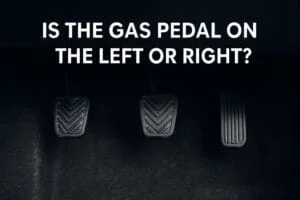
If you’re driving a manual, you’ll also have a far-left clutch pedal, but the gas always stays on the right.
This universal layout exists to prevent confusion, promote muscle memory, and keep cars safe to operate in every country. Even in places where the steering wheel is on the right (like the UK or Japan), the pedals do not reverse.
Why the Gas Pedal Is Always on the Right
People sometimes wonder: “If steering wheels change sides from country to country, why don’t the pedals change too?” The answer is rooted in safety and human ergonomics.
Reason #1: Muscle Memory
Your brain remembers foot placement over time. If car makers switched pedal positions based on region, it would be dangerous for people who rent, travel, or switch cars.
Reason #2: Natural Foot Movement
Your right foot handles precise motion better than your left.
Acceleration requires careful control, so the right foot makes sense here.
Reason #3: Driving Laws and Vehicle Standards
Global safety agencies agreed on a universal layout decades ago. Cars follow the same basic pattern everywhere to avoid accidents and confusion.
Reason #4: Manual Cars Need the Left Foot
Even though automatics dominate today, clutch pedals in manual cars make it necessary to keep the left side free for clutch action and the right side focused on throttle and braking.
What About Cars in the UK, Japan, and Other Right-Hand-Drive Countries?
If you’ve only driven in one country, switching sides of the road can be intimidating. You sit on the opposite side of the cabin, reach for the gear shifter with the other hand, and everything feels backward at first.
But the pedals stay exactly the same:
| Country | Steering Wheel Position | Gas Pedal Position |
| United States | Left | Right |
| Canada | Left | Right |
| India | Right | Right |
| UK | Right | Right |
| Japan | Right | Right |
| Australia | Right | Right |
The pedal setup never changes.
That consistency is a lifesaver when traveling.
A Closer Look at Each Pedal (Automatic Cars)
If you drive an automatic, life is simple. You have two pedals, and you use one foot for both.
1. Brake Pedal
- Located on the left side
- Wide and easy to find
- Slows or stops the vehicle
2. Gas Pedal
- Located on the right side
- Narrow and tall
- Controls speed
One Foot Only
Never use both feet in an automatic. Manufacturers expect your left foot to stay completely out of the way so you don’t accidentally hit both pedals at once.
Understanding the Layout in Manual Cars
Manual cars add a third pedal: the clutch, located on the far left.
So the layout becomes:
- Far left: Clutch
- Middle: Brake
- Right: Gas
How each foot works:
- Left foot: Only the clutch
- Right foot: Both gas and brake
This setup trains your feet to separate tasks logically:
- Smooth starts and gear changes from the left
- Speed control from the right
Even though manual cars are less common now, the pedal layout influenced how automatics were designed later.
Why You Should Never Press Both Pedals Together
Some drivers—especially beginners—try using their left foot for braking and their right foot for accelerating. It feels logical at first, but it’s unsafe.
Here’s why:
● It confuses your brain
Your legs end up acting independently, which leads to slow reaction times.
● It increases brake wear
Hovering over the pedal causes light pressure without realizing it.
● You could accelerate and brake at the same time
Cars are not designed for this, and it can cause unintended movement.
● Emergency stops become harder
Your right foot’s muscle memory is trained for braking force.
If you drive an automatic, let your left foot rest.
It has nothing to do.
Why Pedal Placement Feels Different in Each Car
Even though every gas pedal sits on the right, not every car feels the same.
Here are the things that vary:
1. Pedal Height
Some pedals are closer to the floor, while others sit higher for quicker access.
2. Pedal Resistance
Sports cars often have firm pedals; economy cars tend to be lighter.
3. Pedal Shape
Some vehicles use:
- Hinged-on-floor gas pedals
- Hanging pedals
- Wider brake pedals
4. Cabin Design
The angle of the dashboard, seat position, and footwell shape can make the gas pedal feel closer or farther than you’re used to.
5. Drive-by-Wire Throttle
Modern cars don’t use physical cables—they use sensors. This changes how sensitive pedals feel.
If you switch cars often, it’s always worth taking 30 seconds before driving to feel each pedal gently.
Why Some People Mix Up the Pedals
Pedal confusion happens more often than people admit. Here are the common reasons:
● Nervousness
New drivers focusing too much on traffic forget what their feet are doing.
● Switching between cars
Especially between manual and automatic.
● Wearing bulky shoes
Thick boots can catch both pedals at once.
● Poor seat position
If you sit too close or too far, you lose intuitive pedal control.
● Fatigue
Long driving hours slow reaction time.
● Medical conditions
Some affect reflexes or coordination.
If you ever feel unsure, pause, reset your posture, and remind yourself of the basics:
Left is brake. Right is gas. One foot. One job.
What Pedal Layout Looks Like in Trucks, SUVs, and Hybrids
Despite size differences, heavier vehicles still follow the same layout, because:
- Safety standards require uniformity
- Large vehicles need predictable pedal use
- Commercial drivers switch between many types of vehicles
Even hybrids and electric cars keep the gas pedal on the right, though the pedal controls power differently.
Electric cars use their right pedal to control motor torque instead of fuel.
But the position is the same.
Special Cases: When Cars Use Only One Pedal Effectively
Electric vehicles (EVs) created a unique situation. Many EV owners use something called one-pedal driving, where lifting off the accelerator slows the car dramatically using regenerative braking.
But this doesn’t replace the brake pedal—it just reduces how often you need it.
Even in EVs:
- Gas pedal = right
- Brake = left
- Same rules
- Same muscle memory
The layout never changes.
Pedal Safety Tips Every Driver Should Practice
Over the years, we’ve learned that safe pedal control isn’t just about knowing the layout. It’s also about using the pedals wisely.
Here are the habits that make a real difference:
1. Sit at the right distance
Your knee should be slightly bent when pressing the brake fully.
2. Test each pedal before you move
A gentle tap lets you feel sensitivity and travel.
3. Avoid thick-soled shoes
They reduce pedal feedback.
4. Keep the footwell clean
Loose bottles or debris can roll under the pedals.
5. Stay mindful when switching cars
Every vehicle has its own pedal “character.”
6. Never rest your foot on the gas
A light accidental press is still a press.
7. Brake with purpose
Smooth pressure prevents jerky stops.
Why the Gas Pedal Has Never Changed Location in Over a Century
The layout we use today has been around since the early 1900s. Before that, cars had a chaotic mix of levers, rods, hand throttles, and floor pedals scattered anywhere designers felt like putting them.
But as cars became standardized:
- People switched vehicles more often
- Safety expectations grew
- Driving laws spread
- Travelers needed predictable layouts
Manufacturers agreed to settle on:
- Gas on the right
- Brake in the center
- Clutch (if present) on the left
It worked so well that it never had to change again.
What About Other Vehicles—Motorcycles, ATVs, Boats?
Just for comparison, other vehicles use different control layouts:
Motorcycles
- Throttle by right hand
- Rear brake by right foot
- Gear shift by left foot
ATVs
- Throttle by thumb or hand lever
- Brake levers on handlebars or foot pedal
Boats
- Throttle on a control lever
- No pedals at all
Cars intentionally keep things simple and universal.
Two feet. Two pedals. No complexity.
Final Thoughts
When you break it down, the question “Is the gas pedal on the left or right?” has a straightforward answer. But the real value lies in understanding why it’s there, how to use it confidently, and how to avoid common mistakes.
The gas pedal has always lived on the right—no matter where in the world you drive—because consistency saves lives. The more predictable cars are, the easier they are for everyone to operate safely.
If you’ve ever questioned your pedal placement, shaken your foot before merging, or double-checked yourself when driving a different car, you’re not alone. Every driver goes through that moment. What matters is knowing the layout, staying mindful, and building the habits that keep driving calm and safe.
And now you know everything you need to feel confident with your feet before your next trip.