An air conditioner that blows cold on the highway but turns weak or warm in traffic is a common and frustrating problem. It usually shows up at red lights, in stop-and-go traffic, or while idling—exactly when cool air matters most.
This behavior isn’t random, and it isn’t caused by “bad luck.” Car AC systems depend heavily on airflow, pressure, and component balance. When a vehicle is moving, airflow helps the system operate efficiently. When the car slows down or stops, any weakness in the system becomes far more noticeable.
In some cases, the issue is minor and easy to correct. In others, it points to underlying problems that won’t fix themselves. The key challenge is understanding why the cooling changes with speed instead of guessing or replacing parts blindly.
This explanation breaks down why an AC system cools better while driving, what changes when the car is idling, the most common causes behind the problem, and how to approach a fix logically. With a clear understanding of how the system behaves, it becomes much easier to identify the real issue and address it correctly—without confusion or unnecessary expense.
Understanding Your Car’s AC
When you’re driving, fresh air rushes across the condenser, helping it cool the refrigerant quickly. That’s why the AC feels sharp and refreshing on the road. But when the car stops, the airflow slows down.
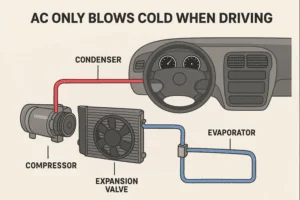
The AC system in a car isn’t as mysterious as it looks. It’s basically a loop of refrigerant moving through a few key parts: a compressor, a condenser, an evaporator, and several valves and sensors.
When everything works smoothly, hot air from the cabin is absorbed, cooled, and sent back through the vents. The part many drivers don’t realize is how much the system relies on airflow and pressure—especially the condenser, which sits at the front of the car and needs moving air to cool off.
If anything in the system is already weak—a tired fan, a low refrigerant charge, a clogged condenser, a struggling compressor—this is when it shows. The AC loses efficiency, and the cold air fades.
Now let’s get into every reason this happens and how to fix each one.
1. Weak or Non-Working Condenser Fan
This is the number one cause of AC that only gets cold when your car is moving. The condenser fan is supposed to take over cooling duties when the car isn’t in motion. If the fan slows down, cuts out intermittently, or dies completely, the refrigerant won’t cool properly at idle.
What you’ll notice
- Ice-cold air while driving
- Warm or mildly cool air at stoplights
- Temperature fluctuates when switching from highway to city streets
- Engine temperature may also rise in heavy traffic
How to check it yourself
- Turn the AC on with the hood open.
- Look at the condenser fan—does it start spinning immediately?
- Does it run slowly, jerk, or not spin at all?
How to fix it
- Replace the fan motor if it’s dead.
- Check the fuse or relay for the fan.
- Inspect wiring for damage or corrosion.
In most cases, replacing a faulty fan solves this issue completely.
2. Low Refrigerant Level
Refrigerant doesn’t just cool—it carries oil that lubricates the compressor. When the level gets low, pressure in the system drops, and the AC loses cooling power at idle because the compressor can’t build enough pressure while spinning slowly.
Why it gets cold while driving
At higher RPMs, the compressor spins faster and compensates for the low refrigerant temporarily.
Signs you’re low
- AC cycles on and off
- Hissing noises when the AC starts
- Slight cooling at idle but not enough
- Better cooling at higher speeds
Fix
Recharge the refrigerant, but don’t stop there—find the leak. Refrigerant doesn’t evaporate; it escapes through a leak somewhere in the system. A shop can locate it with dye or a sniffer test.
3. A Weak Compressor
The compressor is the heart of the AC system. When it’s healthy, it builds the pressure required to push refrigerant through the loop. But as compressors age, they can weaken, especially at low speeds.
Symptoms
- Cold air only at higher RPM
- Clicking or rattling noises when AC is on
- AC stops working completely on very hot days
- Pressure readings from gauges show low output
Why driving helps temporarily
Higher engine RPM = faster compressor rotation = enough pressure to cool the refrigerant.
Fix
A partially failing compressor usually needs replacement. Sometimes the clutch or pulley is the problem, not the compressor itself, which is cheaper to repair.
4. Dirty or Blocked Condenser
The condenser needs airflow. Leaves, dirt, sand, and road debris build up over time, blocking airflow and trapping heat.
What it causes
- Warm AC at stoplights
- Slight improvement when driving
- AC struggles on extremely hot days
How to check it
Look through the grille with a flashlight. If the fins are completely covered, you’ve found your issue.
Fix
- Spray the condenser with low-pressure water
- Straighten bent fins carefully
- Remove trapped leaves and debris
This simple cleaning can drastically improve cooling.
5. Failing Expansion Valve or Orifice Tube
This little part controls refrigerant flow into the evaporator. When it clogs or sticks, cooling becomes inconsistent.
Why it affects idle
Clogged valves reduce flow, especially when the system pressure is lower at idle.
Symptoms
- AC gets cold randomly
- Cold while driving / warm at idle
- Frost on AC lines
- Hissing from behind dashboard
Fix
Replace the expansion valve or orifice tube. It’s often done during a major AC service.
6. Moisture or Air Trapped in the AC System
A system that was previously opened, serviced poorly, or leaked may have moisture or air trapped inside. This makes cooling weak and unpredictable.
Why idle suffers
Air pockets disrupt refrigerant flow and reduce pressure stability.
Signs
- AC cools sometimes and not others
- Strange noises
- Temperature swings without pattern
Fix
A full evac-and-recharge with vacuum drying removes trapped air and moisture.
7. Cabin Air Filter Is Completely Clogged
This isn’t always the main cause, but it can make symptoms worse. If the cabin filter is dirty, the blower can’t push enough air across the evaporator.
Result
The AC seems weak, especially at idle.
Cheap fix
Replace the cabin air filter—takes 5 minutes and costs very little.
8. Idle Speed Too Low
Some cars with older engines or vacuum issues idle too low, causing the compressor to struggle. If your idle RPM dips below normal, this can directly affect AC performance.
Signs
- Noticeable engine shudder at stoplights
- RPM fluctuates
- AC warm during low idle
Fix
A mechanic can diagnose vacuum leaks, sensor issues, or idle air control valve problems.
9. Blower Motor Problems
If the blower motor is weak, airflow will suffer at idle but improve slightly when the alternator provides more voltage at higher speeds.
Symptoms
- Airflow varies with RPM
- Weak air at idle
- AC feels cold but doesn’t push strongly
Fix
Replace the blower motor or resistor.
10. Cooling System Issues Raising Under-Hood Heat
An overheating engine can cause your AC to shut down or reduce cooling to protect the system.
Symptoms
- Engine temperature climbs in traffic
- AC shuts off under heavy load
- Cooling comes back once the engine cools
Fix
Check radiator fans, coolant level, water pump, and thermostat.
How to Diagnose the Problem Like a Pro (Step-by-Step)
You should prefer a simple, logical approach when diagnosing AC issues. Here’s the same process to use:
Step 1 — Check condenser fan with AC on
If it’s not spinning, you’ve likely found the issue.
Step 2 — Listen for unusual noises from the compressor
Grinding, clicking, or inconsistent cycling are major clues.
Step 3 — Feel the AC hoses under the hood
One should be cold, the other warm. If not, refrigerant flow is disrupted.
Step 4 — Inspect condenser for dirt and debris
A blocked condenser reduces cooling dramatically.
Step 5 — Check airflow from vents
Weak air = blower motor or cabin filter problem.
Step 6 — Watch the AC behavior at different RPMs
This helps reveal compressor weakness or low refrigerant.
Step 7 — Check engine temperature
An overheating engine affects AC performance.
When You Should See a Mechanic
You can handle basic checks at home, but professional help is necessary when:
- The compressor is failing
- There’s a refrigerant leak
- The system needs a proper vacuum/recharge
- The expansion valve is clogged
- There are electrical faults
These require equipment and training.
How to Prevent This Problem in the Future
Here’s what to do:
- Clean the condenser twice a year
- Change the cabin air filter regularly
- Run the AC even during winter once a month
- Have the refrigerant checked every few years
- Inspect cooling fans periodically
- Fix engine overheating right away
Little habits keep AC issues away.
Final Thoughts
If your AC only blows cold while driving, don’t panic. It’s almost always caused by something simple and mechanical—nothing mysterious, nothing impossible to repair. Once you understand how airflow, pressure, and temperature work together, the entire situation makes sense.
Whether it’s a weak fan, low refrigerant, a tired compressor, or a clogged condenser, the fix becomes much easier when you know what to look for. We hope this guide helped you understand the “why” behind the symptoms and gave you the confidence to take the next step toward solving the issue.