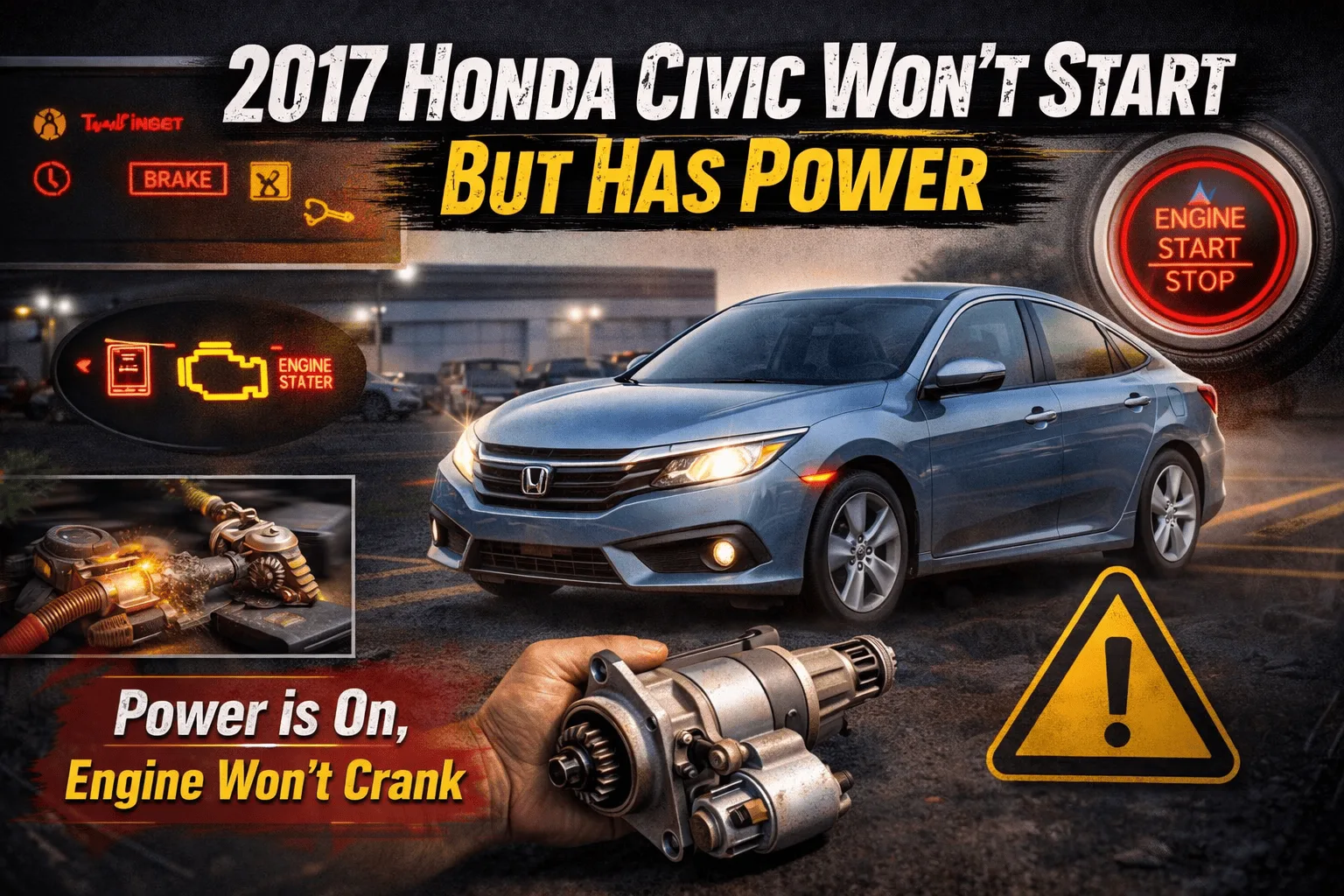
A 2017 Honda Civic that has full electrical power but refuses to start can be especially confusing. Dashboard lights illuminate normally, accessories work, and the battery appears healthy—yet the engine doesn’t crank or respond. This combination often leads drivers to rule out the battery too quickly, even though the problem lies elsewhere.
In modern Civics, the starting process depends on several systems working together, including the starter circuit, immobilizer, brake or clutch interlocks, and electronic control modules. If any one of these fails to communicate properly, the car can appear “alive” while remaining completely unable to start.
The explanation that follows covers the most realistic reasons a 2017 Honda Civic can have power but not start, how each cause typically presents itself, which checks can be done safely, and when the issue requires professional diagnosis. The focus is on clear cause-and-effect reasoning so the problem can be narrowed down logically rather than through trial and error.
What “Has Power but Won’t Start” Really Means
Before diving into causes, let’s clear up what’s actually happening.
When people say their Civic “has power,” they usually mean:
- Dashboard lights turn on
- Headlights are bright
- Infotainment system works
- Power locks and windows function
But when they try to start the car:
- The engine doesn’t crank
- Or it cranks very weakly
- Or it’s completely silent
This tells us something important: your problem is not always the battery, even though that’s the most common assumption.
How the Starting System Works (In Simple Terms)
Starting your Civic requires several systems to agree with each other at the same moment:
- Battery sends power
- Key or push button sends a signal
- Immobilizer confirms the key is valid
- Brake pedal switch confirms you’re pressing the brake
- Starter relay sends current
- Starter motor turns the engine
If any one of these steps fails, the car won’t start—even if everything else looks fine.
The Most Common Reasons a 2017 Civic Won’t Start but Has Power
Let’s go through them one by one, starting with the issues you see most often.
1. Weak Battery (Yes, Even When Lights Work)
This surprised me the most.
A battery can have enough energy to run electronics but not enough strength to crank the engine. Starting an engine requires far more power than running lights or screens.
Signs you notice:
- No crank or a single click
- Interior lights dim slightly when trying to start
- Problem worse after sitting overnight
Even a battery that’s only a few years old can behave this way, especially in hot climates or after frequent short trips.
What helped:
A proper battery load test—not just a voltage check
2. Corroded or Loose Battery Connections
This one is sneaky.
Your battery terminals may look fine at first glance, but corrosion can hide between the clamp and post.
Symptoms:
- Complete silence when starting
- Power cuts in and out
- Car starts randomly after wiggling cables
I’ve seen Civics towed in for this exact reason, only to be fixed in ten minutes.
3. Faulty Starter Motor
If everything lights up but the engine doesn’t even try, the starter motor becomes a strong suspect.
What it feels like:
- No sound at all
- Sometimes a faint click
- Issue gets worse over time
Starters don’t usually fail all at once. They weaken slowly, which is why some days the car starts normally and other days it refuses.
4. Starter Relay or Fuse Issues
The starter relay acts like a gatekeeper between the battery and starter motor.
If it fails:
- Power never reaches the starter
- You get silence instead of cranking
Sometimes simply swapping the relay with a similar one in the fuse box can confirm the issue.
5. Brake Pedal Switch Failure (Push-Button Models)
This one catches many Civic owners off guard.
Your Civic will not start unless it detects the brake pedal being pressed.
Clues:
- Push button does nothing
- “Press Brake to Start” message stays on
- Brake lights don’t turn on
A faulty brake switch can make the car think you’re not pressing the pedal—even when you are.
6. Immobilizer or Key Recognition Problems
Modern Civics use an anti-theft system that must recognize the key before starting.
Common signs:
- Key warning light flashing
- Engine doesn’t crank at all
- Car starts fine with a spare key
Weak key fob batteries or interference can interrupt communication between the key and the car.
7. Steering Wheel Lock Issues
If the steering wheel is turned hard against its lock, the ignition system may refuse to engage.
What to try:
- Gently turn the wheel left and right
- Press the start button at the same time
I’ve personally fixed a no-start situation this way in a parking lot.
8. Neutral Safety Switch (Automatic Transmission)
Your Civic will only start in Park or Neutral.
If the switch fails:
- Car thinks it’s in gear
- Starter circuit stays locked
Sometimes shifting to Neutral and trying again works temporarily.
9. Blown Fuse You Didn’t Expect
Not all fuses are obvious.
A single blown fuse related to:
- Ignition system
- Engine control module
- Starter circuit
…can shut down starting while leaving everything else powered.
10. Engine Ground Connection Problems
Grounds complete the electrical circuit. If a ground strap is loose or corroded, power can’t flow properly.
Results:
- Random no-start
- Flickering electronics
- Inconsistent behavior
Ground issues are common in cars exposed to moisture or poor previous repairs.
When the Civic Cranks but Still Won’t Start
If the engine turns over but doesn’t fire, the issue shifts slightly.
Possible causes include:
- Fuel delivery issues
- Ignition problems
- Sensor failures
But since your question is about having power with no start, most cases involve no crank, not fuel or spark.
Simple Checks You Can Do Before Calling a Tow Truck
Here’s what I personally recommend checking first.
Step 1: Try the Spare Key
This alone has solved more no-start situations than you’d believe.
Step 2: Check Brake Lights
If they don’t turn on, the brake switch is suspect.
Step 3: Wiggle Battery Cables
If the car suddenly responds, you’ve found your culprit.
Step 4: Shift to Neutral and Start
This can bypass a failing transmission safety switch.
Step 5: Listen Carefully
Silence, clicking, or slow cranking all point to different issues.
When a Jump Start Helps—and When It Doesn’t
Jump starting can be helpful, but it’s also misleading.
- If the car starts immediately with a jump, suspect the battery
- If nothing changes, look elsewhere
- If it starts but dies later, charging system may be involved
A jump start is a test, not a cure.
Why This Problem Feels Random
One of the most frustrating parts is inconsistency.
The Civic may:
- Start fine in the morning
- Refuse in the afternoon
- Act normal again the next day
That’s usually because:
- Electrical components are borderline
- Heat affects resistance
- Vibration temporarily restores contact
Intermittent problems are still real problems.
When It’s Time to See a Professional
You should involve a technician if:
- The issue keeps returning
- You hear no starter response
- Warning lights appear
- Basic checks show nothing obvious
A proper diagnosis involves:
- Scan tools
- Voltage drop testing
- Starter draw testing
Avoid shops that replace parts without testing.
How Ignoring This Can Lead to Bigger Trouble
What starts as an inconvenience can become:
- Complete starter failure
- Being stranded unexpectedly
- Higher repair costs
Addressing it early keeps the problem small.
Preventing Future No-Start Issues
Here’s what to do now:
- Replace battery proactively
- Clean terminals yearly
- Replace key fob batteries regularly
- Pay attention to small changes
Cars usually warn us—we just have to listen.
Final Thoughts — Don’t Panic, Diagnose Calmly
If your 2017 Honda Civic won’t start but still has power, you’re not alone—and you’re not stuck forever. This issue is common, understandable, and usually fixable without major repairs.
I’ve learned that patience and logic beat frustration every time. By breaking the system down and checking each piece calmly, you’ll either fix the problem yourself or walk into a repair shop informed and confident.